‘Veg’ out this summer with seasonal produce

Photo credit: SeriousEats.com

Photo credit: SeriousEats.com

I have neither space large enough nor thumbs green enough for a home garden, so thank goodness we have some pretty amazing farmers’ markets here in the Bay Area.

On my shopping list? A few warm-weather vegetables that are available in abundance right now (not to mention they make a super-healthy addition to summertime meals).

Read on for fun facts and quick recipes for five of my favorites:
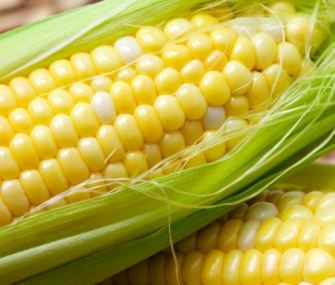
Photo credit: JamesBeard.org

Photo credit: JamesBeard.org

Corn

Averaging 84 calories per ear, corn contains vitamin A, folate, fiber and antioxidants.

Look for husks that have an even green color, silks that are a pale golden tone and plump kernels that ooze a milky juice when popped, which means the ear is fresh.

Corn is also super-convenient because it comes pre-packaged for grilling! Simply remove the silks, brush a little butter on the kernels and pull the husks back up before tossing on a preheated grill for about 15 minutes, turning regularly.
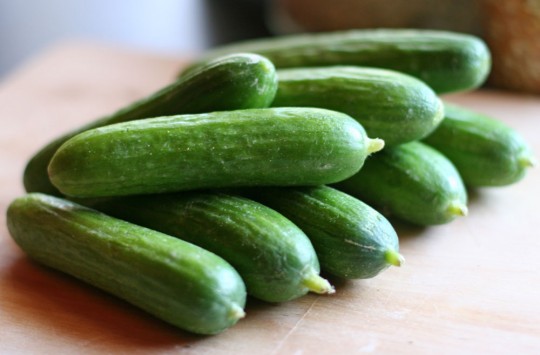
cucumber2

Photo credit: JustAGlimpse

Cucumbers

There’s truth in the saying “Cool as a cucumber;” did you know that the inside of this potassium-packed vegetable can actually be up to 20 degrees cooler than the air in which it sits?

As a general rule, the smaller the cucumber, the smaller the seeds, and look for one that is firm, straight and blemish-free.

For a sweet and sour treat, try slicing two cucumbers thinly and mixing with one-quarter cup of rice vinegar, one teaspoon sugar and one quarter teaspoon salt, plus two tablespoons toasted sesame seeds.
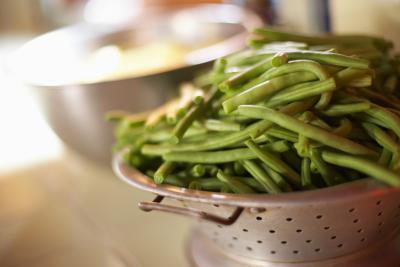
Photo credit: LiveStrong.com

Photo credit: LiveStrong.com

Green Beans 

Crunchy, flavorful and a rich source of fiber, green beans boast important nutrients such as vitamins A, B6 and C – not to mention a healthy dose of minerals like iron, calcium and magnesium.

Choose crisp, well-formed beans that have smooth skin because a woody or tough appearance with discolored brown spots is usually a sign they are not fresh.

For an elegant side dish, combine a pound of blanched beans with two tablespoons olive oil and one-third cup each of crumbled blue cheese and crushed walnuts.
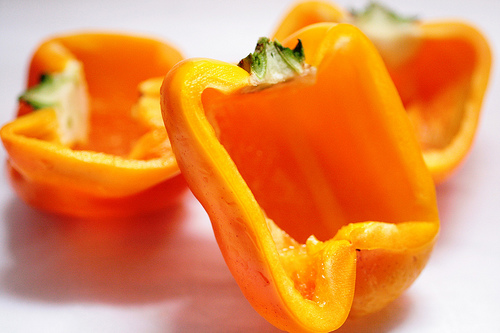
Photo credit: StraightFromtheFarm.net

Photo credit: StraightFromtheFarm.net

Sweet Peppers 

Lacking the hotness for which some of their family members are known, sweet (or “bell”) peppers contain small levels of the healthy alkaloid compound capsaicin, which may have anti-bacterial, anti-carcinogenic, analgesic and anti-diabetic properties.

Go for a firm pepper that’s vibrant in color and free of surface punctures, bruises or shriveled stems.

Roasted peppers are a quick fix that will allow you to add exquisite flavor to a variety of dishes; simply quarter peppers, removing seeds and membranes before roasting in a 500-degree oven until the skin blisters and turns black (peel off skin when cool).

Photo credit: ehow.com

Photo credit: ehow.com

Tomatoes 

Although technically a fruit, the tomato is used most often as a vegetable for cooking purposes. Lycopene, a much talked-about antioxidant present in tomatoes, has been known to neutralize free radicals in the body and cut the risk of some cancers.

When buying, focus on choosing a specimen that feels heavy for its size and smells deliciously earthy. And whatever you do, don’t refrigerate tomatoes when you get them home; you’ll run the risk of turning them mushy or mealy in temperatures cooler than 50 degrees.

For a delicious side dish, halve tomatoes and top with a mixture of one quarter cup grated Parmesan, one teaspoon fresh oregano, plus salt and pepper, to taste. Drizzle with olive oil and bake for about 15 minutes – or until tender – in a 450-degree oven.

If you want to eat more local veggies this summer, a good place to start is the Natural Resources Defense Council’s “Smarter Living: Eat Local” site here, which includes information about markets around the country as well as which produce is currently in season around the U.S.

Sweeten your summer with seasonal fruit

Photo credit: Culinate.com

Photo credit: Culinate.com

One of my favorite summer pastimes is indulging in the abundance of fruit. There’s just no better way to celebrate the flavors of the season than to feast upon the (literal) fruits of your local farmer’s labor.

Below are five must-haves for summer munching. Whether you cook ’em, bake ’em, grill ’em or simply devour them as-is, this tasty produce is at its peak and ripe for the picking, so enjoy!

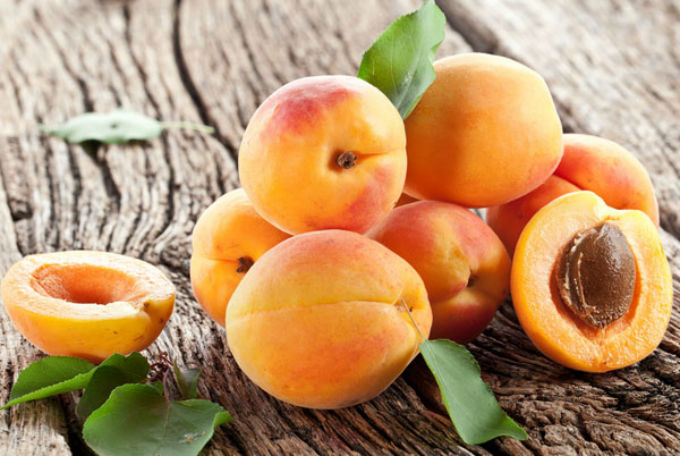
1. Apricots, Plums & Pluots

Stone fruits signal the official arrival of summer. Branch out from the traditional apricots and plums with the pluot, a  plum-apricot hybrid that’s super sweet and tasty. One cup of sliced stone fruit has about one quarter of your daily vitamin C, which helps the body form collagen – the main protein in connective tissue – in bones, cartilage, muscle and blood vessels.

When selecting stone fruit, look for plump, firm skin that is unbroken and free of blemishes. Ripen at room temperature and then refrigerate or eat immediately for a delicious snack.

Or for an easy complement to grilled pork or lamb chops, simply cut the fruit in half (removing the pit) before brushing with equal parts honey and Dijon mustard and grilling until browned on both sides.

Photo credit: AskMen.com

Photo credit: AskMen.com

2. Berries

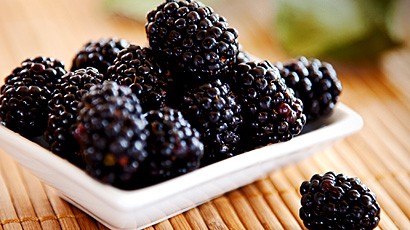
Versatile and popular, strawberries, blueberries and raspberries – not to mention the more exotic boysenberries and olallieberries – can be eaten as picked or require very little effort to prepare.

Not only are they packed with vitamins and nutrients, but a diet rich in colorful berries may help reduce your risk of several types of cancer, thanks to their phytochemicals and flavonoids.

Choose ripe, vibrant-looking berries that are firm with no mushy spots or mold.

For a healthy summer dessert topper, puree two cups of berries in a food processor with two tablespoons each of blackberry brandy and orange juice, plus three tablespoons honey. Strain through a sieve to remove seeds, and just before serving over frozen yogurt or angel food cake, mix the sauce with one cup of fresh berries.

Photo credit: BBCGoodFood.com

Photo credit: BBCGoodFood.com

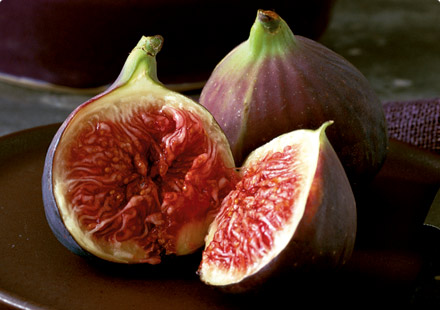
3. Figs

I first tried fresh figs a few years back while traveling in Italy and immediately fell in love with them – so much so that I ended up dragging my unsuspecting husband through several fruit market detours there to get my fix. Since they’re so delicate and perishable, fresh figs are something of a rarity here in the States.

If you do happen to stumble upon them, keep two things in mind: 1) Buy without hesitation (trust me!), and 2) Avoid specimens that are shrunken, oozing from splits, leaking milky liquid from the stem or generally overly-squishy.

For an appetizer (or dessert) fit for any foodie, try quartering fresh figs just down to the base before filling with blue cheese crumbles and drizzling with local honey.

Photo credit: TheKitchn.com

Photo credit: TheKitchn.com

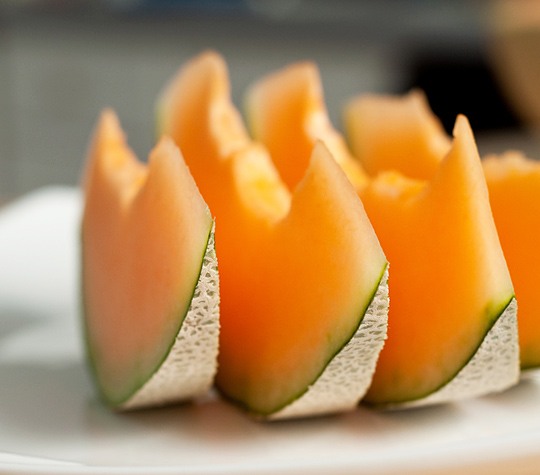
4. Melons

Summer picnics would not be complete without big, juicy watermelons. Whether tossed in a fruit salad, chomped on as thick slices or scooped directly from their makeshift rind bowl, it’s delicious, refreshing and hydrating. The same goes for cantaloupes and honeydew, which are all satisfying, nutrient-dense and low in calories.

When perusing fruit at the market, keep in mind that ripe watermelon has a hollow sound when knocked on, and cantaloupes and honeydew should have a strong, sweet aroma in the top part, along with a bottom that’s elastic to the touch.

Make a simple, yet sophisticated, dessert by de-rinding and cubing or balling melon before tossing with a half cup of chopped fresh mint and drizzling with local honey.

Photo credit: Boldsky.com

Photo credit: Boldsky.com

5. Peaches & Nectarines

Originally native to China, peaches come in both white and yellow varieties, with the white flesh having a lower acidity level. On average, nectarines (with recessively-smooth skin) tend to run smaller and sweeter, but both are wonderful for snacking.

Pick fruit that has a good all-over color and is neither too hard nor too soft, but go more on smell – the more your mouth waters from the sweet aroma, the better the fruit will be.

Kick your brunch up a notch with this fun drink: Add two peaches, two nectarines and one mango (all sans skins and pits) in a blender and pour in enough of your favorite fizzy mixer (ginger ale, tonic water, sparkling mineral water, etc.) to just cover the fruit before blending until smooth. Slowly add more mixer until you get your preferred consistency, garnishing with fresh mint and a floater of champagne.

To load up on fresh fruit at your local farmer’s market, visit the Natural Resources Defense Council’s “Smarter Living: Eat Local” site here to find information about markets around the country, as well as which produce is currently in season around the U.S.
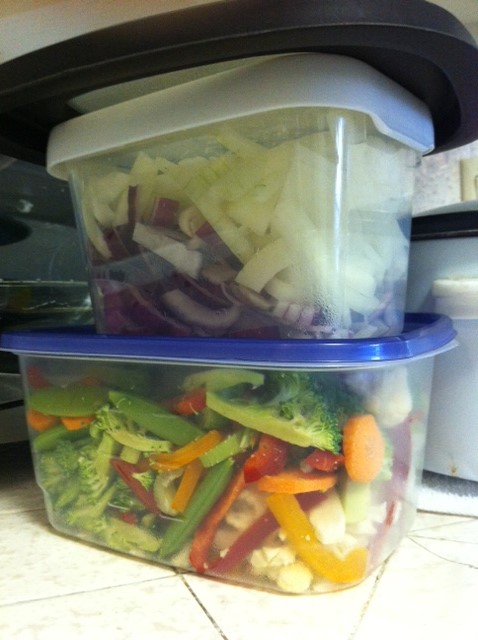
Wok this way: Seven-veggie stir fry

StirFry2

Cook with a wok, and not only will you have a healthy, vegetable-dense dinner on the table in minutes, but kitchen clean-up will also be a breeze.

The first step on your way to the wonderful world of wok cooking? Pay a visit to Tane Chan, owner of The Wok Shop in San Francisco’s Chinatown.

The Wok Shop is not only known as the best store in the country for woks, but Chan just so happens to be the authority on Chinese cookware. In fact, she’s been selling woks for more than 35 years and takes great care in matching each customer with the perfect pan for his/her needs.

Step two? Find a wok-friendly recipe and start experimenting. Below is a deliciously-simple stir-fry to get you started!

Seven-Veggie Stir Fry

Ingredients:

  • 4 boneless, skinless chicken breasts, cubed
  • 3 Tbsp corn starch
  • 3 Tbsp peanut or canola oil, divided
  • 1/4 cup soy sauce
  • 2 Tbsp mirin
  • 2 Tbsp sweet chili sauce
  • 1/4 tsp garlic powder
  • 1 medium yellow or red onion, diced
  • 2 bell peppers (one red, one yellow), sliced thinly
  • 1/2 head broccoli, broken into small florets
  • 1 cup pea pods
  • 3 carrots, peeled and sliced
  • 1/2 head cauliflower, broken into small florets
  • 3 stalks celery, thinly sliced

Directions:

  1. Place cubed, raw chicken in a resealable plastic bag with corn starch and toss to coat
  2. Heat a large wok before coating with 2 tablespoons oil (you’ll know it’s ready when you flick a drop of water on the surface and it evaporates)
  3. Add chicken, stirring with paddle until no longer pink, about 3-5 minutes
  4. Add veggies, stirring constantly while pouring in remaining oil, plus soy sauce, mirin, sweet chili sauce and garlic powder
  5. Cover for 4-5 minutes to cook vegetables until crisp-tender
  6. Continue to cook uncovered for another 2-3 minutes before removing from heat
  7. Serve alone or atop a bed of steamed brown or white rice

A few helpful hints: 

Prepare veggies ahead of time to make quick work of this easy weeknight meal (we made extra for multiple nights).

StirFry4

Don’t forget to season your wok to create a non-stick finish that will add extra flavor as well as protect it.

StirFry1

And there you have it…there’s simply no better fun, fast (and yummy) way to get food on the table. Happy wokking!

StirFry3

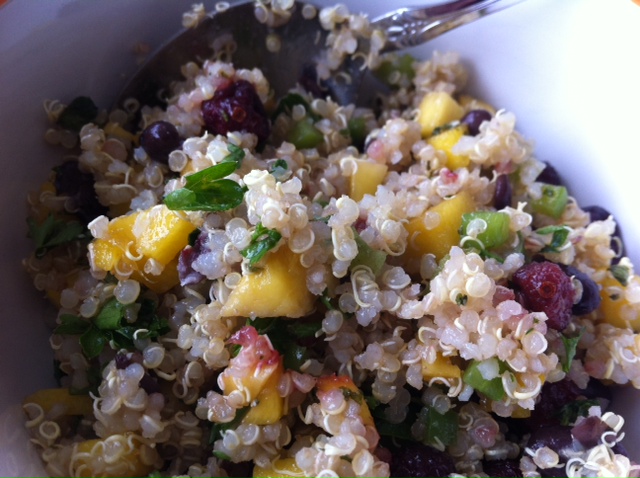
Sweet and sour summer quinoa salad

QuinoaSalad

It was love at first taste with this light and tangy salad at my local grocery store.

But paying $9.00 per pound for it from the self-serve section? That’s when I decided to take matters into my own hands.

After cooking, chopping and swapping some ingredients, I’m pretty pleased with the result, which makes a delicious midsummer dinner or side dish to share.

Sweet & Sour Summer Quinoa Salad

Ingredients: 

  • 2 cups uncooked quinoa
  • 1 green bell pepper, diced
  • 2 mangoes, peeled, pitted and diced
  • 1/2 red onion, diced
  • 1 can black beans, rinsed
  • 1 handful parsley, roughly chopped
  • 1 cup dried cranberries
  • 1/2 cup balsamic vinegar
  • Salt and pepper, to taste

Directions: 

  1. Cook quinoa according to directions on package, set aside
  2. Prep veggies while cooked quinoa is cooling, combining bell pepper, mango, onion, beans, parsley and cranberries in a large bowl
  3. Add quinoa, then balsamic vinegar, salt and pepper, mixing to incorporate
  4. Chill in refrigerator for a few hours (or overnight) before serving

Recipe redux: Edamame-Kale Succotash Salad

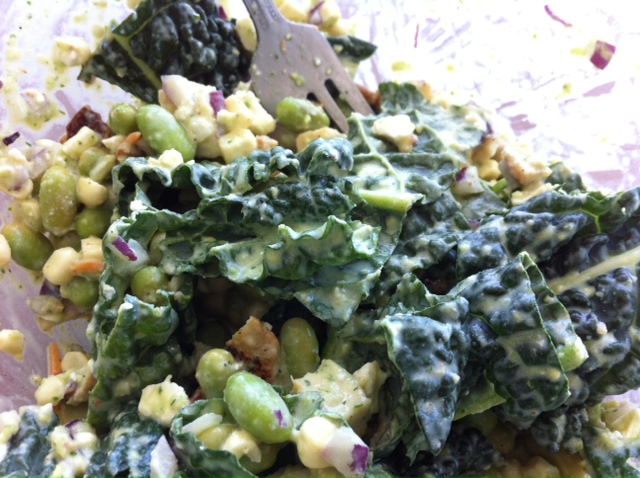
SoyKaleSuccotash

Just look at all that leafy green goodness…

Growing up in the Midwest, I always equated ‘succotash‘ with those bags of soggy, cubed veggies from the freezer section of the grocery store.

But after drooling over this recipe for Succotash Salad with Buttermilk Avocado Dressing in the June 2013 issue of Better Homes & Gardens, I decided it was worth another shot.

That’s right; you heard it here first, folks: Succotash is making a comeback! 

I did make a few tweaks to the recipe – based partly on personal preference (I’m not a huge fan of the texture of Butter lettuce) and partly on sheer laziness (I couldn’t find lima beans at my store, so I opted for edamame and called it a day).

The result was pretty tasty, though, so if you try it yourself, be sure to let me know what you think!

Kinetic Fix Edamame-Kale Succotash Salad

Ingredients:

  • 2 ears fresh sweet corn, shucked and kernels cut off
  • 1 package frozen edamame, cooked and cooled
  • 1 cup low-fat buttermilk
  • 1 avocado, halved, seeded and peeled
  • 1 tbsp fresh parsley, roughly chopped
  • 1/2 tsp garlic salt
  • 1 tsp dry mustard
  • 1/4 tsp ground black pepper
  • 1 bunch kale, washed and finely chopped
  • 2 cups grilled chicken breast, cooled and diced
  • 1/2 cup finely chopped red onion
  • 1 package cherry tomatoes, washed and halved
  • 1/2 cup crumbled feta cheese

Directions:

  1. To make the dressing, blend buttermilk, avocado, parsley, garlic salt, dry mustard and black pepper in a blender or food processor until smooth.
  2. Combine remaining ingredients (kale, corn edamame, chicken, onion, tomatoes and cheese) in a large bowl.
  3. Pour dressing over salad mixture, tossing until it’s fully coated. Serve immediately.

Dietary self-defense: 5 tips for avoiding popular food label traps

honest_labels_600

Food labels: More than meets the eye

Confused about calorie counts? Don’t know the difference between “low-fat” and “reduced fat” when it comes to your favorite foods?

You’re not alone.

In an online survey of more than 25,000 respondents in 56 countries, market research firm Nielsen found that 59 percent of consumers admitted they have difficulty deciphering nutritional labels on food packaging.

Another 78 percent also said they’re trying to lose weight through dietary changes – which begs the question: How can we be effective at doing that if we’re not really sure what we’re eating?

foodaisle_4

The fact is, most people don’t understand enough about what’s on food labels to make an informed choice about what’s best for them.

So next time you find yourself strolling the aisles, cut through the confusion by familiarizing yourself with the five most common tricks when it comes to food labeling:

1. Serving Size.

Although the numbers are based on a single serving, the package may contain several. Do the math and make sure to multiply accordingly – it adds up.

2. Calorie Count. 

When it comes to numbers, think quality over quantity. Some healthy foods are higher in calories (likewise, there are unhealthy foods that are low in calories but high in sodium or sugar), so it’s important to factor in nutrient density when making meal choices.

3. Ingredient List.

Say the first ingredient listed in chocolate cake is enriched bleached flour. Sounds healthy enough, right? Wrong. Even though ingredients are listed in order of descending amounts, some items are used in several forms (e.g. sugar) and listed under various names (i.e. corn syrup, fructose, juice concentrate), so be sure to add ’em up to determine true amounts.

4. Percentages.

Here’s where food makers deploy another trick of the trade. Take two percent milk, for example; we assume it’s 98 percent fat-free, but what it actually means is that two percent of the weight of the milk is fat (whole milk is four percent, FYI).

So while two percent is reduced, it’s not low – in fact, about 30 percent of the calories in a cup of two percent milk come from fat. The same applies to ground meats, so when in doubt, buy skim and go for the highest percentage of lean you can find.

5. Terminology.

Think “reduced” and “low” are the same thing? Think again. A food that says reduced simply means it contains at least 25 percent less of something.

Soy sauce, for example, may contain less sodium than the original version, but that doesn’t mean it’s “low” in sodium (in fact, one tablespoon packs about 700 milligrams, closing in on your daily cap of 1,500 to 2,300 milligrams). When in doubt, check labels and compare against dietary guidelines to determine whether or not the label is misleading.

Want a good laugh on the subject? Check out comedian Brian Regan‘s bit about food labels here.

TurboCharged book giveaway winner!

TurboChargedCongratulations to Bryan Kraus, our TurboCharged book giveaway winner!

Bryan, please email info@kineticfix.com with your mailing address, and we’ll get your book shipped to you ASAP.

If you missed my interview with TurboCharged author Tom Griesel, be sure to check out parts one and two for his insight on how to accelerate your fat-burning and get lean…just in time for bathing suit season!

And to jump-start your new routine, here’s a sample TurboCharged recipe to help retrain your body to source energy from your body fat (and fat from your diet), along with the natural sugars ingested from fruits and vegetables:

Photo credit: SeriousEats.com

Photo credit: SeriousEats.com

TurboCharged Variety Dressing 

Ingredients: 

  • 1/2 cup tomato juice
  • „ 1/2 tsp dry mustard
  • „ 1/2 tsp salt
  • „ 1/4 tsp black pepper
  • „ 1/4 tsp paprika
  • „ 1 Tbsp grated onion
  • „ 2 Tbsps minced parsley
  • „ 2 tsps chopped green pepper
  • „ Dash cayenne

Directions: 

  1. Place all ingredients in a jar and shake together vigorously until thoroughly blended.
  2. Pour over a chopped salad or toss with cut veggies for a tangy treat!

Will the real carb culprit please stand up? (Part II – and Giveaway!)

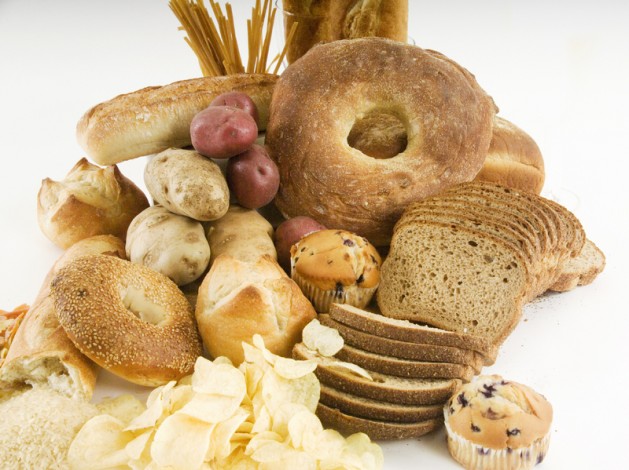
donut-carbohydratesInterested in trying the TurboCharged program for yourself? Here’s your chance – we’re giving away one FREE copy of the book! Details at the bottom of the post…

In part one of my interview with health expert and TurboCharged author Tom Griesel, we spoke about the different types of carbohydrates and how the body processes them, along with the best foods to eat to help prevent excess fat storage.

Next up, I wanted to get into the nitty-gritty of his program, which stems from the Griesel’s belief that by learning to work with your body and feeding it the correct type of foods, you can automatically improve the way it functions and looks.

Here we chat more about role of exercise in his healthy lifestyle plan, along with how he can help ‘Turbocharge’ your body’s fat burning abilities to radically improve your body (and mind) in a short period of time.

Photo credit: Superskinnyme.com

Photo credit: Superskinnyme.com

In your book, ‘TurboCharged,’ you talk about helping people make the switch from using sugar to fat as fuel for the body. Can you elaborate on that?

There are two fuels that our bodies will use: sugar or fat (three if we include alcohol). We are also in either a fat-storage or fat-burning mode, depending on what types of food we choose to eat.

By eating a diet more in line with our ancestral or evolutional adaptations, and avoiding a constant stream of concentrated carbohydrates and the subsequent insulin release and fat storage they promote, our bodies become accustomed to using more fat—including our body fat for our energy needs.

Without our diet increasing the hormones that store excess sugar as fat, we are then able to use our own body fat for energy, as well as being better nourished.

Another important point is that most “sugar burners” will convert lean body mass into sugar for energy instead of sourcing their body fat due to an easier conversion process and a preference for sugar. Loss of lean body mass is the main cause of diet failure and recidivism.

Give us a quick overview of a ‘day in the life’ of the program.

First, more water is consumed, particularly first thing in the morning, to ensure adequate hydration needed for normal body processes. Metabolic waste is meant to be eliminated through the kidneys. When the kidneys can’t handle the job due to inadequate hydration, the liver is forced to do the job (definitely not optimal).

The morning is the most important time, because we usually use about a quart of water for normal respiration and metabolic function overnight while we are sleeping.

Water is also not sipped but used in larger quantity to fill the stomach. Doing so has the same effect as various bariatric surgeries. Satiety hormones are released when the stomach is full. Many studies confirm this happens with food, liquid or a combination of the two.

Next, when we are actually hungry, we choose a food that is more in line with our ancestral diets: fruits, leafy greens, non-starchy vegetables, nuts, seeds, legumes, eggs, meats and seafood (all high nutrient per calorie and mostly moisture-rich).

Meals are also very simple with just a few different ingredients and often just one item (mono-meals). This speeds digestion, eliminates common digestive problems, and most importantly, increases fat burning by greatly reducing the release of insulin—the fat storage hormone—which can be triggered by large meals or combinations of foods.

Engaging in low-to-moderate activity as much as possible is encouraged, along with one-minute periods of strength training three to five times each day, stress reduction techniques and a good night’s sleep.

Can you share one of your favorite tips for readers who want to start incorporating healthier habits into their day?  

Thirst and hunger are often confused. This is probably because our natural diet always consisted of very moisture-rich foods that supplied water and nutrition at the same time. Today, many people confuse thirst for hunger and eat when they should be drinking water. Choosing the wrong foods or beverages when this happens only compounds the dehydration problem.

And, finally, as a long-distance runner, I’ve got to ask: How does exercise come into play in your plan?

Exercise is good for us. However, too much exercise is just as bad as too little, particularly if losing excess body fat is the goal. Exercise is a very inefficient way to manage caloric intake and lose excess body fat.

In fact, when a reduced-calorie diet is being implemented, less exercise is better than more and low-intensity activity is better than more strenuous exercise. This is because the combination of reduced calories and strenuous exercise such as aerobics results in the loss of lean body mass due to the inability to source body fat quickly enough to adequately fuel the activity. This is particularly true for sugar burners whose bodies would rather convert protein to sugar rather than using their excess fat.

Light resistance exercise, for about one minute, three to five times per day is sufficient to maintain (and in some cases build) lean body mass while dieting. On a normal calorie intake, when performed regularly with intensity, it is sufficient to build and strengthen without creating excess stress.

All stress, good or bad, results in the release of catabolic (muscle-wasting) hormones and is best avoided. Loss of lean body mass from any cause, including strenuous exercise, triggers primal survival mechanisms that will cause anxiety and feelings of hunger until the lean body mass is returned. When faced with this situation, eating a typical diet will result in most of the weight regained being fat, not muscle.

GIVEAWAY:

One KineticFix reader will have the chance to win his/her very own copy of the book. (Open to U.S. and Canada residents only).

To enter:
1. [Mandatory] Leave a comment below telling me why you want to get TurboCharged on Tom’s program
2. [Optional] Tweet the following, “I want to win a copy of ‘TurboCharged’ from @KineticFix and @TurboChargeDiet wp.me/p3iGmO-cT ”

I will randomly pick a winner on Thursday, June 13. Good luck!

Will the real carb culprit please stand up? (Part I)

Photo credit: Stack.com

Photo credit: Stack.com

In the battle of the bulge, carbs often hold enemy status.

But, as it turns out, to carb or not to carb isn’t the real question when it comes to weight loss; what matters more is the type of carbs you’re consuming.

Why? Well, not all carbs are created equal when it comes to how our bodies process them, say health experts Dian and Tom Griesel, authors of TurboCharged, a lifestyle plan that claims to help people “quickly lose excess body fat and keep it off.”

Are you among the 75% of adults who consume less than three servings of veggies per day?  Photo credit: Turbocharged.us.com

Are you among the 75% of adults who consume less than three servings of veggies per day?
Photo credit: Turbocharged.us.com

The problem is this: All carbs are converted to blood sugar, which is then converted to either glycogen (short-term energy) or body fat (long-term energy).

Eat a steady stream of carbs, and your glycogen tank is always topped off, so your body never dips into its fat stores.

The solution? A diet rich in what the Griesels term ‘diluted’ carbs (fruits, veggies, etc.), which are much more moisture-rich and nutritionally-dense than traditional ‘concentrated’ carbs, which tend to mess with our systems.

To learn more, I sat down with Tom Griesel about this carb conundrum. The first half of our interview is below.

Tell us, why have carbs gotten such a bad rap?

Perhaps because all carbohydrates are traditionally lumped into a single category, or alternatively considered as either simple or complex. However, the fact is that there are simple and complex carbohydrates (starches and sugars) and also concentrated and diluted carbohydrates (grains and fruits/vegetables), and each has a different effect after consumption. Also, foods are rarely eaten by themselves—and combinations of foods, including carbohydrates, have different effects on our digestive and hormonal systems when compared to eating a single food alone.

So is there such a thing as ‘good’ and ‘bad’ carbs?

We believe the biggest differentiator is in concentrated carbohydrates vs. diluted or naturally moisture-rich carbohydrates. Concentrated carbohydrates have a different hormonal effect than naturally moisture-rich and fiber-rich carbohydrates. In addition, processed foods usually contain significant amounts of carbohydrate along with a totally unnatural combination of ingredients.

Why do specific combinations (e.g. sugar/fat) take more of a toll on our bodies?

Sugar/fat combinations or starch/fat combinations are not found in nature. They are a very recent (from an evolutionary standpoint) artificial addition to our diets. We are now eating stuff that was never available prior to the last 50 years or so. This combination has been found to be the most likely to result in fat storage (think potato chips, french fries and donuts).

These combinations are common in almost all popular processed-food products consumed today, and the typical American diet is built around them. Our bodies are just not adapted to process these combinations without problems. We are unwittingly participating in a huge dietary experiment that is obviously turning out badly, based on the rapid rise in almost every chronic ailment known.

Tell us why you attribute the consumption of grain to the rise of obesity, diabetes, heart disease and other significant illnesses.

Some societies have been eating grains for a while (about 10,000 years or so, which is actually very short from an evolutionary perspective), but the time period for most humans has been much less. Grains are what we would classify as concentrated carbohydrates.

Grains also score very low on a nutritional value-per-calorie basis when compared to leafy greens, non-starchy vegetables and fruits that humans evolved eating over hundreds of thousands of years. Grains provide a concentrated form of calories but few nutrients compared to other readily available choices (that we are better adapted to process).

It is important to understand that there is really not much of a difference in the way our bodies process them regardless if they are whole or refined. They are all broken down quickly into sugar. This concentrated form of sugar, even in what would be considered relatively small amounts, will cause a spike in blood sugar levels.

And why is this spike in blood sugar problematic?

High blood sugar levels signal the body to release insulin to stabilize the situation. Most of the excess sugar is converted and stored as body fat, particularly in people who regularly consume a steady supply of carbohydrates throughout the day. Excess concentrated carbohydrate consumption is the cause of metabolic syndrome.

Are there any particular foods we should eliminate from or add to our diet for better overall health?

It is now widely believed that almost everyone has sensitivity to wheat, wheat products and other products containing gluten, which cause gastrointestinal problems even without any diagnosis of celiac disease. Between intestinal damage, causing decreased nutrient absorption and low nutrient content, a grain-based diet leaves many people fat yet malnourished.

The very best choices are moisture-rich, nutrient-dense foods: fruits, leafy greens, non-starchy vegetables, nuts, seeds, some tubers and legumes, eggs, animal proteins/fats, fish and other seafood (meat and fish are over 60 percent moisture content prior to cooking). Avoid processed foods.

Stay tuned for part two of our interview in which Tom discusses the role of exercise in his healthy lifestyle plan, along with how to ‘TurboCharge’ your body’s fat burning abilities… 

You are what you eat: Food-label reading 101

man-reading-food-label

Photo credit: MensFitness.com

While we’re all aware that a diet of whole foods is preferable…it’s just not always practical.

Sometimes it’s a quick-fix dinner on a busy weeknight. Or maybe a hankering for something from the “comfort” food category (My vice? Boxed brownies!).

But whether you regard them as a dietary staple or a necessary evil, packaged good are a fact of life.

The only way to understand the relationship between the foods you eat and how they affect your overall health is by arming yourself with information: That means reading and interpreting the food labels around you.

Understanding food labels can also help you make better choices―that is, if you know how to use the information to your advantage.

Here’s an overview of the most important elements to keep in mind next time you make that weekly trip to the market.

First, what’s on the label, in a nutshell:

  • Serving size
  • Calorie information
  • Nutrient information
  • Percent daily values

Next, here’s how to utilize it (refer to corresponding areas of the chart below):

NutritionFactsPanelFDA

Photo credit: FDA.gov

  1. Check the serving size. 
    • All the information on the label is based on a standardized single serving, say one cup. So if you end up eating two servings, or two cups of food in this example, remember to multiply the numbers by two.
  2. Count your calories. 
    • This section of the label can help you manage your weight (i.e., gain, lose or maintain). Just remember: the number of servings you consume determines the number of calories you actually eat, so make sure your math is correct!
  3. Watch out for red flags.
    • Eating too much fat, saturated fat, trans fat, cholesterol or sodium may increase your risk of certain chronic diseases, such as heart disease, some cancers or high blood pressure.
    • Not sure how much is too much? Here are a few guidelines:
        • Total fat: Should be 25-35% of calories, or roughly 3 grams of fat per 100 calories
        • Saturated fat: Limit to less than 20 grams per day
        • Trans fat: Ideally 0 grams per day, but the maximum is 2 grams per day
        • Sodium: Aim for a range of 1,500 – 2,400 milligrams per day
        • Sugar: Avoid foods with sugar as one of the first three ingredients
  4. Load up on the good stuff. 
    • Most Americans don’t get enough dietary fiber, vitamin A, vitamin C, calcium and iron in their diets, which actually help reduce the risk of some diseases and conditions, such as osteoporosis, heart disease and healthy bowel function.
    • Aim or more of the following:
        • Fiber: Good sources cointain 3g or more, but try for 25-30g per day overall
        • Vitamins A & C, Calcium and Iron: Choose foods with high values of these key nutrients
  5. Look at the bigger picture.
    • Daily Values are recommended levels of intakes based on 2,000- and 2,500-calorie diets. Think of them as a frame of reference, regardless of calories, and use the information to compare similar products and brands. Just remember to make sure that the serving sizes are similar, especially the weight of each product – e.g. gram, milligram, ounces!

Approach the art of reading food labels as an act of dietary self-defense. Not only will it help you avoid unhealthy pitfalls such as excess sodium and sugar, but it will also help make you more aware of what you’re putting into your body and how it affects you on a daily basis.

To read more on understanding and using nutrition facts labels, visit the FDA’s website on the topic here.