Fighting the good fight against plantar fasciitis

photo

During my Detroit Marathon week seven training recap, I mentioned that I’ve been dealing with a case of plantar fasciitisPlantar-huh, you say?

Here’s what it is

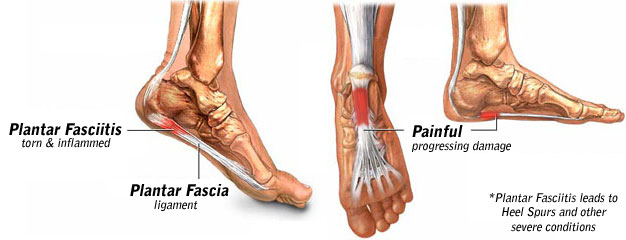
Unless you’ve been plagued by it (and in that case you know all too well), plantar fasciitis (or fasciosis, as some say) reveals itself as heel pain. Technically, it’s been described as an inflammation (hence “itis”) of the plantar fascia, which is the flat band of tissue (ligament) that connects your heel bone to your toes.

Non-technically speaking? It sucks.

The most common symptom is a very painful first few steps out of bed in the morning. Once the foot warms up, the pain subsides, only to rear its ugly head again after long periods of standing or after getting up from a seated position.
plantar_fasciitis_clip_image001

How’d it happen? I can’t pinpoint a specific incident, just that it appeared toward the end of training for my marathon last fall. Certain types of exercise (i.e. running), faulty foot mechanics, age, obesity and long periods of time in your feet are the usual suspects in terms of contributing factors, though.

What I can say for certain is that it’s frustrating — not only because it threatens to derail training, but also because there is no real consensus on treatment. So in the meantime, I’ve been taking matters into my own hands to manage the heel pain, which morphed into a related calf/shin injury after Hood to Coast.

Here’s what I’m doing about it

1. Sensible Shoes. 

Because I spent a few weeks this summer traipsing around Italy in flats and sandals (whoops), I’m paying the price. So now I opt for shoes with a low to moderate heel, good arch support and shock absorbency. And while I haven’t completely given up flip flops, I also try not to go barefoot for long stretches of time, especially on hard surfaces.

2. Enough Rest.

Although not running is one way to try to stop PF, it’s no guarantee. And even though I’m mid-training, I do try to give my feet a rest when I can. This means not only cutting back on activities like walking or running on hard surfaces without proper support, but also taking advantage of rest days and putting my feet up whenever I can.

3. Ample Ice. 

I’m not always great about it, but when possible I try to reduce pain and inflammation with ice. The protocol is to hold an ice pack over the area of pain for 15-20 minutes three or four times a day or after activity. But my favorite is an ice massage: I freeze a water bottle full of water and roll my foot back and forth over it for 10 minutes.

4. Anti-inflammatory Meds.

To kill the dull ache (and try to keep things from getting too inflamed after a workout, I’ll take an over-the-counter pain reliever like ibuprofen (such as Advil or Motrin), naproxen (such as Aleve) or aspirin. All of these are non-steroidal anti-inflammatory drugs (NSAIDs) which help relieve minor aches and pains.

5. Rolling and Stretching.

Immediately after activity, I try to stretch out my plantar fascia, Achilles tendon and calf muscles. But the best tip I got was from when I was at a fitness studio in Seattle: They had us step on a lacrosse ball to roll out our arch, so I went right home and bought one. Now it’s my favorite thing to do in front of the TV or on a  conference call.
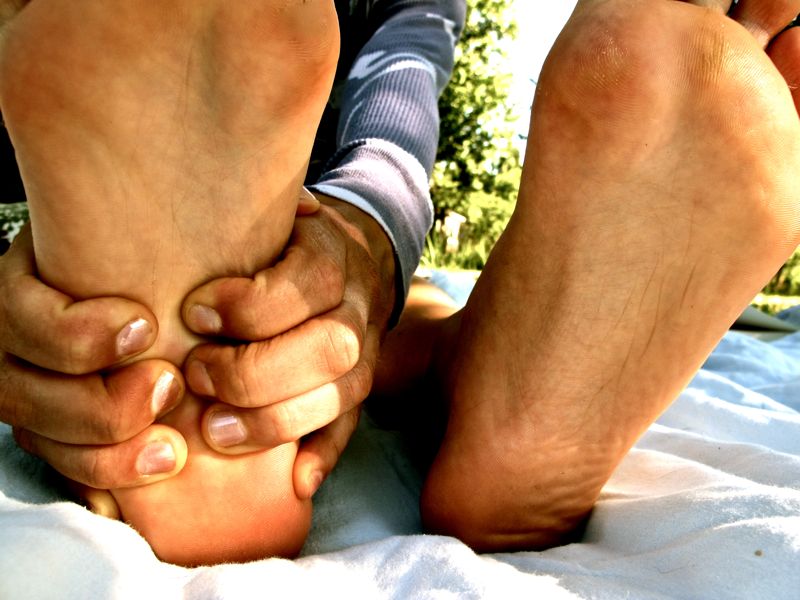
acupuncture-for-plantar-fasciitis_full

6. Night Splints.

I ordered a Strassburg Sock, which stretches my calf and the arch of my foot while I sleep. The idea is to hold the plantar fascia and Achilles tendon in a lengthened position for an extended period of time, although it’s not super comfortable sleeping with a flexed foot, so I haven’t been consistent enough with this to say whether or not it works.

7. Insoles and Orthotics. 

My running shoes are outfitted with Superfeet’s Berry insoles for added support and impact reduction, but I also wear these arch sleeves — thanks to a recommendation from Twitter friends! Not only do they keep my foot from rolling in, but the gentle massage feels great when I know I’m going to be standing for long periods of time.

8. Replacing Shoes. 

Did you know that running shoes lose their support and cushioning after around 300-500 miles of use? Here’s my trick: I buy two pairs at once and alternate them every other run to allow each pair an “off day” to bounce back, plus I’m tracking their mileage carefully to make sure I’m not wearing anything past the point of no return.

9. Ah, Massage.

There are countless health benefits to a good massage, plus it’s one of my favorite rewards for training and recovery. ‘Nuff said.

10. Non-Running Work. 

Even though I’m a former personal trainer, training myself for a marathon leaves me with little time (or energy) to focus on the other stuff. That’s why I’m consulting with a local trainer to help me build a base of stability and range of motion to correct any underlying imbalances, manage injury and keep me running safe and strong in the long run.

11. Physical Therapy.

Finally, another medical professional I’ve recently started working with is a PT. She was able to diagnose some underlying issues and imbalances and provide me with a series of exercises to help get my foot more mobile, stretch the plantar fascia and Achilles tendon and strengthen my lower leg muscles, which stabilize the ankle and heel. Plus, she offers a host of other tips and tricks, which will hopefully get me up and running again soon!

Have you successfully dealt with PF? And, if so, what worked?
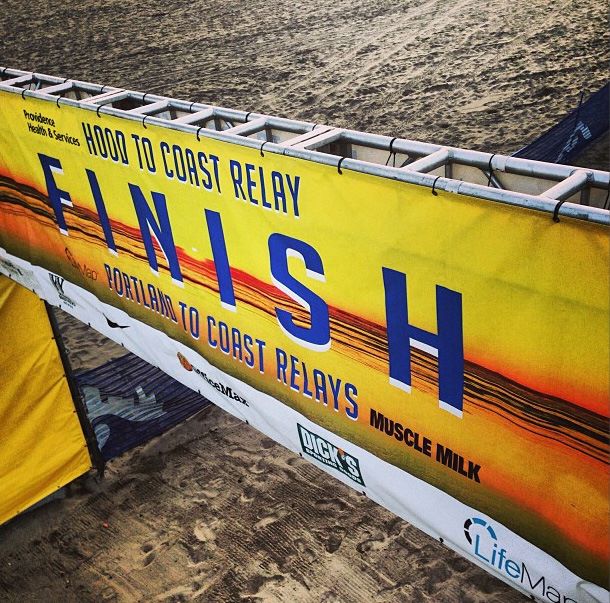
10 dos and don’ts for running a 24-hour relay race

1622199_743051392386399_1308500740_n

During Monday morning’s post-race recovery run (ouch), I had plenty of time to reflect back on last weekend’s Hood to Coast experience. It may have been my first relay, but it certainly won’t be my last — so I wanted to share some learnings that I’ll be applying again come Ragnar Napa Valley next month (and hopefully HTC again next year!).

KineticFix’s 10 dos and don’ts of running a 24-hour relay race:

The DOs…

…train, at least a little bit. 

Running takes enough motivation as-is, but factor in lack of sleep, back-to-back runs over varied terrain, little rest between legs, irregular fueling, irregular other things and…well, you get the picture regarding what can go awry if you don’t get in some mileage and/or practice a few two-a-day workouts ahead of time.

…plan well in advance. 

Make your list, and check it twice. I even Googled around for a few last-minute ideas based on veteran runners’ suggestions because, hey, you never know when you’ll need an ice pack at 6am for an injured team member or a dose of stomach medicine for someone who’s feeling wonky before their 2am leg. Check the weather, too!

…invest in Ziploc bags. 

Packing individual outfits into gallon-sized bags makes it easier to get dressed in the middle of the night when your brain is out of commission. And be kind to your van-mates by putting post-run outfits into bags, as well. Don’t think you stink? Take a good whiff as you re-open each bag when home, and let me know if you beg to differ!

…lube up. 

You can thank me later on this one. Even after spraying myself from head to toe with liberal amounts of TriSlide, I still have a few hot spots from my dusty leg 21 where the grit started to grind in between my skin and my clothes. Nothing will stop you in your tracks faster than a blister, so when in doubt, protect any and all sensitive skin.

…trust in yourself and your team.

There’s no way to get through this without an incredible amount of teamwork, so look for opportunities to pitch in, whether it’s driving a few legs, helping to navigate, being in charge of van organization or even hooking up your teammates with a place to crash. You’ll be amazed at what your body can do, and what you can achieve together!

The DON’Ts…

…forget to pace yourself.

This goes for everything across the board — from running to fueling to sleep, etc. You probably won’t even feel your first run, but remember that you’ve got two full cycles of the same in 24+ hours, so treat it like a marathon instead of a sprint in order to finish strong.

…expect to stay organized.

Our running joke was, “Have you seen my…?” And this was in two vans of highly-organized women, so you can imagine the sheer mayhem that goes on in vans with lower levels of OCD. Do your best to keep your own stuff corralled into one or two bags, then make team bags of communal items, such as food, first aid and night gear, to help.

…think you can get by on minimal clothing/gear.

There’s a fine line between bringing excessive amounts of crap into an already-crowded van and having to spend the night shivering in your only cold, wet running outfit. Do yourself a favor and pack one full outfit (complete with socks and underwear) for each leg, plus a spare pair of shoes and an outfit for downtime/after the race.

…ignore the importance of recovery. 

Sure, you’re riding high on adrenaline, but there will be peaks and valleys throughout the race, so avoid digging yourself into a hole at all costs. If you want to run well, you’ve got to double-down on the non-running activities: After each leg, re-fuel with protein, stretch out, change into dry clothes and rest up as much as possible.

…leave home without your sense of humor.

Inevitably, you’ll end up in a situation that’s out of your control. And it’ll happen when you’re low on sleep and not firing on all cylinders. If/when that happens, take a deep breath, take a step back and try to laugh about it. Remember: Any race is a success when you can come out of it with sore legs from running — and sore abs from laughing.

A final 'do?' Get to know the Honey Bucket, your best friend/worst nightmare during the race

A final ‘do?’ Get to know the Honey Bucket, your best friend/worst nightmare during the race

What are your relay dos and don’ts?

Have runs, will run: Tips for easing that race-day anxiety

pre-race-nerves_0

“Any runner who denies having fears, nerves, or some other kind of disposition is a bad athlete, or a liar.” – 1950s British Olympian Gordon Pirie

The bad news? Pre-race jitters are inevitable. The good news? It’s a normal part of the process. Whether you’re a seasoned veteran aiming for a new PR, or a rookie concerned about just getting to the finish line, nerves are natural and can add an element of excitement to your race.

But when pre-race fears become more than just nervous energy, it’s important to nip it in the bud before your performance is affected and it starts to take all the fun out of racing. Regardless of whether it’s a string of bad races, a layoff due to injury, or merely a lack of confidence in your level of fitness, here are a few tips to help keep you on track come race day.

Prepare properly

You may not appreciate the importance of setting out your race-day gear the night before the event until you make a critical mistake…and then you never forget.

A few years back, the gun went off at the Nike Women’s Half Marathon in San Francisco when I realized that I had, in a cloud of nervous forgetfulness, left my timing chip in the hotel room a mile or so away. Without any time to go back, I ended up running the race chip-less, finishing sans official time or record of my participation.

Lesson learned; now I lay out everything the night before and do a double-check before bedtime.

Practice visualization

Walk through every aspect of the race in your mind’s eye, from warming up at the starting line to navigating the course and crossing the finish line triumphantly. Expect a certain amount of discomfort or pain if you’re pushing your limits, but know that you’ve mentally rehearsed it and can handle anything that comes your way.

mindest

When all else fails, imagine your worst-case scenario, and how you’d cope with it. Chances are the reality won’t be half as bad as what you can dream up.

Chew wisely

Race-day nerves can wreak havoc on your digestive system, so tread carefully when it comes to what you ingest in the hours before your event. Skipping a meal is not an option (especially for longer endurance events), so look for foods that are easy to digest and have a mix of nutrients, such as bananas, sports bars, oatmeal or even bagels and toast with peanut butter.

If you’re wary of how something will set, do a trial run during training to work out the kinks in a more controlled environment.

Line up correctly

There’s nothing more unnerving than realizing that you’re in the wrong place at the wrong time on race morning.

Avoid angering the elites or getting stuck behind slower runners by lining up according to your closest predicted finishing time. This way you can start with people who are at a similar pace, which will help you relax and focus on your own performance.

Channel the tortoise

I’ve witnessed all too many nervous runners who shoot across the starting line like jackrabbits when the gun goes off, only to slow to a shuffle 200 yards later when their adrenaline wears off and oxygen debt sets in.

tortoise-hare

Regardless of how good you feel, resist that temptation. Hold back a bit in the early stages to find your pace, and once you’ve relaxed into a rhythm, start pushing.

Run your own race

I’d argue that only a small part of the race is physical; the rest is mental. Fight the urge to compare yourself to those around you. Unless you’re a top-ranked elite athlete, there will always be someone faster than you. And on the flip side, there will always be someone slower than you.

So pick your route, stick to your plan and race against the most daunting competitor: Yourself.

Think happy thoughts

Above all, it’s important to focus on what you already have achieved, rather than what you might not. Whether it’s attempting a new distance, making it through a grueling training schedule or just having the guts to step up to the starting line, you’ve got something to celebrate.

change-your-thoughts-quote-image

How do you deal with race-day anxiety? 

Body After Baby: Tried-and-true tips for new moms

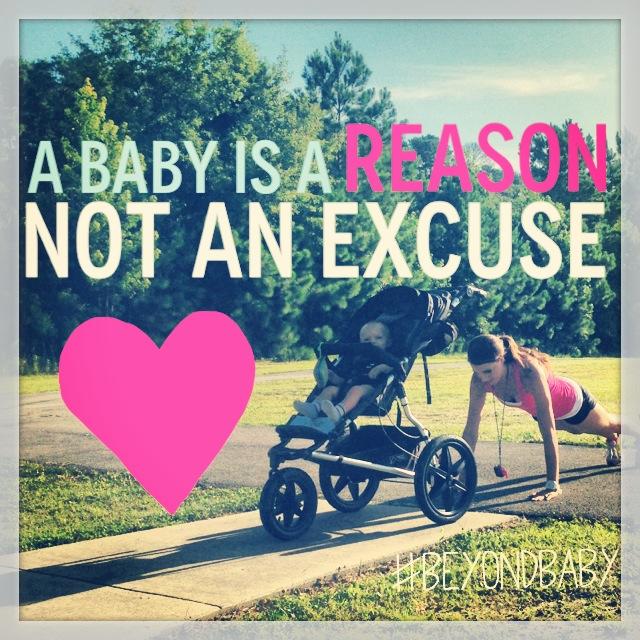
Photo courtesy of BeyondFitPhysiques.com

Photo courtesy of BeyondFitPhysiques.com

After catching up with ultra-mama Sarah Evans a few weeks ago, I thought it’d be fun today to revisit some of the great advice from a few of my other “mom friends” about reclaiming their pre-baby bodies.

We’re not talking about fitting into some kind of Barbie doll-sized skinny jeans, though; we’re talking about getting your groove back — feeling good inside and out, finding a new routine and establishing healthy habits for the whole family.

That’s why I love the sentiment in the photo above, and it’s also why I find people like Sarah and the other moms I interviewed so inspiring.

I still don’t know how they find the time — or the energy — but I admire their creativity and determination for maintaining a fitness routine despite a new (and pretty darn demanding) member in the household.

And speaking of “homes,” Hubby and I are making our way north to our new one this week… More on that in this week’s marathon training recap!

Moms, how did you get back into your fitness groove post-baby?

Have workouts, will travel: How I stay fit on the road

Photo courtesy of DangerouslyFit.com

Photo courtesy of DangerouslyFit.com

We all know that the best way to stay healthy is to make eating well and exercising a daily habit. But what happens when a trip throws you off your usual routine?

Between travel and a move, Hubby and I are hypothetically “homeless” (that is, without a permanent address) for almost two months this summer. Deep breath. 

We need a constant amid the chaos. And for us, that’s a good sweat session. So here’s how I plan to stay on track when everything else feels like it’s spinning out of control:

1. Make a plan. Figure out what works with your schedule, and commit to making it your new routine for the interim. For me, that’ll be a quick morning run before breakfast each day to start things off on the right foot.

2. Have a goal. It’s easier to motivate yourself when there’s something bigger at stake. Having my marathon training all mapped out will help me take the guesswork out of my daily workouts.

3. Keep it simple. K.I.S.S. — yep, “Keep it simple, Stupid.” Between running and body-weight exercises, I’ll be streamlining my workouts as much as possible over the next few weeks to keep things uncomplicated.

4. Mix it up. Variety is the spice of life, so when I’m running a lot I mix in complimentary workouts. This often means adding a few new DVDs into the rotation:

Yoga helps balance tight running muscles, so I’ll pop in one of the 12 Yoga Warrior 365 classes and laugh along with instructor Rudy Mettia’s irreverent approach to the practice.

– And for an intense, efficient cardio session when the weather’s not cooperating, I’ve been turning to BurstFIT Fire for a full-body, high-intensity interval workout in a mere 20 minutes.

5. Enlist some help. Having a partner in crime makes it much easier to get up and out each morning. That’s when I lean on Hubby; we keep each other honest about our workouts while on vacation, plus it’s fun to explore new cities that way.

6. Cut some slack. When things get super hectic, it’s good to know when to give yourself a break. Over the years, I’ve realized that an extra rest day here and there won’t hurt my training; in fact, taking a breather can actually help in the long run.

What are your best tips for sticking to a fitness routine while traveling? 

Feel the squeeze: 4 reasons to try compression gear (+ giveaway!)

shutterstock_112606778

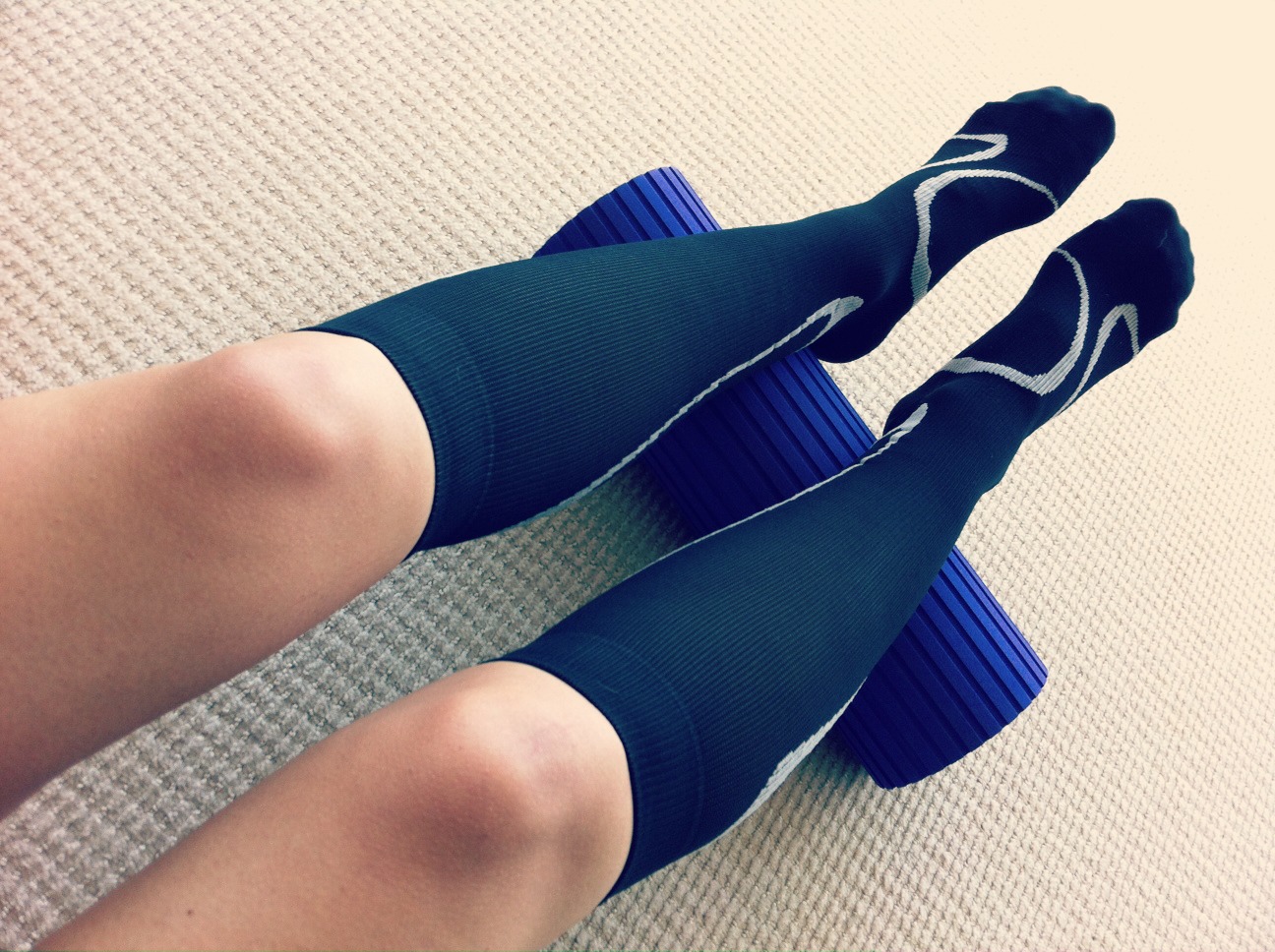
Once reserved for diabetics and frequent flyers, compression socks have gone mainstream, thanks to athletes who swear by their performance benefits in training, racing and recovery.

“I started wearing compression gear in 2007, and I sure got some funny looks as the first person in the USA to wear them [at Ironman Louisville that year],” said Chris McDonald, a professional triathlete and four-time Ironman champion. “I was chatting with a surgeon about post-op recovery, and he said to me, ‘I know nothing about sport, but I can’t tell you quality compression socks will help with return blood flow.’ So I just tried them!”

Although experts are still debating whether the effects are more in your head than your legs, I’m a proponent of compression gear, based on experience. Not only do my legs feel fresher mid-run, but they’re also less sore the day after. Plus, blindingly-bright colors keep me happy during hard workouts 🙂

Personal opinions aside, though, there are a few reasons why it may be worth setting your gear budget back a few bucks (prices for these puppies are in the $45-70 range) to get ahead in your training:

1. Improve circulation. Ever get that “heavy legged” feeling while working out? Compression gear can help prevent blood from pooling in hard-working muscles to keep legs feeling peppy.

2. Stay comfortable. If you’re worried that wearing compression socks means you’ll have to give up your favorite cushy, anti-blister socks, think again. Many brands offer arch support and extra padding in the toe and heel.

3. Increase protection. Socks aren’t just for shielding feet against shoes. Much of today’s compression gear does double duty with special materials that provide a cooling effect and SPF sun protection.

4. Speed recovery. Bounce back faster with recovery-based styles, which are engineered to help get fresh blood into muscles and flush out byproducts, such as lactic acid.

All the brands and technology out there can get overwhelming, which is why I recommend starting at a site like BrightLifeGo. They’re an authority on the subject of compression, having tested and handpicked their entire collection of socks and stockings — both for athletic use and everyday wear. 

I even found a new favorite brand there — Sigvaris. Style-wise, they’re a departure from my usual obnoxiously-colored gear…but functionally, I just couldn’t pass up their graduated compression design, extra-cushy footbed and anti-blister toe fabric. 

sigvaris

Factor in all the other bells and whistles, like high-tech fibers to regulate temperature (and odor), Achilles Tendon Protectors to reduce vibrations on ligaments, plus extra-wide top bands to keep everything in place…and, well, I pretty much live in these things when training, racing and traveling. 

Want to feel the squeeze yourself? Here are a few things to take into account when picking your perfect pair: 

  • Length: Do you want a knee-high sock or a full-length legging?
  • Use: Are you looking to use compression for work, play — or both?
  • Level: How tight do you want it — mild relief or moderate support? 
  • Design: Is form (aka style) just as important as function? 

“I definitely feel the benefits with both performance and recovery time,” said McDonald. “If you can recover quicker you can train harder. Put on compression for all travel (including drives over two hours), wear them during and post workout, and put a pair of compression socks on as you are sitting around at night. It’s not rocket science; it just takes routine.”

Is compression a part of your training and racing attire?

Enter my Rafflecopter giveaway to win two FREE pairs of Sigvaris compression socks or sleeves, courtesy of BrightLifeGo!

10 tips for recovering from a 50K

CM50K_5.31

Let me be the first to say it: Finishing one 50K definitely does not qualify me as an expert in all things ultra marathon.

But I have been training for, running and racing all kinds of distances for almost 20 years now (crap, that makes me feel old), so I am somewhat of an expert on my body and how to help it bounce back from pretty intense endurance events.

This is by no means an exhaustive checklist; it’s just what I like to do to help kick-start the recovery process, which — if done properly — is where the real gains in your training can occur.

1. Celebrate — You just ran 31 miles! Accept that round of hugs, collect your medal, then take a load off for a few minutes…preferably in the shade.

2. Eat — Refuel your body so it can repair and rebuild. For me, this equates to fistfuls of candy at the finish, but I always follow it up with a good meal.

3. Drink  — Celebratory glass of Pomegranate Cider (see step no. 1) aside, I spend the rest of the day trying to rehydrate until my pee runs light yellow.

4. Assess — Do a head-to-toe check for injuries or issues. From blisters to poison oak to tweaked joints, it’s better to recognize it sooner rather than later.

5. Address — I pop Advil for aches, wear compression gear to soothe muscles, apply Tecnu, and bathe in ice or Espom salts to reduce inflammation.

6. Sleep — Restless legs may make it tough to sleep the night after the race, so two nights later I aim for a long, deep sleep to allow my body to reboot.

7. Rest — More than just sleep, this means taking a day (or two) off after a race that gives my body — and mind — and break from the training grind.

8. Reflect — Drafting up the race report while the event is still fresh in my head lets me figure out what worked well — and what didn’t — for next time.

9. Move — I start with light walking the day after and ease in with a gentle swim on day two. By day three, I follow it up with an easy session on the bike.

10. Plan — Last but not least, it’s important to continually set goals to stay motivated. This usually comes in the form of a new race registration!

What are your best strategies for recovering from a big event? 

Effective Exercise: The right way to warm up and cool down

200069246-001

When you’re pressed for time, it’s easy to think that skipping a warm-up, cool-down and stretch might be the most efficient way to work out, right?

Big mistake. As counter-intuitive as it may sound, taking some time to allow your body to ease in and out of things — even if it means shortening the actual workout — will actually help you reach your goals faster.

How? It’s simple, really: Focusing on flexibility can lower your risk for injury, so you’ll be able to keep a more consistent workout schedule, thus obtaining better results in the long run.

I’ve talked before about several other benefits to warming up and cooling down, but here are some specifics to consider before your next sweat session.

Ideal Workout Sequence: 

  1. Warm-up: 5-10 minutes of low-intensity cardio to get blood pumping
  2. Light stretching: Mix gentle and dynamic moves to prime body for performance
  3. Intense Exercise: Attack the workout confidently now that you’re loose and limber!
  4. Deep stretching: Take advantage of warm muscles, which are more pliable
  5. Cool-down: 5-10 more minutes of low-intensity cardio to bring heart rate down

How to Warm Up:

Gradually increase intensity. If you’re going to run, for example, progress from a fast walk to a jog to a run. For biking, start in a low gear and allow legs to spin out before adding elements of speed and resistance. And if you’re lifting, try a series of light weights before progressing to several sets at your goal weight.

Wake up your brain. Get your mind and body in sync for workouts or sports that require hand-eye coordination or fancy footwork. Add some balance and agility drills to activate your reflexes, which will help you respond and react better during peak activity.

Include dynamic movements. After your body is warmed up and you’ve done a few static stretches, move onto dynamic stretching, which takes your body through its full range of motion and should include things like arm and legs swings, torso twists, jumping jacks or fast running.

How to Cool Down:

Gradually decrease intensity. Reverse the progression, whether it’s slowing from a run to a jog to a walk, allowing legs to spin out at a slower speed on low resistance or doing a few sets of easier exercises with lbs in the weight room.

Think loose, long and lean. It’s time to reward muscles for a job well done by allowing them to relax into some deep stretches that speed circulation to joints and tissues, remove unwanted waste products and reduce soreness and stiffness.

Refuel and replenish. Within an hour (really, the sooner the better), drink up and eat up. Use water to rehydrate, and aim for a snack with a carb/protein ratio of 4:1 for maximum benefit when it comes to repairing muscles and restoring energy levels.

Do you bookend your workouts with a warm-up and cool-down for better results? 

Perky no more? Your sports bra may be to blame

Ladies, did you know that eight out of 10 of us are wearing the wrong bra size, and 56 percent of us experience pain when working out, as a result?

The lesson: Mid-workout discomfort is easily preventable — if you take the time to find a well-designed, properly-fitting sports bra.

Source: Well&Good NYC

Source: Well&Good NYC

That’s because there’s no internal structure for supporting the “twins” against gravity and excessive movement beyond a band of fibrous tissue called Cooper’s ligaments. And once stretched, it can cause both discomfort and permanent damage.

The good news is that you can provide a “little help for your friends” and find a good sports bra in just three simple steps:

1. Pick a Style: Consider the degree of support you’ll need, which will vary by both activity and body type.

2. Find Your Size: After selecting the appropriate style, use your measurements to determine size.

3. Test the Fit: Jump around! A snug fit is ideal, but focus on the bottom band, which provides 70 percent of the bra’s support.

One of my favorite brands when it comes to bras is Moving Comfort. They’ve got boobs down to a science (literally), thanks to a dedicated in-house sports bra biomechanics lab in the company’s Seattle headquarters.

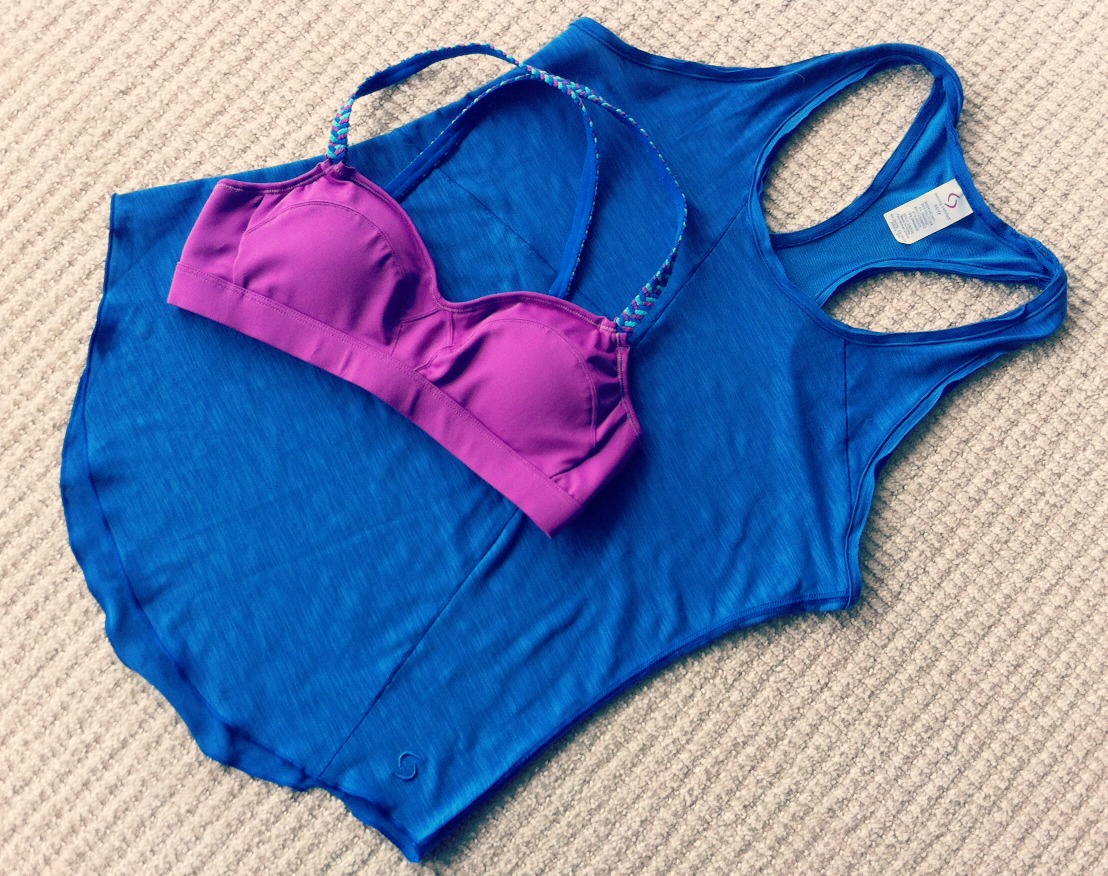
I was on the hunt for something for yoga and bootcamp — supportive but not restrictive — and their suggestion was the Hot Shot ($38), a sweetheart of a sports bra with minimal back coverage that allows for enhanced range of motion.

MCbra1

I paired it with the matching Metro Tank ($48), a fun racerback style that transitions well from class to running around town on errands. It’s loose enough for a forgiving feel without excessive fabric.

MCbra3

Moving Comfort’s team of experts also offer a few pointers to help prolong the, ahem, “shelf” life of your bra:

– Keep it fresh. Wash a sports bra after every 1-3 wears to remove the build-up of sweat, dirt and bacteria, which break down the fabric.

– Keep it safe. Good option: Fasten the hooks, and throw it in the washing machine. Better option: Toss it in a lingerie bag first. Best option: Hand wash to give it extra special care.

– Keep it cool. Hang dry or tumble dry low, since dryers wear down the fabric and moisture management properties.

– Keep it breathing. If it does get thrown in the dryer, never use dryer sheets or fabric softeners which “coat” the fabric and keep it from breathing.

– Keep it new. Depending on how often a sports bra is worn, it should be replaced every 6-12 months.

In need of a new buddy for those bosoms? Visit MovingComfort.com and check out their handy sports bra finder to locate a style that suits your needs.

Disclosure: I was given Moving Comfort items to review. All opinions are my own.

Fave Fix: My must-have gear for trail running

50KGear

If there’s one thing I’ve learned from the past few months on the trails, it’s that running off the roads is a whole different beast than running on ’em. Aside from the obvious terrain and elevation challenges, it requires a new approach — from gear to strategy to fueling — to get from Point A to Point B, especially when we’re talking ultra-distances.

Because of that, I wanted to share an inside look at how I’m planning for my first ultra marathon — the Canyon Meadow 50K — at the end of the month. See below for what I’ll be wearing, eating, drinking and using to help me recover when all is said and done…and (fingers-crossed) run 🙂

Feet First: The Brooks Cascadia 8 came highly recommended from several trail runner friends due to its traction and responsiveness, plus it was my favorite of all the brands and styles I tested at San Francisco Running Company. I like to buy my running shoes a half size up to allow for feet to swell, and I may add a Superfeet orthotic insole for a little extra support.

– Keeping Cool (& Chafe-Free): I love a trucker-type hat with breathable mesh and a wide brim to block the sun. And under my technical, sweat-wicking t-shirt, I’ll be wearing a Coeur Sports Checkmate Sports Bra, which has anti-chafe seams that are perfect for long race days. On the bottom, I’ll pair the Lululemon Groovy Run Short with CEP Progressive+ Calf Sleeves to promote circulation and protect lower legs, plus Balega Blister-Resist Trail Socks to try to keep my feet from getting too torn up.

Accessories & Extras: Because I’ll be in and out of the sun, I’m slathering on Banana Boat Sport sunscreen and wearing Tifosi sunglasses, which adjust automatically when exposed to UV rays. Electronics-wise, I’m taking my Jaybird Bluebuds bluetooth headphones and am hoping for an early birthday present (hint hint, Hubby) — the Garmin Forerunner 910XT — to help me track mileage and stay on pace. I’ll also use the easy-on, easy-off Fuel Belt Race Number Belt and apply ample amounts of TriSlide to avoid hot spots.

50KJenny

One of the most essential items on the trails, though? A good hydration pack, which not only allows you to carry and consume water between aid stations, but also makes it easier to have other essentials — such as fuel, extra clothing, first aid items, etc. — at your fingertips throughout the race.

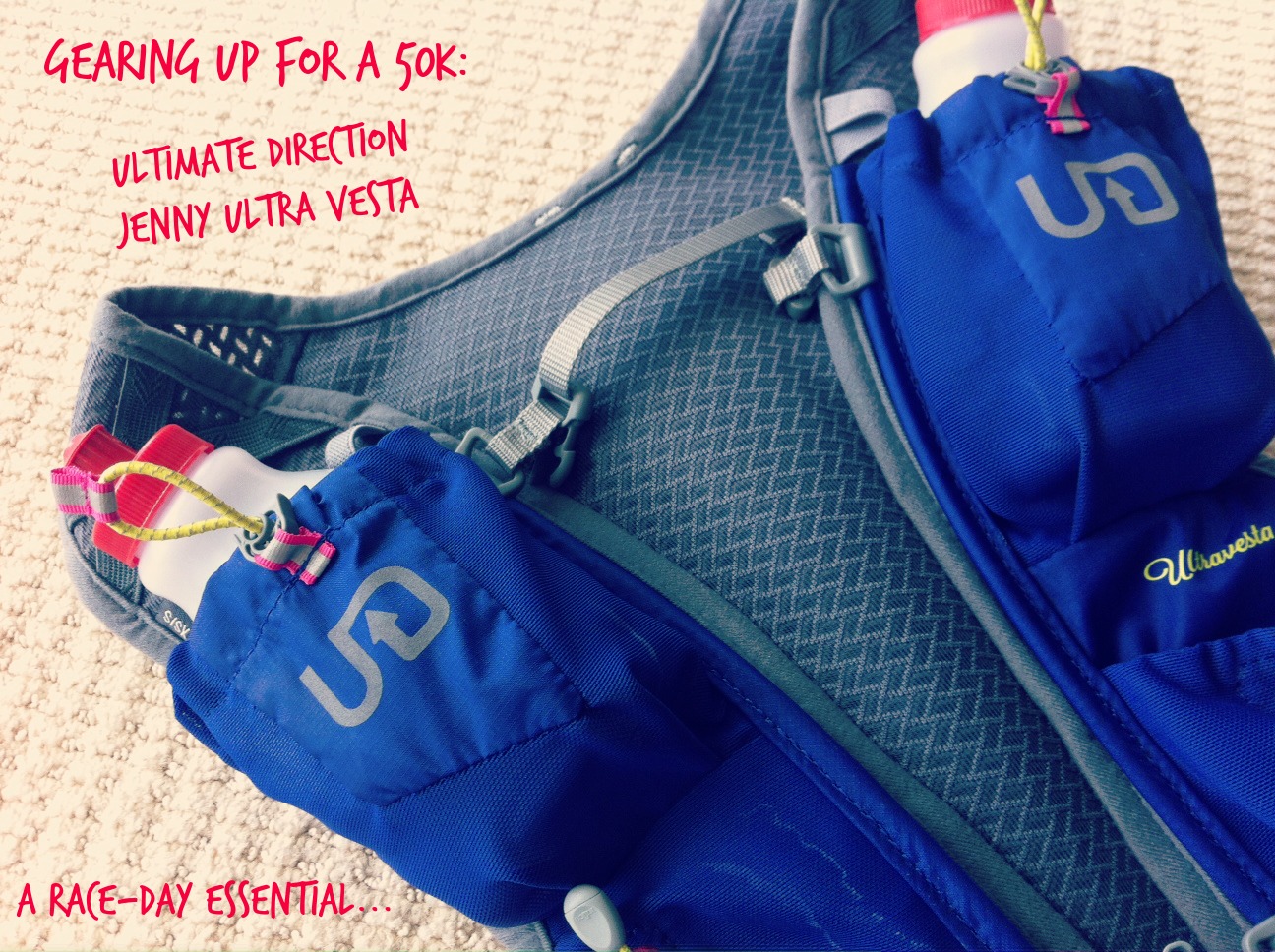
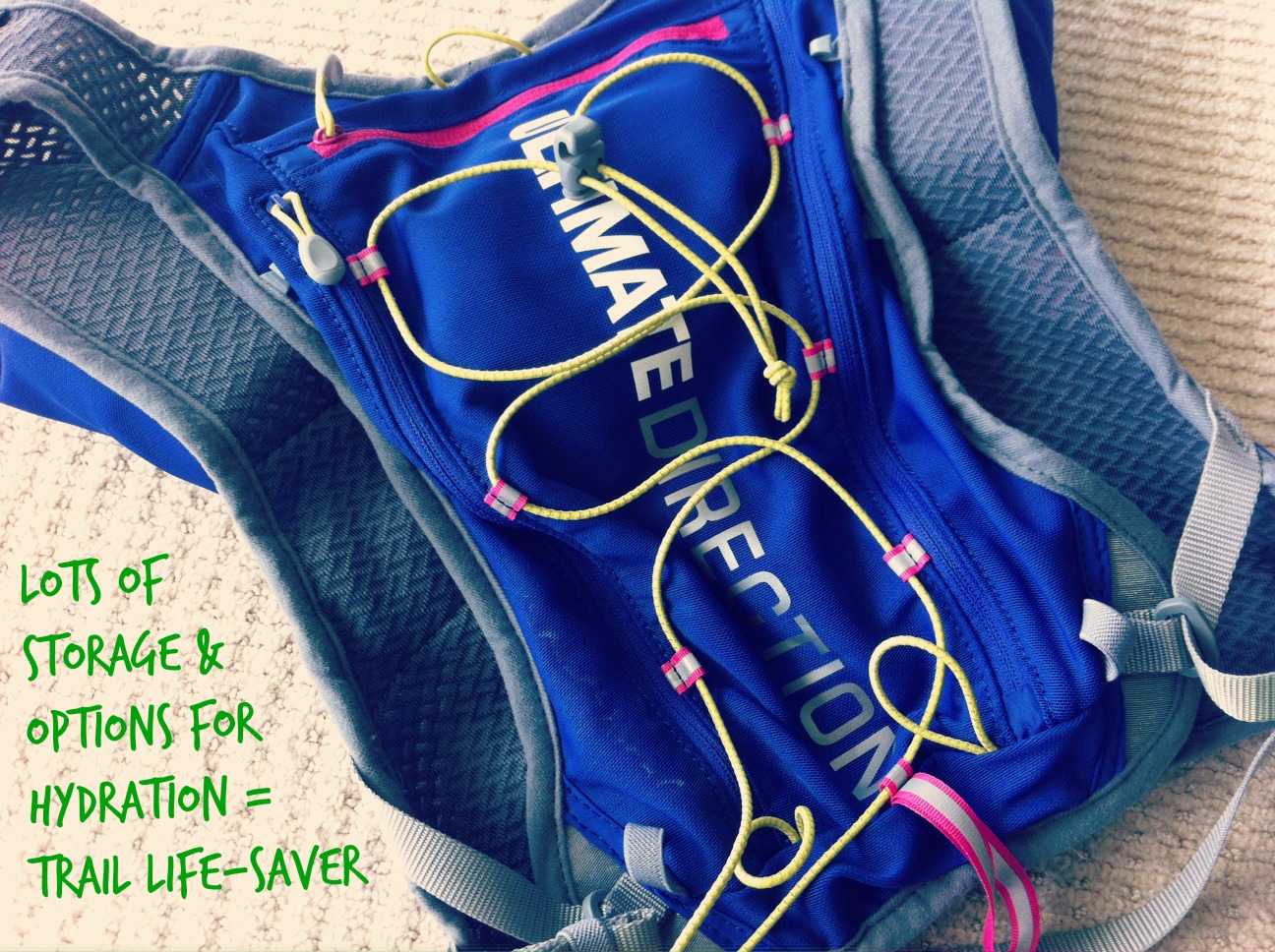
Focus on fit and function; you want something that’s comfortable, compact and efficient so you have everything you need without extra bulk. My favorite is the 2013 Trail Runner Magazine Gear of the Year Award-winning Ultimate Direction Jenny Women’s Ultra Vesta, which is made specifically for women with an adjustable fit.

50KJenny2

No more water bladder slapping against your back here; the Ultra Vesta’s front strap-mounted holsters offer quick, immediate access to twin 10-ounce water bottles, which are concave against the body and positioned higher on the chest to keep from bouncing against…well, you know.

Besides all the pockets for my cell phone, gels, keys, etc. there’s also a main rear compartment that will accommodate a 70 oz. reservoir (sold separately) for longer treks. And, believe it or not, there’s even an ice axe loop, two trekking pole loops, plus reflective accents for low-light visibility, making this a virtual Swiss Army Knife of packs for all kinds of outings and conditions.

50KFuel

So what am I planning on putting in the pack while running? Well, hopefully not too much…I’m aiming for that delicate balance of being prepared between aid stations (which are usually very well-stocked) and not over-packing, which will fatigue me more quickly.

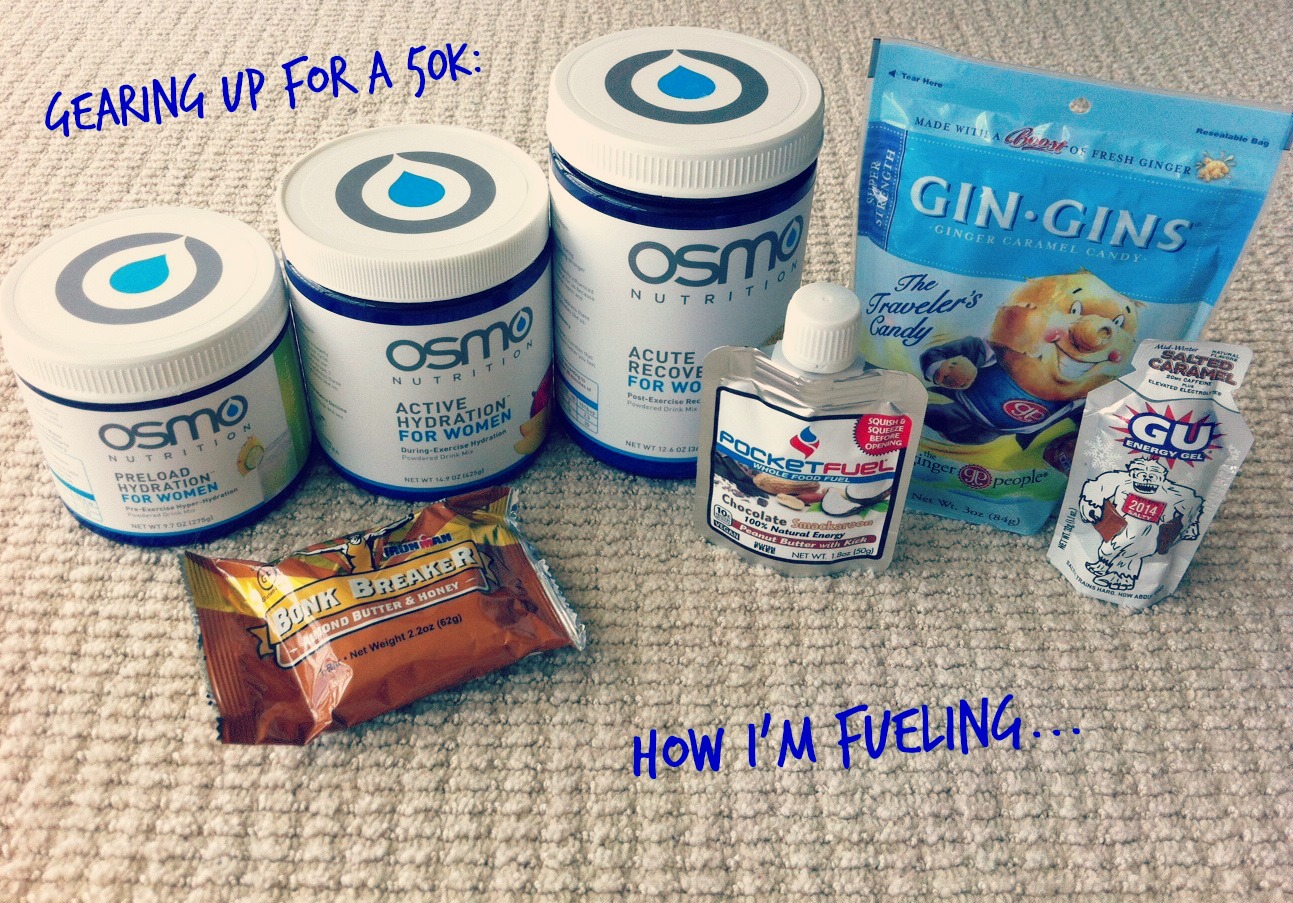
Ward Off Hanger: What’s been working well in training runs is a mixture of PocketFuel for sustained energy, Salted Caramel Gu Energy Gel for a quick hit of sugar and Bonk Breaker energy bars for something more “food”-like. And, of course, Gin Gins Candies from The Ginger People and good ‘ole TUMS to help keep my stomach settled.

Quench Thirst: I’ll fill my water bottles with Osmo Nutrition Active Hydration for the first leg, and I’m aiming to drink every 10 minutes or so throughout the day. Ideally, I’ll refill the bottles at each aid station, most likely with a mix with water and whatever electrolyte drink they’re providing on the course.

50KRecovery

And although the first goal of the day is to cross that finish line in one piece, setting myself up to recover well comes in a close second. The body takes quite a beating over the course of 30-plus miles, so it’s key to remember a few things to aid with muscle repair and regeneration.

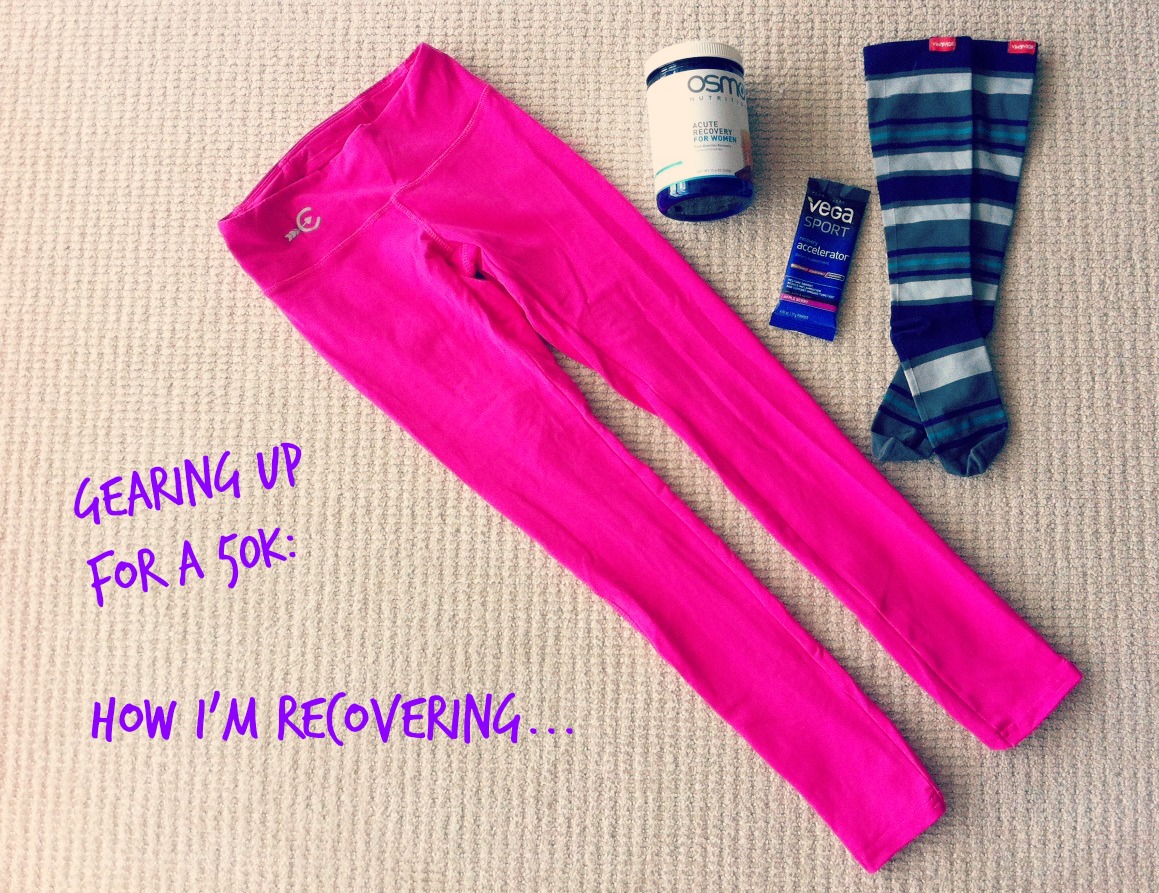
– Refuel and Rebuild: Immediately after finishing (while hitting up the post-race buffet!), I like to mix a packet of Vega Recovery Accelerator in a bottle of water. It’s an all-natural, plant-based recovery drink mix specifically developed to replenish energy and electrolytes, reduce inflammation, muscle and joint pain, support immune system and protein synthesis, and reduce recovery time. Then when I get home, I mix up a recovery smoothie made with Osmo Acute Recovery for Women, a banana, almond milk and ice for an extra boost of nutrition.

Relax and Recover: Finally, one of my favorite post-race treats is a hot shower followed by an afternoon nap in compression gear, which helps reduce swelling and just plain feels good on tired legs. I’ll usually layer Coeur Zipper Tights with Vim & Vigr socks and elevate my legs to start the healing process and make it easier to get out of bed and maneuver around the next day.

What’s your favorite gear to get you through those long trail runs?