Make exercise more fun with The Fitness Games

10629692_10100286123598153_778189155746530908_n

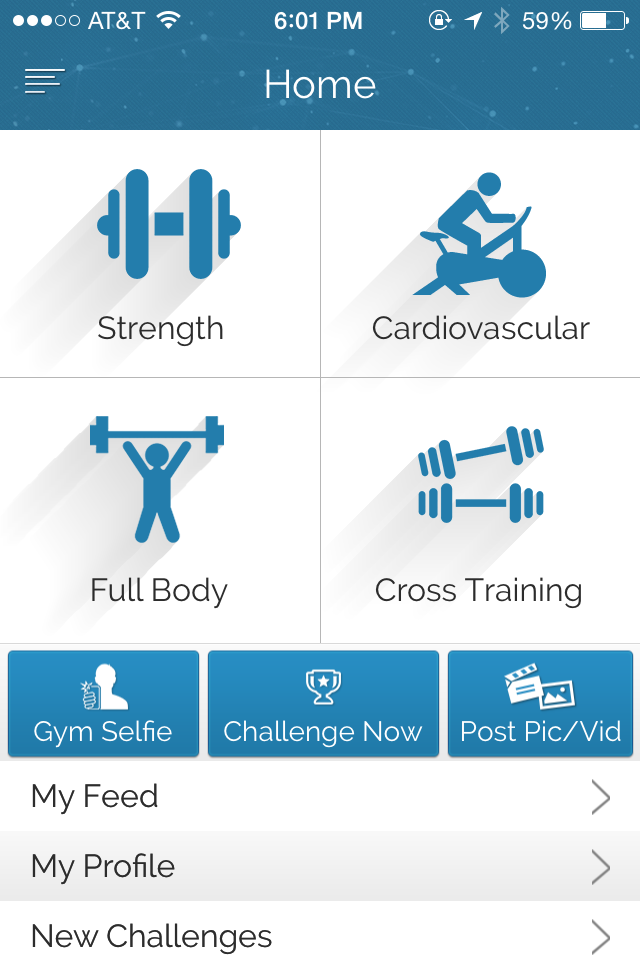
After being sidelined from running for a bit, I’ve been on the lookout for alternative ways to fuel my competitive fire. Enter The Fitness Games, a new app that aims to make exercise as addicting as Candy Crush Saga.

Some background: I met founders Arya Farzin and Joseph Phillips, two nationally-certified trainers with a combined 20 years of experience in the fitness industry, at this year’s IDEA World fitness conference. Not only are they super-nice, extremely-passionate guys, but there’s a great story behind the creation of the app: Obese for most of his life, Arya decided to make a change when he was 19 years old. After losing 200 pounds, he made it his mission to help people all over the world make the same positive changes…and have fun while doing it.

photo 1

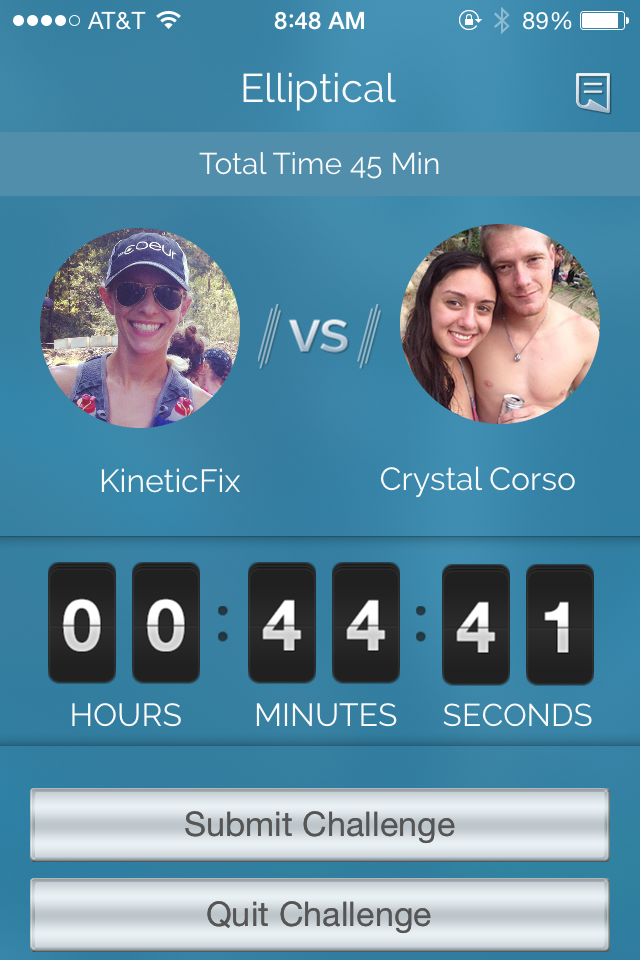
So here’s how it works: Instead of having to go it alone each day until my marathon training resumes, I can challenge anyone, anywhere, to any type of workout, post photos and videos to show progress, or simply challenge myself with one of the app’s workouts. What I love most, though, is that I can find a partner  — regardless of geography or time zone — to connect with via GPS so we can compete and track our progress in real time.

Whether it’s a virtual elliptical buddy (yep, I need some help staying on the machine for 45 minutes) or motivational match-up for some strength training, all I do is post the the workout I want to complete via the app dashboard. Other users respond if they are interested in doing the same workout, and then it’s go-time!

photo 2

Workouts are divided into four categories: Cardio, Strength, Full-Body and Cross Training. Each category operates on a unique scoring system that was carefully designed to determine how hard users exercised to determine the winner of each head-to-head contest.

Points earned during challenges can be used to level up, as well as unlock free workouts. And all workouts performed are tracked, scored and saved so users can see their progress over time.

photo 3

If you’re looking for a way to get motivated and make workouts a team effort, this is a simple, yet effective, tool for tricking yourself into being more consistent. And, let’s face it, there’s nothing like a little friendly competition to get us all stoked for that next sweat session, right?

Let the games begin!

This post was sponsored by The Fitness Games through their partnership with Fit Approach. I was not compensated monetarily, but was provided the Platinum Version of the application for review. As always, all opinions are my own.

Have runs, will run: Tips for easing that race-day anxiety

pre-race-nerves_0

“Any runner who denies having fears, nerves, or some other kind of disposition is a bad athlete, or a liar.” – 1950s British Olympian Gordon Pirie

The bad news? Pre-race jitters are inevitable. The good news? It’s a normal part of the process. Whether you’re a seasoned veteran aiming for a new PR, or a rookie concerned about just getting to the finish line, nerves are natural and can add an element of excitement to your race.

But when pre-race fears become more than just nervous energy, it’s important to nip it in the bud before your performance is affected and it starts to take all the fun out of racing. Regardless of whether it’s a string of bad races, a layoff due to injury, or merely a lack of confidence in your level of fitness, here are a few tips to help keep you on track come race day.

Prepare properly

You may not appreciate the importance of setting out your race-day gear the night before the event until you make a critical mistake…and then you never forget.

A few years back, the gun went off at the Nike Women’s Half Marathon in San Francisco when I realized that I had, in a cloud of nervous forgetfulness, left my timing chip in the hotel room a mile or so away. Without any time to go back, I ended up running the race chip-less, finishing sans official time or record of my participation.

Lesson learned; now I lay out everything the night before and do a double-check before bedtime.

Practice visualization

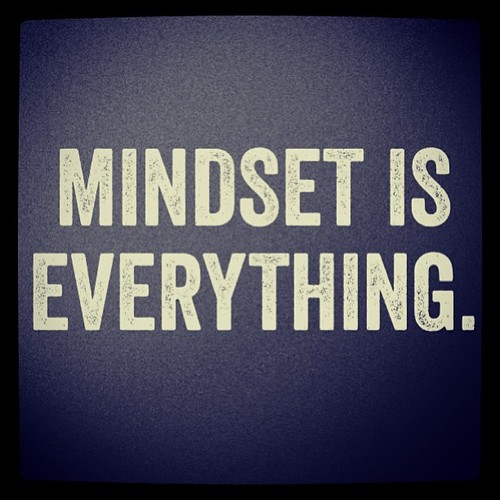
Walk through every aspect of the race in your mind’s eye, from warming up at the starting line to navigating the course and crossing the finish line triumphantly. Expect a certain amount of discomfort or pain if you’re pushing your limits, but know that you’ve mentally rehearsed it and can handle anything that comes your way.

mindest

When all else fails, imagine your worst-case scenario, and how you’d cope with it. Chances are the reality won’t be half as bad as what you can dream up.

Chew wisely

Race-day nerves can wreak havoc on your digestive system, so tread carefully when it comes to what you ingest in the hours before your event. Skipping a meal is not an option (especially for longer endurance events), so look for foods that are easy to digest and have a mix of nutrients, such as bananas, sports bars, oatmeal or even bagels and toast with peanut butter.

If you’re wary of how something will set, do a trial run during training to work out the kinks in a more controlled environment.

Line up correctly

There’s nothing more unnerving than realizing that you’re in the wrong place at the wrong time on race morning.

Avoid angering the elites or getting stuck behind slower runners by lining up according to your closest predicted finishing time. This way you can start with people who are at a similar pace, which will help you relax and focus on your own performance.

Channel the tortoise

I’ve witnessed all too many nervous runners who shoot across the starting line like jackrabbits when the gun goes off, only to slow to a shuffle 200 yards later when their adrenaline wears off and oxygen debt sets in.

tortoise-hare

Regardless of how good you feel, resist that temptation. Hold back a bit in the early stages to find your pace, and once you’ve relaxed into a rhythm, start pushing.

Run your own race

I’d argue that only a small part of the race is physical; the rest is mental. Fight the urge to compare yourself to those around you. Unless you’re a top-ranked elite athlete, there will always be someone faster than you. And on the flip side, there will always be someone slower than you.

So pick your route, stick to your plan and race against the most daunting competitor: Yourself.

Think happy thoughts

Above all, it’s important to focus on what you already have achieved, rather than what you might not. Whether it’s attempting a new distance, making it through a grueling training schedule or just having the guts to step up to the starting line, you’ve got something to celebrate.

change-your-thoughts-quote-image

How do you deal with race-day anxiety? 

No sleep ’til Seaside…or Calistoga

ragnarrelay

Every runner has a bucket list, whether it’s to cover a certain distance, reach a specific time goal or sample a new kind of event to keep yourself feeling challenged. And while the first two are usually moving targets (read: works-in-progress), the third is actually something you can feel the satisfaction of checking off the list.

That’s precisely why, when I was asked to join two 24-hour relays — one in Oregon and one in California — this summer/fall, I jumped at the chance for both.

Now, my idea of a fun weekend isn’t exactly jumping into a van with strangers, then depriving ourselves of sleep and running without showering three times over so we can cover 200 miles together… But you know what? I’ve heard that it’s a bonding experience, a chance to make new friends and create some pretty cool memories, so it’s something I’ve always wanted to try.

And I guess now I’ll just have twice the tales to tell afterward!

What is Hood to Coast?

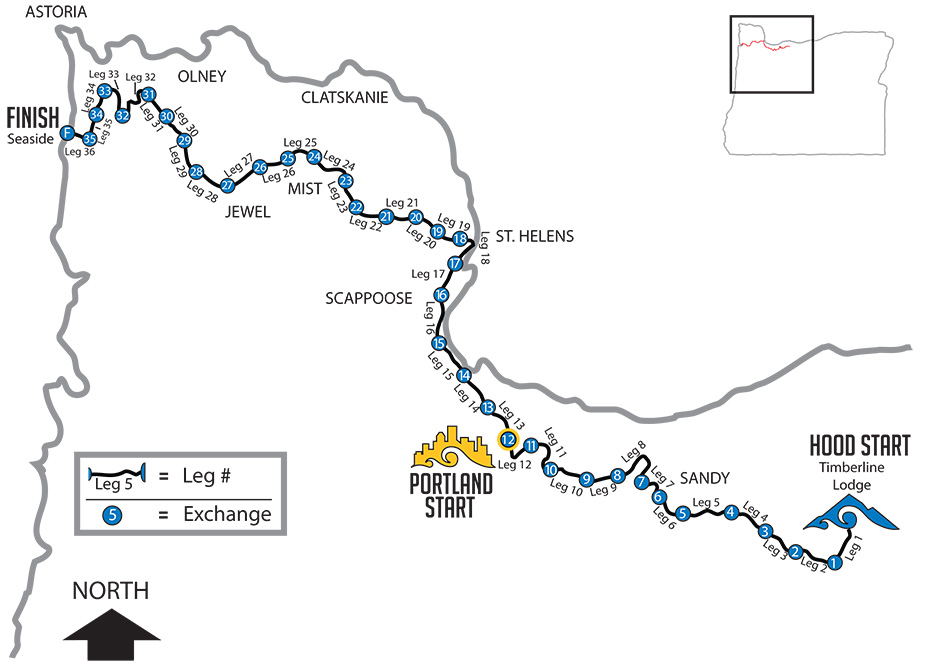
The “Mother of all Relays,” Hood to Coast is one of the longest and largest relays in the world with 12,600 runners (1,050 teams of 12) tackling a 200-mile course that runs from Timberline Lodge on the slopes of Mount Hood, the tallest peak in Oregon, through the Portland metropolitan area, and over the Oregon Coast Range to the beach town of Seaside on the Oregon coast.

course-map

Hood to Coast began in 1982 with eight teams and has filled the team cap on the opening day of registration for the last 16 years straight.

There’s even a whole documentary dedicated to the event, the Hood to Coast movie, which covers four unlikely teams on their epic journey to conquer the race. I watched it a few years back, and was instantly hooked; check out the trailer here.

What is Ragnar? 

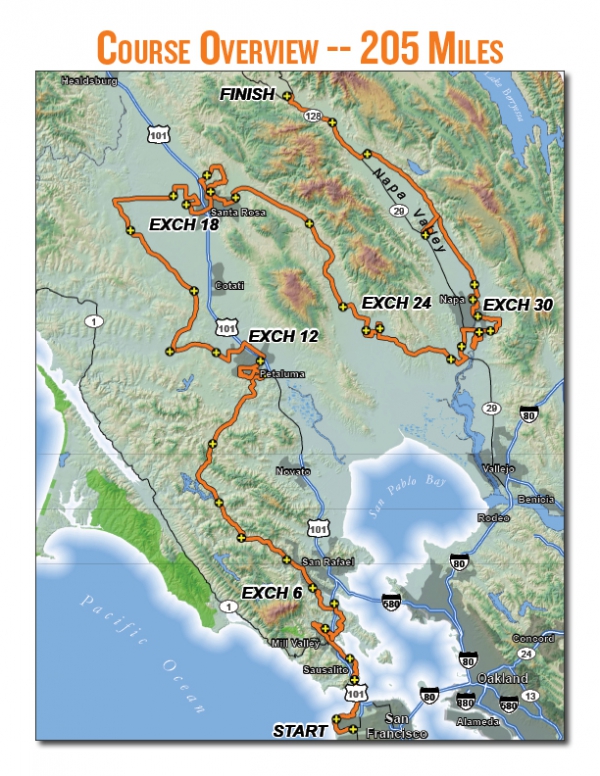
As the Ragnar Relay Series’ official “run now, wine later” race, Ragnar Relay Napa Valley is set in — you guessed it — Northern California’s wine region during harvest season. Teams start from San Francisco and race across the Golden Gate Bridge, then experience the rolling hills and farmland of Petaluma before heading toward the Valley of the Moon.

nevgg5xrmwbmtoao9ad1

Just as with Hood to Coast, teams of 12 are split evenly into two vans. Only one runner hits the road at a time, and each participant runs three times, with each leg ranging between three and eight miles and varying in difficulty. As they say, “Some call it a slumber party without sleep, pillows or deodorant.”

Yep. It’ll be run, drive, eat, sleep (?), repeat for 200+ miles as we trek through my old stomping grounds. Check out the promo video for the event here.

Two 24-hour relays in two months…are you crazy?!

The short answer: Quite possibly. But you already knew that, right?

The long(er) answer: I’d be lying if I said I wasn’t a little anxious about taking the plunge on not one, but two. I mean, I like my sleep, and if given the choice I’d prefer not to stink up a van with five others as we hang out in our filth for a whole day.

But…I’m also eager to switch up my racing routine, which will keep me motivated during this marathon training cycle. And if I’m looking on the bright side of not sleeping for 24+ hours (if there is one), these races will not only allow me to get more experience running on tired legs, but I can also cross two big items off my bucket list.

Although I’ll likely need a nice, long nap at the end.

Hood to Coast is August 22-23, and Ragnar Napa Valley is September 19-20. Stay tuned for race recaps with all the details as I cover almost 400 miles with my respective teams! 

Body After Baby: Tried-and-true tips for new moms

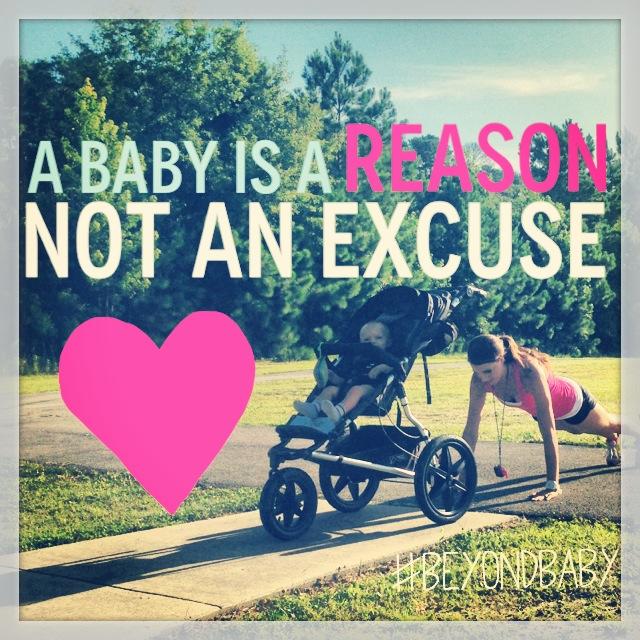
Photo courtesy of BeyondFitPhysiques.com

Photo courtesy of BeyondFitPhysiques.com

After catching up with ultra-mama Sarah Evans a few weeks ago, I thought it’d be fun today to revisit some of the great advice from a few of my other “mom friends” about reclaiming their pre-baby bodies.

We’re not talking about fitting into some kind of Barbie doll-sized skinny jeans, though; we’re talking about getting your groove back — feeling good inside and out, finding a new routine and establishing healthy habits for the whole family.

That’s why I love the sentiment in the photo above, and it’s also why I find people like Sarah and the other moms I interviewed so inspiring.

I still don’t know how they find the time — or the energy — but I admire their creativity and determination for maintaining a fitness routine despite a new (and pretty darn demanding) member in the household.

And speaking of “homes,” Hubby and I are making our way north to our new one this week… More on that in this week’s marathon training recap!

Moms, how did you get back into your fitness groove post-baby?

Checking in with ultra-momma Sarah Evans

SE1

I first spoke with Sarah Evans earlier this year after seeing that she totally smashed her marathon PR (and qualified for Boston) a mere four months after having a baby.

Inspired and intrigued, I asked if I could pick her brain, and my interview with her continues to be one of the most popular KineticFix posts to this day.

Six-plus months have passed since then, and we have yet to coordinate trail running schedules (one day!), although we do connect every so often over social media to root each other on.

So I figured it was about time for us to catch up on life, running and our shared love for getting lost on the trails…

KineticFix: How has training been going since we last chatted?

Sarah Evans: Training has been fun and one of the things that has remained consistent and steady in my life.

Since the first of the year I’ve ran several races, including a PR (personal record) at the Kaiser Half Marathon in February (1:33:40), a 35k on my (34th!) birthday in March and a fun 5k (tried to break 20 min; not quite there yet!) with my mom in April, culminating in my first Ultra (a 50k) this month!

I’ve continued running, cross training with cycling and have been including a lot more yoga and HIIT (high intensity interval training), boot camp-type workouts to my regimen instead of the boring, slow strength training that I did in the past.

I also decided to resign from my job as a medical device rep at the first of the year to stay home and raise my daughter for the time being. Since then I’ve studied for and passed/received my personal training certification through the National Academy of Sports Medicine, and I’m also going to take classes to become a certified run coach next month through Road Runners Club of America.

So I’m really exploring other opportunities in the sport that I love while still being able to stay close to home with my baby girl.
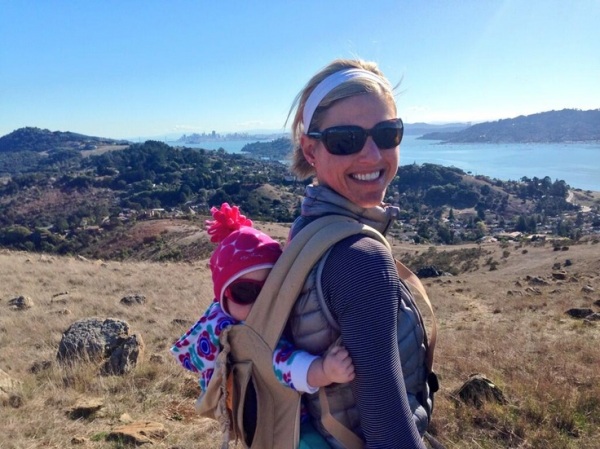
SE3

KF: Wow, you’ve sure been busy! So can you share your latest tips for maintaining a workout schedule with a increasingly-active baby girl?

SE: With having an ever-changing and super-active baby, running has continued to remain my outlet and my ‘me’ time to get out in the early mornings before the day gets hectic (or exhausting!).

I still maintain my Sunday mornings with my friends on the trails; those are my 3-4 hours that are an unspoken religion to me to get out solo, so my husband is very supportive of that routine. But I’m also finding more time to run with my daughter in the BOB stroller, since she’s becoming much more aware, active and awake for longer periods; it’s a time we can spend together and I can start sharing my love of running with her!

During a typical weekday, I’m awake around 5:30/6am to get in a run or a spin on my bike before my daughter wakes up (at 7am). Twice a week I get until 7:30am to go on a longer run if I want, and my husband gets up with our daughter. It gives me some extra ‘me’ time and my husband gets some of those precious morning minutes that are so sweet with a baby. It’s a great compromise and schedule that we have worked out!

On those mornings, I know I have a chunk of my training done for the day, and then me and my daughter can enjoy the morning together taking a walk, playing in the yard or at the park. Then I will add on small/additional ‘workouts’ throughout the day.

SE7

That’s what I think is important for many busy women and moms to realize: You don’t need a full hour or two a day to work out. Just add it in little by little throughout your day! I keep resistance bands, my yoga mat, foam rollers, some small hand weights, ankle weights and an exercise ball out in our living room all the time (hey it eventually blends in with all the toys!).

While my daughter is laughing at her reflection in front of the mirror, practicing crawling or working on developmental skills with some toys, I can get in 10 minutes of core work, leg and butt exercises, lunges (during which I will hold her for extra weight!), you name it. I also have 10-20 minute ‘bootcamp’ or total-body workouts I’ll do, where each exercise is done for one minute.

It’s easy to stop those workouts, if needed, in the middle and pick them up later in the day. And when my daughter takes a nap, I’ll fit in a 20-minute yoga session in between dishes, laundry, taking a shower and preparing her meals. It is truly the small things you do throughout the day that add up.
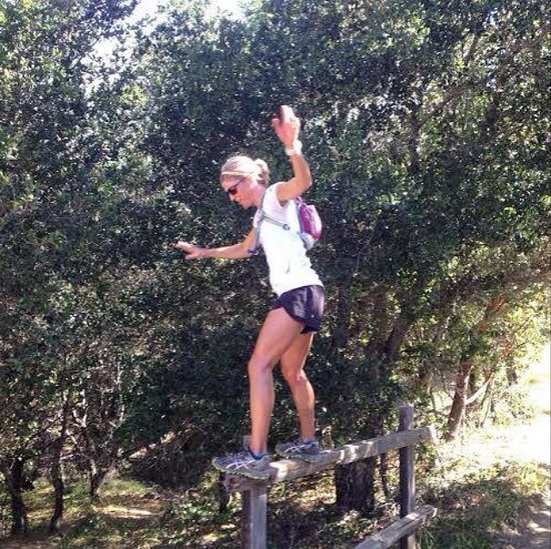
SE8

Another way I also stay active with a 10-month old baby is by walking (or many times run!) when I do errands. We jog the mile to the grocery store or run/walk the 1.25 miles to the park, all instead of driving the car. We spend a lot of time outside, so that automatically lends itself to being active, in fresh air and staying fit.

And how I maintain my workout and training schedule is truly planning my weeks in advance. This works especially well when you have a training plan for a race mapped out, then you already know what  will be running weeks/months in advance!

I will put the entire plan into my calendar, marking down what mileage or workout I need to do and on what days. Then when I look at my week on Sunday evening, I already know whether I need to carve out time early in the morning, during a ‘lunch-break’ (for me that may be nap-time) or sometimes later in the evening.

This helps because just as I’ll schedule a lunch, a meeting or an appointment with someone, I also schedule my run (or any workout, spin, strength, core work, etc.) It’s  important to make that meeting with yourself, and this way it’s really difficult for me to miss a run or cross training workout because it’s pre-scheduled into my day!
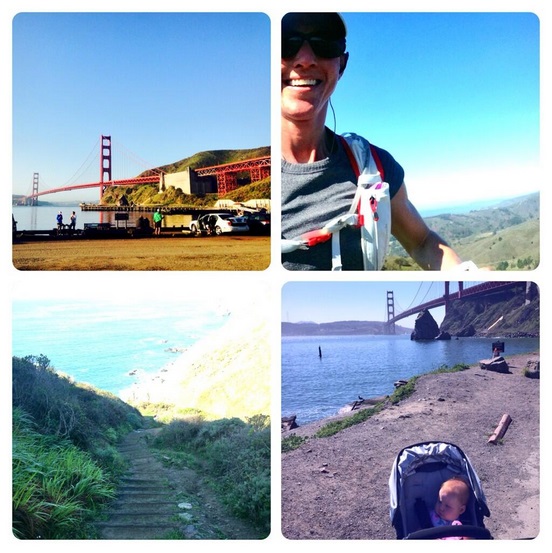
SE2

KF: All great ideas! Speaking of getting active in the great outdoors, you’ve entered ultra territory, too. Why the step up to longer distances? 

SE: I am competitive, especially with myself, and I’m always looking for the next challenge. I found myself wanting another hurdle to overcome (as if having a baby or my come-back from breaking my foot two years ago wasn’t enough!).

I had recently broken my personal records for the marathon and half-marathon within four and six months, respectively, post-baby — so I thought an Ultra (starting off with a 50K) would be the natural next step. Pair that with my absolute LOVE of the trails, and it seemed like a no-brainer.

There’s a big difference going from road runs with speed to the long, slow pacing of a trail ‘ultra’ distance. It taps into a different part of yourself and your spirit, and it seems to exceed a certain fitness level and delves into mental strength…but I like that new challenge!

I’m hoping that this isn’t my last Ultra. The community that surrounds the trails and ultra-running is very unique, open and friendly, and I love the feeling I get from getting dirty, sometimes lost (I think you can relate!) and being out in nature.

SE4

KF: Oh, yes! I like to say that if there’s a way to get lost, I’ll find it — especially on the trails. What’s next on your list, and can you share your game plan for getting there?

SE: I’m looking forward to kicking it up a notch and getting back into speed work and intervals when I start training for the Chicago Marathon, which I will be running along with my mom for her first marathon! This was also my first marathon in 2008, so I am looking for another personal record and Boston Qualifying time.

I’ll create my own training plan; I enjoy researching and finding new workouts to add to my runs and being my own coach. There’s not the pressure of answering to a coach, but I’m also my own worst critic, so I do a pretty good job at keeping myself in check!

I am also working out the details of registering for the 2015 Boston Marathon (with my last marathon qualifying time) and then trying to get into the Boston to Big Sur Challenge next April where you run back-to-back marathons, six days apart, on opposite coasts of the country. And I’ve always been a big fan of The North Face Endurance Challenge, so that could possibly be another 50k (or dare I say 50 mile!?) opportunity.
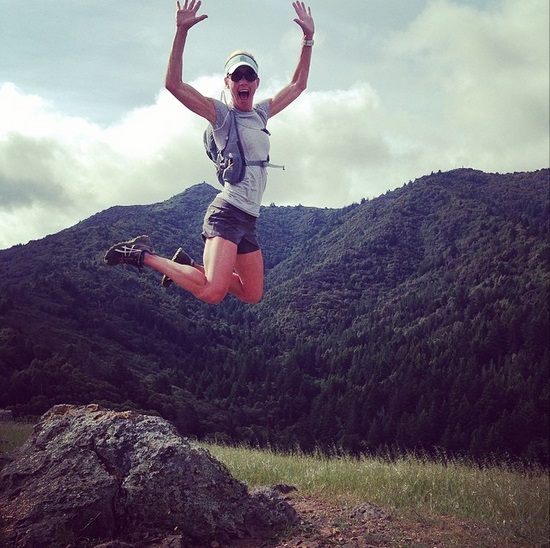
SE5

On the exploring and fun side, I have a deep desire to also run Rim to Rim (and maybe Rim!) in the Grand Canyon, so I may be putting together a group for late next Spring.

All of these races really are just a celebration for the running that I do on a daily, weekly basis. I don’t run just to race, the races just seem like a great opportunity to add on challenges to my running, which I still do purely for the freedom, joy and love of it.

I am very excited to share this passion with my daughter and possibly run a race with her one day, as I am doing with MY mom this year! I am also very lucky to be able to spend time at home with my daughter in her first year of life and to start to use my personal training and coaching certifications for my own knowledge and to share with my friends and family who seem to enjoy picking my brain for advice and input in their own active lives.

Now, as I look at my plans for the next year, there seems to be a lot going on. But in the end, it’s done for the fun of it all, to spend time on the trails with my running crew and to celebrate our training with races…not to mention coming home to my husband and daughter and going out for Mexican!

It’s the easy, simple things sometimes 🙂

SE6

Special thanks, Sarah, for taking the time to chat. Can’t wait to follow along on your adventures over the next year — and hopefully hit those trails with you soon!

Have workouts, will travel: How I stay fit on the road

Photo courtesy of DangerouslyFit.com

Photo courtesy of DangerouslyFit.com

We all know that the best way to stay healthy is to make eating well and exercising a daily habit. But what happens when a trip throws you off your usual routine?

Between travel and a move, Hubby and I are hypothetically “homeless” (that is, without a permanent address) for almost two months this summer. Deep breath. 

We need a constant amid the chaos. And for us, that’s a good sweat session. So here’s how I plan to stay on track when everything else feels like it’s spinning out of control:

1. Make a plan. Figure out what works with your schedule, and commit to making it your new routine for the interim. For me, that’ll be a quick morning run before breakfast each day to start things off on the right foot.

2. Have a goal. It’s easier to motivate yourself when there’s something bigger at stake. Having my marathon training all mapped out will help me take the guesswork out of my daily workouts.

3. Keep it simple. K.I.S.S. — yep, “Keep it simple, Stupid.” Between running and body-weight exercises, I’ll be streamlining my workouts as much as possible over the next few weeks to keep things uncomplicated.

4. Mix it up. Variety is the spice of life, so when I’m running a lot I mix in complimentary workouts. This often means adding a few new DVDs into the rotation:

Yoga helps balance tight running muscles, so I’ll pop in one of the 12 Yoga Warrior 365 classes and laugh along with instructor Rudy Mettia’s irreverent approach to the practice.

– And for an intense, efficient cardio session when the weather’s not cooperating, I’ve been turning to BurstFIT Fire for a full-body, high-intensity interval workout in a mere 20 minutes.

5. Enlist some help. Having a partner in crime makes it much easier to get up and out each morning. That’s when I lean on Hubby; we keep each other honest about our workouts while on vacation, plus it’s fun to explore new cities that way.

6. Cut some slack. When things get super hectic, it’s good to know when to give yourself a break. Over the years, I’ve realized that an extra rest day here and there won’t hurt my training; in fact, taking a breather can actually help in the long run.

What are your best tips for sticking to a fitness routine while traveling? 

Detroit Marathon: My “renegade” training plan

marathon-03

My hometown of Detroit has a reputation for being scrappy, gritty and a little rough around the edges. But I’ll let you in on a little secret: We love it that way.

You see, as my all-time favorite Superbowl commercial reminded us, “It’s the hottest fires that make the hardest steel.” Adversity doesn’t scare Detroiters; it only makes us stronger.

So I chose this race, in particular, to celebrate the city and everything that makes it unique and exciting — from crossing international borders twice and running an “underwater mile” to the scenery on Belle Isle and views of the city from Corktown to Indian Village, just to name a few.

And what better way to prepare than to use a training plan developed out of Hansons Running Shop, a locally-owned, nationally-recognized running institution (and founder of the Hansons-Brooks Distance Project)?

Sure, it may be a bit unconventional. But in a city that’s anything but conventional, I wouldn’t have it any other way.

What It Is

Promising a “PR-busting performance,” the Hansons Marathon Method focuses on lower-mileage long runs that emphasize quality over quantity.

In layman’s terms? While the focal point of other plans is one weekly looong run (up to 20-22 miles), the Hansons philosophy is that no one workout is more important than another.

That translates into six days a week of running — double that of my previous plan — with an equal focus on endurance, speed and strength.

Why I Like It

It’s controversial — specifically the absence of 20-mile (or more) long runs — but according to the reviews, it works.

Credit a little something called the “residual training effect,” which banks on the cumulative impact of workouts. So, for example, a long run that’s “only” 16 miles now includes three workouts’ worth of fatigue in the legs.

Rather than preparing runners to tackle the first 16 miles of a marathon, this plan is geared toward being able to hang tough in those critical last 16 miles.

Will It Work?

We shall see! I’d be lying, though, if I said I wasn’t at least a little nervous about being able to get to the start line uninjured, especially with all the non-stop running. I can’t remember the last time I ran six days a week.

But I’ve got a decent level of overall fitness built, and I think the Hansons Method will help me get to that next level of physical — and mental — stamina.

Plus, there’s another factor in this race that’ll make things even more interesting: heart. I’m so excited to run in, with and for the city I’m proud to call home.

Get ready, Detroit, I’m comin’ for ya.

Training officially starts tomorrow, so check back for my weekly recaps!

Canyon Meadow Ultramarathon: The plan

LakeChabot1

Holy crap. What did I get myself into?

Right now, my brain keeps going back and forth between two thoughts:

I can’t wait to hit the trails tomorrow and make this happen.

That first step after 26.2 will put me officially at the longest distance I’ve ever run…and then I’ve got five miles — and some decent elevation — to go after that. 

Physically, I haven’t kept as regimented a training plan as I usually do for long-distance races. Quantitatively that concerns me a bit, but qualitatively I’m actually not too worried about it because my focus is on covering the distance — which I’m pretty confident I can do — versus racing the clock.

What I have been doing? Getting time “on my feet,” which means long runs (10-15 miles) every weekend, plus oodles of cross-training during the week to ensure I stay in shape without (literally) running myself into the ground.

But I’ve also been taking some time to tend to some of the non-running aspects of the race which, according to recent Born to Run 100-mile finisher Jamie Walker (yep, 1-0-0, that’s not a typo), are just as critical to getting across that finish line in an ultra.

Namely, this means doing some mental preparation and making a plan for staying on top of fueling and hydration during the race. And having an awesome pacer to help me navigate the day is a huge bonus (THANK YOU, Jamie!).

Jamie gave the Feed Zone Portables rice cakes a glowing review for keeping her tummy happy mid-race, so I’ll be following suit and hoping for the same good results. Plus, I’ve whipped up a batch of Hailey Manning’s famous Salty Balls as a second snack option.

Mentally, I know there will be ups and downs throughout the day…but I’ll be keeping two things in mind: First, I just have to keep moving forward. And second, I get to be out there — no one is forcing me — so I might as well enjoy every moment of it!

Finally, I just finished Chrissie Wellington’s autobiography, A Life Without Limits (sensing a theme about awesome female athletes in this post?), and it’s also inspired me to get out there, push those “limits” and see what I’m capable of doing.

In fact, Wellington sums it up pretty perfectly here:

“To my amazement, at so many stages along the way, the limits that I thought I could see in the distance dissolved as I approached them. They turned out not to be real at all but mere assumptions. And that has been the most exciting revelation of all.”

No better motivation than that as I take to the trails 🙂

Stay tuned for the 50K race report!

‘Tri’ a new challenge to kick off summer fitness

Tri1

Think triathlon is only for elite athletes and endurance junkies? Think again.

According to USA Triathlon, participation in triathlons in the United States is at an all-time high. The group’s membership has grown exponentially from around 100,000 in 1998 to 550,446 when last reported in 2012.

The Sports & Fitness Industry Association also estimates that the total number of triathlon participants rose 59 percent from 2008 (1,251,000) to 2011 (1,992,000), thanks to the rise in popularity of endurance sports.

And — let’s face it — if I can do it, anyone can!

Why Tri?

  • Beat boredom by switching focus between swim/bike/run
  • Get in shape from head to toe with weekly full-body workouts
  • Reduce risk of overuse injury in one sport, thanks to cross-training
  • Develop a lean, mean body with endurance & resistance training
  • Fall into a more healthy, balanced lifestyle (nutrition & sleep are necessities!)
  • Reap the benefits of being highly organized around training
  • Reduce stress on the body with swimming & cycling, which are non-impact
  • Drop pounds, thanks to high-intensity cardiovascular training
  • Give more purpose and motivation to your workouts by setting a goal event
  • Lower blood pressure, prevent heart disease & diabetes, reduce risk of osteoporosis
  • Choose from a variety of distances for an individualized challenge

How to Get Started: 

  1. Pick a distance.
  2. Choose an event.
  3. Find a training plan.
  4. Prepare for the big day.
  5. Enjoy your first race.

So why not ‘tri’ something new this summer? You just may like it!

How I work out…of a workout funk

photo

Fitness has always been a part of my life. Initially, yes, I had to force myself to find the enjoyment in it, but as I got into better shape it became a habit, which has now evolved into a full-blown lifestyle.

Most days, it’s not even a question; breaking a sweat is like scratching an itch. Hubby even jokes that I’m like a border collie and need to get out my extra energy with a good run.

Throw in a race with a training schedule, and I’m in my happy place with A) a game plan, B) a goal, and C) the satisfaction of being able to check something off the list each day.

But once in a while the pendulum slows, and it’s tough to maintain my usual momentum…whether it’s a case of the post-race let-downs, a schedule lull, workout burnout, life throwing a temporary curve ball — or  a combo of all of the above.

Like now, where I’m still processing my HITS Napa race and loosely training for my 50K at the end of the month, all while Hubby and I are preparing to mark some milestones and life changes together in the next few months.

Needless to say, the resolve with which I approached triathlon training has waned. So what to do when your usual outlet(s) for release become potential source(s) of stress?

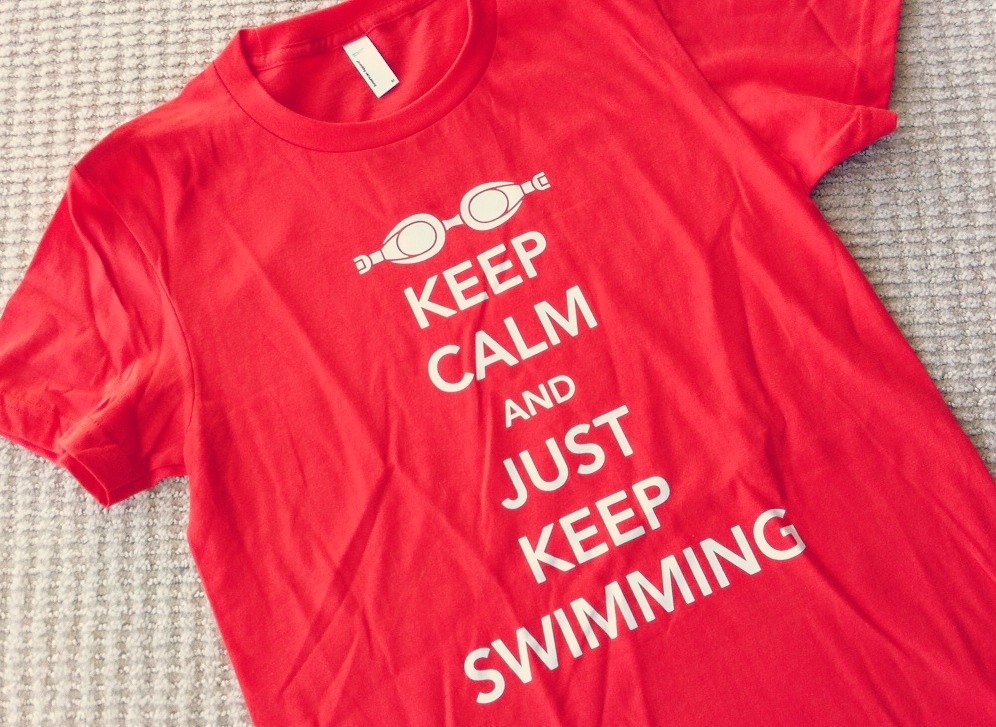
calm

Yup, my new mantra came via mail recently from one of my best friends who wanted to give me a boost (thank you, Marisa!). And little did she know, it led to my return to the pool last week.

I knew I needed to get back on the proverbial horse after my race went poorly, but I’d been feeling cautious, tentative and — honestly — a bit deflated with regards to the water.

So for the first time in a little over a month, I took the plunge. My body wasn’t feeling it. My mind wasn’t into it. So I tricked both by taking a different approach.

Instead of a workout, I went “naked” (sans tech devices) to just try to enjoy splashing around for 1500 yards. Right away I could tell I’ve lost some fitness, but about 1000 yards in, I started to feel a glimmer of that mojo I’ve been missing.

No, I’m not signing up for that bucket-list half ironman anytime soon (I’ve got a lot of work to do first), but it did get me thinking about staying present, finding enjoyment in the process and celebrating incremental victories instead of focusing solely on the pursuit of a singular goal.

So, in the meantime? Just like the shirt says, I’m going to keep calm, put one stroke, pedal and foot in front of the other…and embrace the journey.

How do you bounce back from a tough race or work out of a workout funk?