Pressed for time? Get fit in a flash with 10-Minute Trainer

TMT1

What you’ll get with the 10-Minute Trainer box set

No time to work out?

No excuse, according to 10-Minute Trainer program creator Tony Horton, who has single-handedly revolutionized the world of weight loss.

After successfully molding weekend warriors into athletes with his P90X series, Horton has turned his focus to people who simply want to get off the couch, get moving and establish a healthier routine.

“There’s a lot of this one-size-fits-all philosophy out there; you’ve got folks who have never exercised in their entire life maybe, and they’ve got 100 pounds to lose,” he said recently on the Dr. Oz Show. “You can’t ask them to do Bikram yoga and eat raw the very next day, so the idea here is, how do you stay focused, how do you create a plan, how do you stay accountable – and what is that plan, based on who you are as an individual.”

Horton’s solution was to take his popular, ultra-effective moves and condense them into bite-sized segments that can be done at home in the span of a few commercial breaks.

“I’ve turbo-charged the routines so your muscles become these fat-burning machines to get the best results in the shorted period of time,” he said. “You don’t need a gym, you don’t need fancy equipment. You just need to give me 10 minutes a day, and I will transform your life.”

10_minute_trainer

A sneak peek at Horton’s 10-Minute Trainer moves

But while the notion of getting more for less is always appealing, can you really revamp your body in just a few minutes a day?

“It really comes down to focus,” Horton assured. “You know, the 10 minutes are hard – it’s not an easy 10 minutes. We call it stacking – or muscle confusion; you’re doing several things at once, and that’s the reason why those 10 minutes work.”

But I’d argue that there’s another reason why those 10 minutes a day work: People will actually do them.

By removing the “lack of time” excuse by creating workouts in small segments that can be done at home, plus making exercises both fun and able to be adjusted for all experience levels, Horton achieves his goal of getting people up, moving and started on a routine.

Sure, it’s a little dialed down from Horton’s other programs, such as P90X2, but after trying the program myself, I still found it to be quite challenging. Horton has designed each move with a range of modifications to keep anyone, regardless fitness level, from resting on their laurels.

And on days where I wanted to up the intensity, I was able to stack a few segments together for a great full-body workout that had me sweating buckets and left me sore a few days later…which is always the mark of a great workout in my book!

TMT2

An example of a month-long schedule on the program, which alternates segments each day

Thanks to the folks at Beachbody for providing a copy for review; all opinions are my own. 

Up your endurance: Climbing interval treadmill workout

Get fitter, faster with this speedy interval workout, which I like to use when trying to pick up my overall pace.

It starts with a slow warm-up to get the blood flowing, then mixes short sprints (at a 7mph pace) with three-minute ‘climbing’ recovery segments (6.1-6.4mph) throughout the course of the workout.

Treadmill_climbing interval

Tweak this to suit your individual need for speed by adjusting the paces accordingly. Just make sure you start with an easy enough recovery pace and keep ‘climbing’ each time to gently challenge your body to recover at a faster pace.

As soon as this workout starts feeling too easy, push the sprint speed up slightly and/or adjust the recovery pace up. The first minute of recovery should feel tough, but then your energy should pick up over the next two minutes so you feel peppy enough to be able to tackle the next sprint segment.

Hills: Your not-so-secret trick to better running this year

Photo courtesy of WeDoRunRun.Blogspot.com

Photo courtesy of WeDoRunRun.Blogspot.com

There’s no denying that runners have a love/hate relationship with hills.

Most begrudgingly regard them as a necessary evil, others plot routes to avoid them altogether, and a small sliver actually step up to embrace the challenge.

I like to think of hills as the “vegetables” of a running regimen: They may not be the most appealing thing on the menu, but respecting and learning to love hills can make you a stronger, fitter and faster runner.

Yes, hills can hurt – both the body and the ego – but as much as they are a runner’s nemesis on the roads, they’re are also one of the ways in which runners can dramatically improve technique. But before you add them into your weekly runs, attacking them with abandon, think differently about approaching hills in order to see maximum results.

Start by following the lead of professional runners who deploy more efficient techniques for tacking hills:

  • First, rather than giving an all-out effort, try metering your exertion on the way up. The goal is not to expend all of your energy on the ascent
  • Next, fight your natural instinct to breathe that sigh of relief at the top and hold back on the descent in an attempt to recover. Instead, let the hill work for you on the downslope, and push yourself to keep pace
  • Finally, think about maintaining an even leg cadence on both sides of the hill, which will help you level out your effort. To accomplish this, you’ll have to vary speed and stride length (which, on the plus side, may just help distract you a bit from the pain).

Developing good form takes practice, so slowly add hills into your training routes and consider devoting one day each week for hill-specific drills.

In addition to evening our your exertion over the hills, be sure to maintain good posture and watch ahead for changes in terrain so you can adapt your speed and stride seamlessly. The last thing you want to do is to expend too much energy switching “gears” mid-hill.

Runners, got any more tips for mastering those mighty inclines? Feel free to share with us!

Top 10 exercises to torch calories in front of the TV

Don't be a couch potato - use the time during commercial breaks to fight flab

Don’t be a couch potato – use the time during commercial breaks to fight flab

Got a day where you’re glued to the tube? You’re not alone. American women spend, on average, more than five hours a day watching TV.

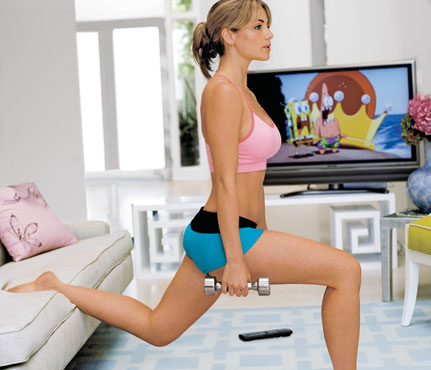
But you can use that time wisely by taking advantage of commercial breaks to fight flab. Try some of these calorie-blasting moves to work in a workout without having to stray too far from the couch:

  1. Sets of stairs – Channel those glory days and pretend you’re running bleachers at the stadium; race the kids, take steps two at a time, or even go backwards (but hold onto the rail!)
  2. Jog in place – Alternate “high knees” and “butt-kicks” (heels to your behind) and play with different patterns and speed intervals
  3. Jumping jacks – Traditional doesn’t have to be boring; start with 30 seconds in the standard stance, and then add in sets of “squat-jacks” (keep legs bent) for an added challenge
  4. Show off your chops – Unleash aggression by kicking, punching, jabbing and pummeling away with a series of martial arts-inspired moves
  5. Get hardcore – Pop a squat on the floor and alternate sets of these moves: Bicycle (cycle legs in the air), plank (push-up position on your elbows), superman (belly on the floor, arms and legs raised) and crunches
  6. Flex appeal – Grab the nearest weighted object (milk gallon, soup can, exercise band, small child) and alternate sets of bicep curls, chair dips, side/front shoulder raises and overhead shoulder presses
  7. Pump yourself up – You can’t go wrong with basic upper-body-building moves such as push-ups (alternate hand position), lawnmowers (add weight for more effect) and pull-ups (get a doorway bar or use the kids’ jungle gym!)
  8. Get down with it – Work your way to a better bottom half with calf raises (alternate where your toes point every set – out, forward and in), squats and lunges in place (ok, walking lunges to the fridge and back count, too)
  9. Dance-off – Challenge your friends to a competition where you see who can choreograph the best mid-commercial dance moves
  10. Stretch it out – Wrap up with this important, but oft-overlooked part of every regimen. Simple positions, held for 30-60 seconds each, help to ease sore, tense muscles and increase range of motion while enhancing circulation and coordination

Pregnancy & exercise: What you need to know about working out for two

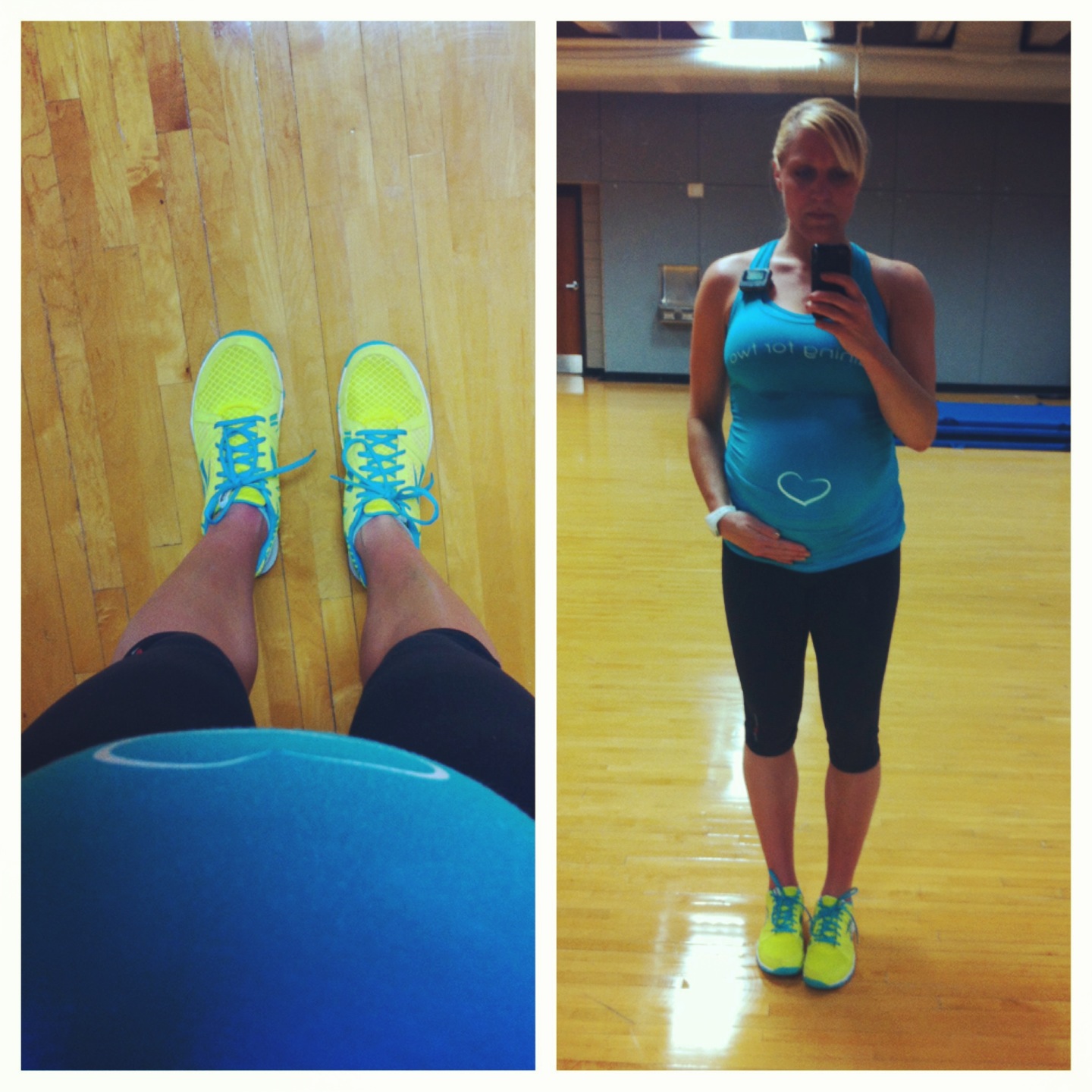
Jess shares a few shots on how she stays active during her pregnancy

Jess shares a few shots now that she’s working out for two!
Credit: Jess Allen/BlondePonytail.com

You can’t read a celebrity magazine nowadays without seeing some kind of commentary on pregnancy and weight gain, whether women are being criticized for being too thin or too heavy.

All this attention on the pregnant figure got me thinking about the changing attitudes toward exercise and pregnancy and how we still have a long way to go in debunking popular myths about staying active while expecting.

To learn more (the topic hits close to home; my sister gave birth March 18), I sat down with blogger Jess Allen of BlondePonytail.com, a personal trainer, group fitness instructor, adjunct exercise science instructor, CrossFit fanatic, coach’s wife and former Stanford softball player (whew!).

Allen is not only in the final few weeks of her pregnancy, but she’s also uniquely qualified to address some of the most common concerns when it comes to working out for two.

Kinetic Fix: How do you think the views toward exercise during pregnancy have changed over the years?

Jess Allen: Thankfully, our society has embraced fitness and pregnancy in recent years. No longer is pregnancy a sentence for sedentary lifestyle. We are seeing women stay active throughout their pregnancy continuing to run, strength train, CrossFit, with modifications, for the duration!

Why is it important for pregnant women to maintain their fitness routine?

While pregnancy isn’t the time to make gains or set PR’s, maintaining one’s strength will help support the impending weight gain that occurs. I think maintaining one’s fitness throughout pregnancy not only promotes an easier delivery (I sure hope this is the case with me!), but women can recover much faster postpartum by staying active.

Walk us through your own experience: Did you amp up your workouts in anticipation of pregnancy, or did you take a wait-and-see approach?

To be honest, this pregnancy was a bit of a surprise! However, I was in the best shape I’ve been in since college, and that has played a huge role in how great I have felt during this entire pregnancy. My energy level and strength have been consistent. As a result, my weight gain has been manageable, and I’m still teaching classes! However, with some workouts, like CrossFit, I have reduced my intensity and expectations.

What’s been the biggest benefit of working out while pregnant?

By practicing a “fit-pregnancy,” I have received many compliments from women telling me how empowering it is to see! That excites me! I want to continue to set a healthy, active example for my future daughter. Staying fit is simply a lifestyle.

Has anything surprised you about exercising with your “new” body?

My lack of mobility! Now that I have a growing belly, I simply don’t have room to bend and move like I used to!

What’s the biggest myth you’d like to dispel about fitness and pregnancy?

The prescribed heart rate (140 bpm) is merely a ball-park figure. Listen to your body. If you can talk and exercise, you are probably fine to keep going. Likewise, be realistic and forgiving; you won’t be able to push yourself like you did pre-pregnancy, so adjust expectations accordingly.

Any favorite exercises for expectant moms that you can share with us?

Even though the mid-section is growing in girth at this time, planks and the many plank variations, help pregnant women support a growing belly, strengthen upper body, and maintain a strong core. Additionally, I love kettle bell swings for a full-body strength move that gets your heart rate up!

Have you made any plans for getting back to your pre-pregnancy level of fitness once Baby Girl arrives this summer?

I have thought a lot about this already! I know I must be adaptable to a new schedule and routine with a baby, but my plan is to utilize the HIIT (high intensity interval training) home workouts I have created in the past and take advantage of my home “gym.” These workouts are efficient but VERY effective, so I don’t need to spend hours working out. Because it will be summer, I anticipate spending time outside, walking my dog and gradually incorporating running and CrossFit back into my routine. Additionally, I plan to breastfeed, so my food choices will revolve around healthy, nutrient-dense foods so my daughter and I both benefit!

Interested in learning more about exercise while expecting? Check out Jess’s blog, Blonde Ponytail, for great workout tips, training advice, nutrition information and more.

And stay tuned for my post-pregnancy interview with Jess…we’ll discuss her workout and weight-loss plans after Baby Girl Allen makes her debut in just a few short weeks! 

30-minute interval workout to beat treadmill boredom

treadmill-running

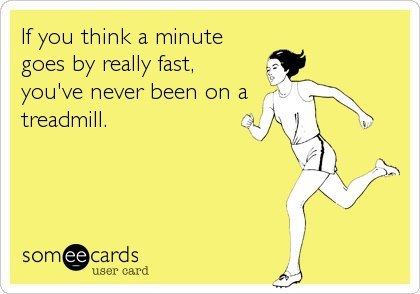
If you’re nodding your head at the cartoon above, I’ve got a great workout for you!

Below is my boredom-busting treadmill routine. It’s designed to distract, so over the course of 30 minutes, you’ll be constantly adjusting your speed. And as an added benefit, this interval approach aids in burning extra calories.

So crank up the tunes, get in the zone, and watch the minutes fly by…

30mintreadmillinterval

A few things to keep in mind:

  • Maintaining an incline of one percent throughout the workout can help prevent shinsplints
  • Listen to your body: If any pace feels too fast, modify to suit your fitness level
  • Calorie burn will vary based on a number of factors: Age, weight, intensity and efficiency, to name a few
  • Finally, be sure to check with your doctor before starting any new exercise program!

“Get me across the finish line” half marathon training plan

Note: I had drafted this post before the tragedy at the Boston Marathon, but held off running it because it just didn’t feel right making light of crossing a finish line when so many didn’t get the chance this past Monday. But now that the second bomber has been captured and is in custody, it’s time for the healing to begin. So let’s run…for Boston. 

A friend of mine just signed up for a half marathon this fall. The best part? It’s her first post-baby 13.1-miler, and she’s doing it along with her sister, who will be tackling the distance for the first time. You go, gals!

My own sister has also been a willing guinea pig participant in both the Rock n’ Roll Chicago and the Detroit Free Press International half marathons with me, so I thought I’d share our favorite training plan below.

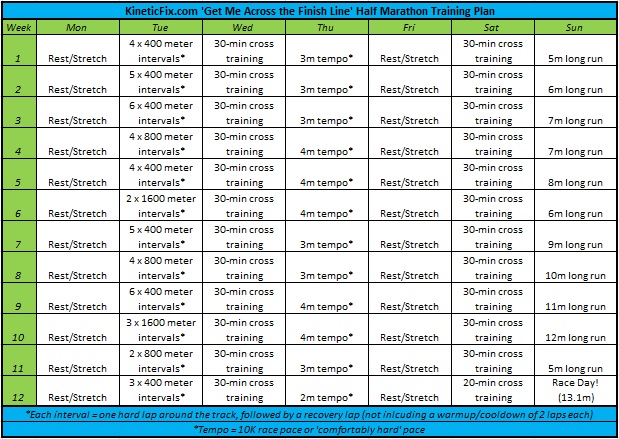
It’s loosely based on Hal Higdon’s training program, but I tweaked it a tad for our individual schedules and fitness levels – i.e. sometimes I’ll take an extra rest day or swap a cross training session (elliptical, bike, rower, stair stepper) in for one of the mid-week runs to help aid in recovery and prevent injury.

Check it out, and let me know what you think (and if you use it for a race, I’d love to hear your results)!

FinishLineHalfMarathonPlan

Running by the numbers: What’s your treadmill pace?

For someone who is admittedly not much of a math person (apologies to my engineer father), I can get pretty nerdy about numbers when it comes to running.

Ask me to do much more than tally a restaurant tip, and I’ll most likely feign a hearing problem. But start a conversation about stats such as personal records and pacing, and I’m a bonafide mathlete!

I love playing with pacing as a way to motivate myself during workouts, especially on the treadmill: Can I run negative splits, doing each mile just a bit faster that the last? What’s my average pace, and will I be able to decrease it over time? How far can I run in 30 minutes? How quickly can I run a 5K?

But while trying to convert the treadmill’s miles-per-hour readout to my pace per mile can help kill some time, sometimes you just want to focus on the task at hand, so here’s a handy conversion chart. Check it out if you’re curious about how fast you’re going, both per mile and per hour.

TreadmillConversionChart

Note: Treadmills are notoriously inaccurate, especially if you don’t calibrate it with your personal information, so expect a small margin of error when it comes to exact speed, distance and amount of calories burned.