Each year, Earth Day — April 22 — marks the anniversary of what many consider the birth of the modern environmental movement in 1970.
Not only is it the largest civic event in the world, celebrated around the globe by a billion people of all backgrounds, faiths and nationalities, but Earth Day is also an opportunity to spend some time outside, celebrating the great outdoors.
It’s also why I’m challenging you to do two things today in honor of Mother Earth:
Get off your computer/phone/iPad and do something nice for the environment, whether that’s picking up trash, teaching your child about Earth Day, taking your recycling in, planting a garden, installing solar panels on your roof or sending a letter to your elected representatives.
Get off your butt, and do something outside to celebrate! Of course, my suggestion is exercise-related, which is why I created the body-weight workout below to be completed in your local park. So why not grab the family, talk about the importance of ecology and break a sweat together?
True enough, especially if you’re a runner. And if that’s the case, there’s a good chance you know this all too well, having likely discussed it extensively with a handful of close runner friends.
The Diarrhea Dilemma
While we like to think our workouts are accompanied solely by philosophical conversations, some inevitably spiral into war stories about bodily functions. But as prevalent as these intestinal issues (aka “Runner’s Trots“) may be, it’s a topic that’s not addressed in all circles.
So what’s a trot-troubled runner to do?
Well, first, realize that you’re not alone — more than half of us have experienced exercise-related GI disturbances. And, second, there’s a lot you can do to prevent (best-case) and handle (worst-case) it. But it also helps to understand exactly what’s happening so you can make an informed plan of attack.
Desperately Seeking…A Restroom
According to the Gatorade Sports Science Institute, “there are three main causes of GI symptoms: physiological (reduced blood flow to the gut), mechanical (bouncing effect of running, for example) or nutritional.”
As you exercise, the body diverts blood flow away from internal organs to support working muscles and cool the surface of your skin. Combine that with intestinal “jostling” and heavy/fatty/fiber-filled/sugary foods, and you’ve quite literally got a ticking time bomb in your gut.
Avoiding The Runs on Your Runs
Don’t want to make “that” emergency call during a long training run or veer off-course for a mid-race porta-potty pit stop? The former used to happen to me frequently, and the latter got me at mile 16 of the 2002 Chicago Marathon…sans TP; ’nuff said.
Here are my eight tried-and-true tips for taming those tummy troubles for good.
1. Develop a pre-run routine. Develop a system (mine’s coffee) to “get things moving” before you head out the door, and you’ll drastically decrease your chances of a mid-run meltdown.
2. Hydrate before, during and after. Dehydration compounds stress on the GI tract, so be kind to your colon and it may just return the favor.
3. Avoid common triggers. Things like NSAIDs, ibuprofen, sugar and fiber are known to irritate or stimulate your intestines, so refrain from ingesting ’em in advance of workouts.
4. Track your habits. Keeping tabs on what you ate and how it affected you during a run can be quite revealing! I know that quinoa, for example, leaves me doubled over…while I can eat potential triggers like dairy, beans, dried fruits, etc. with no issue.
5. Experiment with fuel type. Again, what works for a runner and his/her digestive system can vary from person to person, so take the time during training to see what agrees with you — and what doesn’t.
6. Play with fuel timing. Some people start jogging while chewing their last bite of breakfast, while I prefer to give myself a few minutes to digest before heading out the door. It may take some trial and error to find your rhythm, but it’s well worth the time.
7. Slowly increase intensity. Going too fast or too far too soon can result in GI backlash. Allow your body to acclimate to the stress of speed workouts and long runs by easing in with a warm-up and building a foundation before going all-out.
8. Whip your gut into shape.I consider probiotics my secret weapon for not just gut balance, but also overall health. After experiencing success with them over the past few years (i.e. long runs that bring joy instead of fear), I’ve been taking Sound Probiotics, which came highly recommended from my Coeur pal, Erin, who’s also an accomplished Iron(wo)man.
A little PSA: Sound’s the first probiotic engineered for the competitive athlete.
Why’s this important?
Well, during training you’re more susceptible to illness and fatigue due to the sheer amount and intensity of exercise. And since as much as 80 percent of your immunity resides in your digestive tract, I consider these little pills my insurance policy for optimizing training and recovery.
After an initial adjustment period (very mild bloating), I’ve been thrilled with the results. Not only have I been able to up my mileage without incident, but I’ve also managed to avoid all the nasty bugs circulating this season — which is especially impressive considering my daily ClassPass studio-hopping habit.
That’s a small investment for exponential results. Need more incentive? Use code KINETICFIX for 10% off if you want to try ’em yourself.
If all else fails, though, consider stashing some toilet paper and a few wet wipes in your run belt for peace of mind. Plotting routes with public restrooms also helps, but if you’re concerned it might be something more serious, consult with your doctor to check for underlying health issues.
And whatever you do, don’t underestimate the effect that soothing your gut can have your overall experience, let alone performance, during training and racing. After all, as marathon legend Bill Rogers once famously said, “More marathons are won or lost in the portable toilets than at the dinner table.”
Ring the bell; ClassPass is in session and schooling us on the art of discovering the best boutique fitness classes in 30+ cities worldwide!
What is it?
For $79 – $99 a month (price varies by city), ClassPass’s monthly membership program will give you access to thousands of classes, including cycling, Pilates, yoga, strength training, dance, martial arts and more. Members can take up to 30 classes per month and can visit the same studio up to three times per monthly membership cycle.
Do the math; when we’re talking drop-ins that cost anywhere from $15-25 a pop, as well as memberships that run upwards of hundreds of dollars per month, it’s easy to see why ClassPass has taken the fitness market by storm.
Why Portland?
As much as we like to pretend it’s not happening, the city is booming in just about every facet. And with a studio scene that rivals cities twice its size, Portland — aka America’s Fittest City — is a prime spot for ClassPass to set up shop.
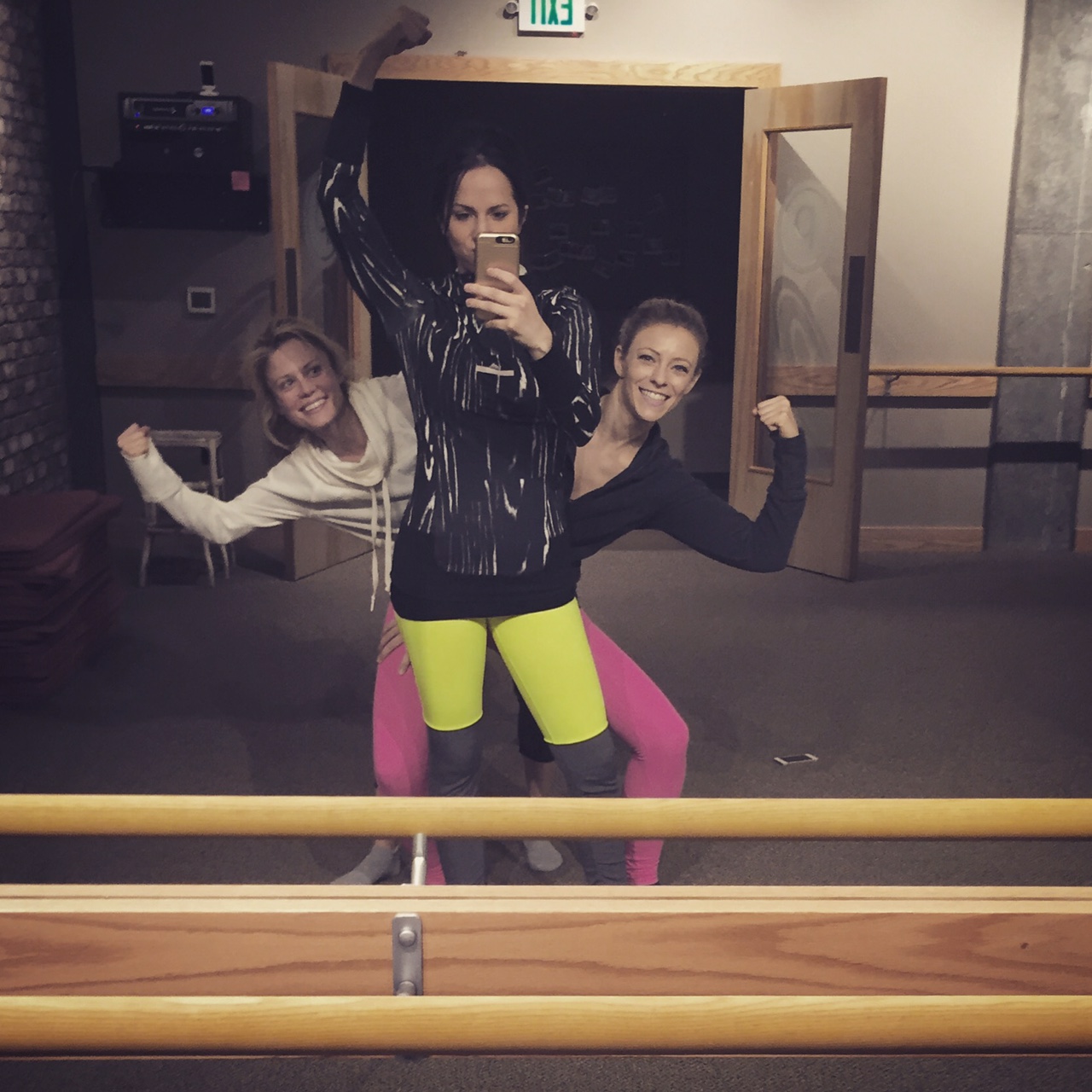
Although I’ve officially been here since last August, I feel as though I’ve barely been able to scratch the surface of what’s available for us fit-minded folks. So when ClassPass asked me to check out their service and give my thoughts, I recruited my workout buddy Carolyn and we embarked on a #30ClassesIn30Days personal challenge.
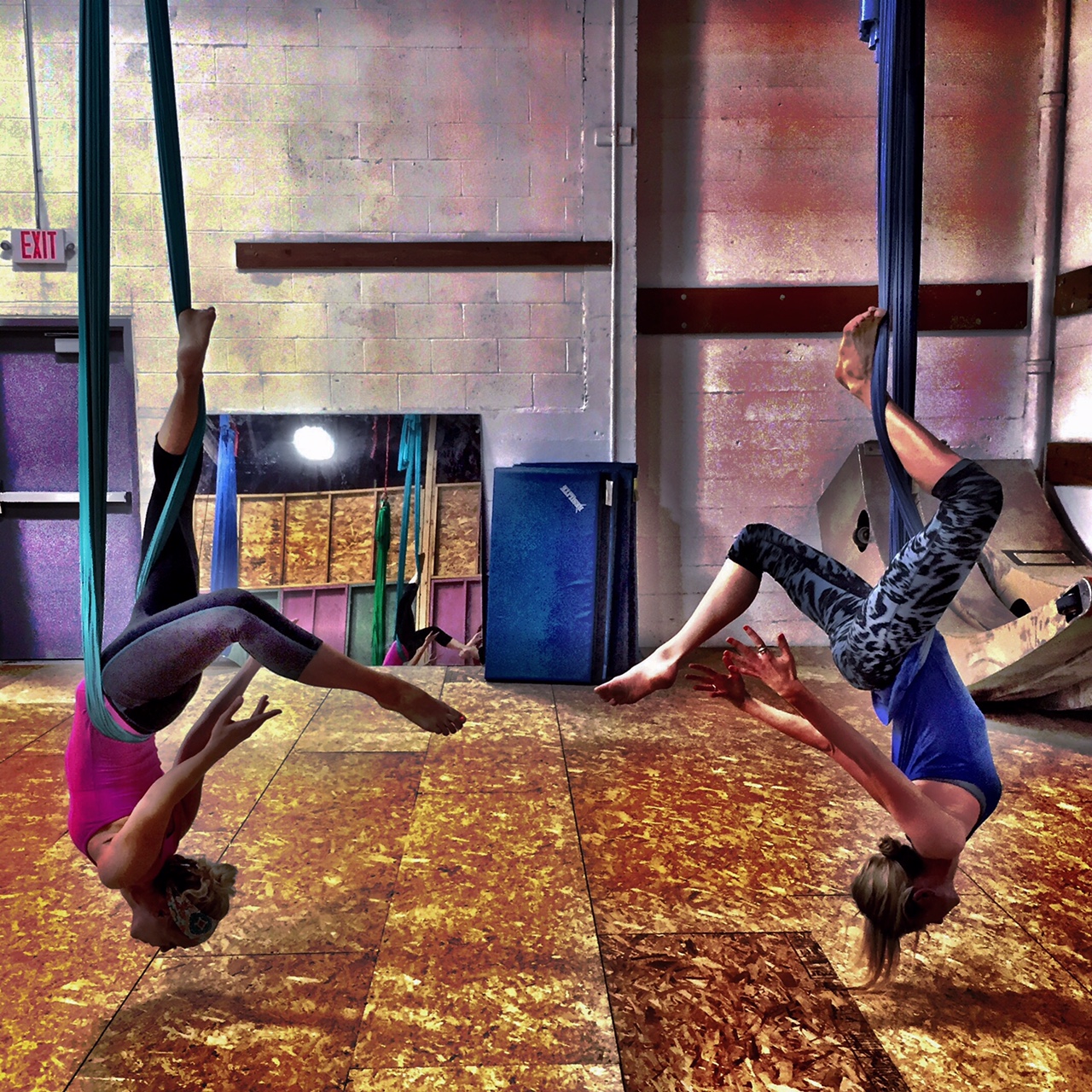
Like kids in a candy store, we explored the entire workout spectrum of Stumptown. From unleashing while kickboxing to finding release through meditation, from swinging kettlebells to swinging through the air in aerial yoga — you name it, we’ve tried it. And had a blast in the process.
Where’d we go?
Read on for a sampling of all the spots that Carolyn and I were able to hit during our first month using ClassPass.
Our goal this next month is to keep branching out; not only is the variety a breath of fresh air, but it’s fantastic to be able to connect with — and support — some of Portland’s sweatiest hardest-working small business owners!
9Round: Get an efficient, yet effective, full-body kickboxing workout in just 30 minutes
a-wol Dance Collective: Fly through the air with the greatest of ease in aerial dance classes
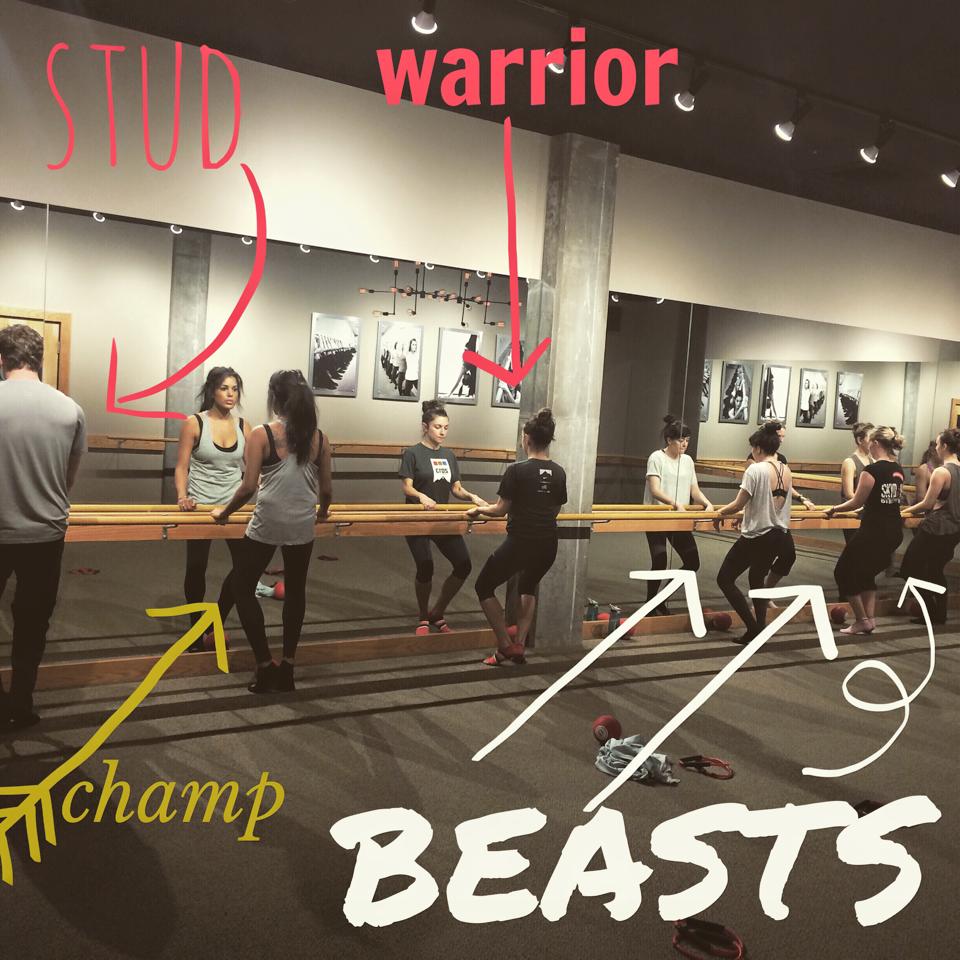
The Bar Method: Reshape your booty body in an hour in an upbeat, barre-based class
From the consumer perspective, I’ve found it to be an excellent discovery tool — not only for studios I’d never heard of, but also for workouts I may not otherwise have tried. Plus, if you’re like me and like to keep your body confused with all kinds of crazy cross-training without completely emptying your wallet, it can be the best of both worlds.
Wanna check it out?
Here’s a list of the cities in which ClassPass is currently available (if you’re not on it, don’t fret — they’re adding more all the time).
And if you’re ready to take the ClassPass plunge, I can sweeten the deal — simply use this link (good for ANY location but expires tomorrow, 3/24) to sign up and get $25 off your first month!
What’s your take on the “boutique fitness membership” movement?
Last month I had a flight that got cancelled and pushed out a day due to all the storms on the East Coast. The upside was that there are worse places to be stuck than in Florida…but the downside was that I would be missing a favorite workout class that I had signed up for in Portland to keep myself motivated and productive after a half day of travel.
But rather than let it derail my fitness routine (or keep me in a gym when I’d rather be catching some final rays of sun), I created a quick 20-minute body-weight workout that could be done in the comfort of my hotel room. It’s the best of both worlds — a mix of cardio and strength that comes in an efficient, yet effective, package.
The workout consists of four rounds, with four exercises in each round. The first exercise in each round is always a cardio move, followed by moves that target the upper body, lower body and core in the second, third and fourth exercises, respectively.
Allow yourself a minute or two to recover between rounds, and you’ve got yourself a great way to get a full-body workout in before you hit a full day or meetings (or an afternoon at the beach)!
Who knew you could sculpt a strong, lean physique by barely moving a muscle?
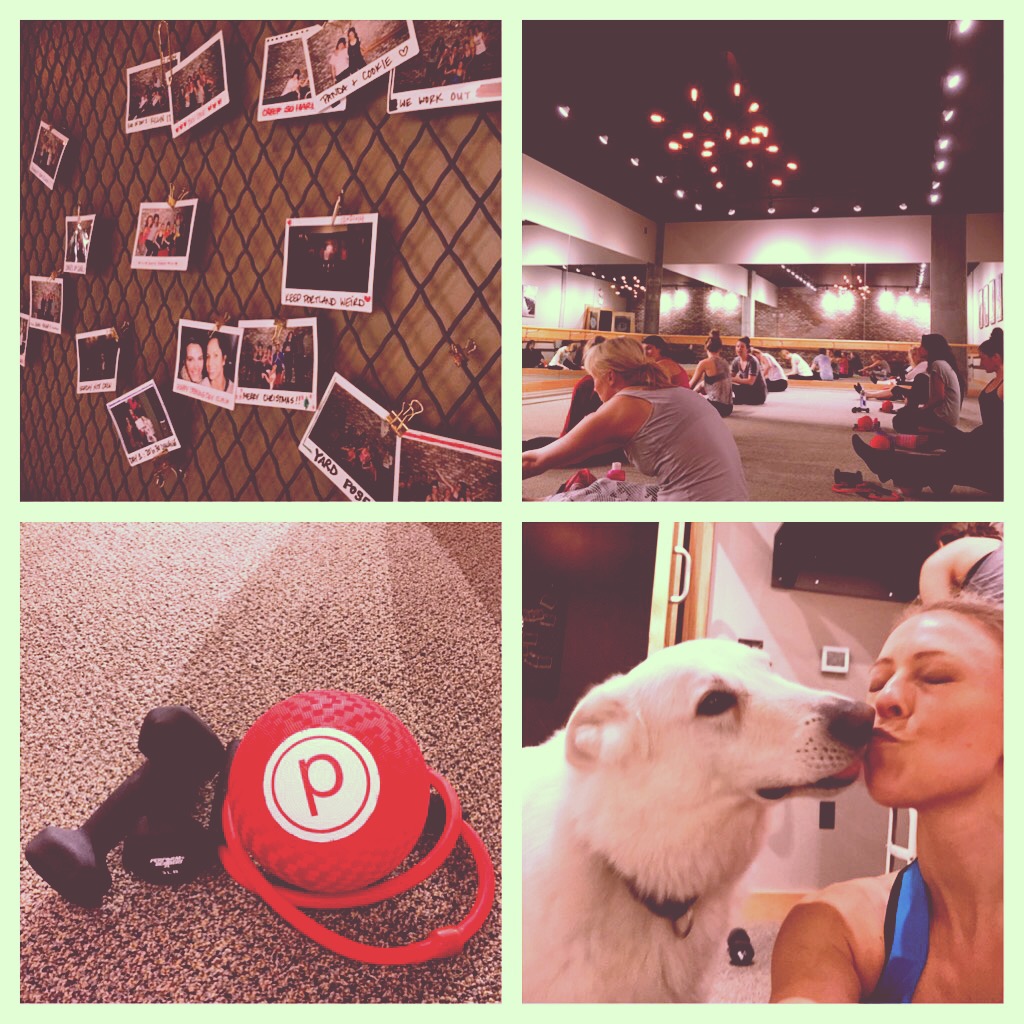
Well, you can; it comes in the form of PureBarre, a total-body workout that fuses together elements of ballet, Pilates, yoga and pure shake-inducing wonderfulness into one 55-minute session.
Founded by dancer, choreographer and fitness guru Carrie Rezabek Dorr, it’s actually the largest, most established barre franchise in the nation, with more than 200 studios across the country, and more opening every month. Who knew?!
Now, I’ve got to admit when I first caught wind that a new barre studio would be opening in the Pearl District this winter, I remember thinking that Portland needed another barre studio like we need more fixed gear bikes, waxed mustaches and Mason jars.
But soon thereafter I was introduced to Ally Coucke, owner of Pure Barre Portland – Pearl District, who assured me that her studio’s method emphasizes more “athletic” movements — so much so that pro footballers, such as Brent Celek of the Philadelphia Eagles, take classes in their-off season to help hone their strength.
My ears perked up at that. Ok, I’ll keep an open mind (a.k.a. if it can make me a stronger runner and help lift, tone and tighten, it’s worth a shot).
Sure enough, Coucke was true to her word — my skepticism has been turned into fanaticism after just a few classes with the lovely ladies at this studio.
You see, PureBarre utilizes the ballet barre to perform a series of small, isometric movements that are focused on lifting your seat, toning your thighs, abs and arms — basically, all those trouble spots in need of targeting.
After starting with a brief warm-up, which utilizes some light weights for arm work, the structure of each workout is the same although the the exercises vary from class to class: thigh work, seat work and core work followed by a glute sequence (my favorite!) and some final stretches during the cool-down.
And while we all know there’s no such thing as isolated spot-toning, when combined with a healthy diet and exercise regimen, PureBarre has been met with consistently rave reviews when it comes to sculpting muscles, improving posture and creating an overall leaner look.
I can vouch for this myself — after just a few weeks of classes, I’ve certainly felt a difference in the way I feel and how I carry myself. But I’ve also noticed that my hips, thighs and butt are also, ahem, carrying themselves a bit differently, too.
But that’s just the tip of the iceberg when it comes to some of the other benefits you can experience when bellying up to the barre:
Since the technique is low-impact, your joints are protected by avoiding any bouncing or jumping
Each strength section is followed by a stretching section in order to create long, lean muscles without bulk
The concentration needed gives mental benefits similar to those obtained by the practice of yoga or meditation
All classes are the same level, as the technique was designed to work for people at all levels of fitness
Instructors keep things fresh and exciting by adding new moves and constantly changing music
And did I mention just how great the instructors are?!
Credit: PureBarre Pearl District
Having people at the helm of a studio who are warm, approachable, knowledgeable and who don’t take themselves too seriously has created a strong sense of community and makes PureBarre a safe haven for those in search of a supportive, effective, fun workout experience.
Coucke also knocked it out of the park when designing her space; from the custom-made front desk, bench and storage cubbies made of reclaimed wood to the vintage lighting and decor in the hallways to the Edison-inspired chandelier in the classroom, it’s something you’ve got to see for yourself to fully appreciate.
Transform your body, balance your mind — and challenge whatever you thought you knew about barre in the process.
Single classes are $25 a pop, but new students can sign up for a month of unlimited classes for only $99. PureBarre also offers multi-class packages and specials for brides and new moms, which you can view here.
For more information on the technique or to find a location near you, visit PureBarre.com.
I’ll let you in on a little secret: Ab exercises are my fitness kryptonite. As much as I love working out, I go deer-in-headlights at mere mention of the word “sit-up.”
But skipping out on my midsection isn’t an option; core strength is critical — not just for support and stability but, let’s face it, also fitting into this season’s skinny jeans.
My solution? Sneak in core strength training through a series of compound exercises (working several muscles groups at a time), rather than isolation exercises (working one muscle group), thus avoiding a mid-gym meltdown.
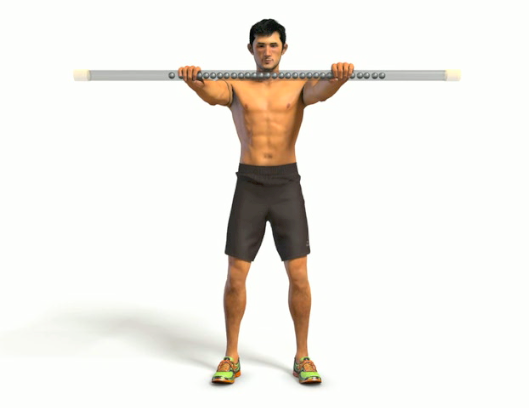
Enlisting the help of some innovative new equipment helps, too: Enter the ActivMotion Bar, which I’ve been experimenting with recently thanks to the folks at Fit Approach. It’s a weighted bar filled with rolling steel weights, which creates instability through a fluid-like motion to better challenge your body during some of your typical workout moves.
Got 10 minutes? Try this bar-based core series — perform each of the five exercises below for one minute each, and then repeat the entire circuit.
Use a broomstick in a pinch, a weighted bar at the gym, or invest in an ActivMotion Bar if you want to kick things up a notch for at-home workouts.
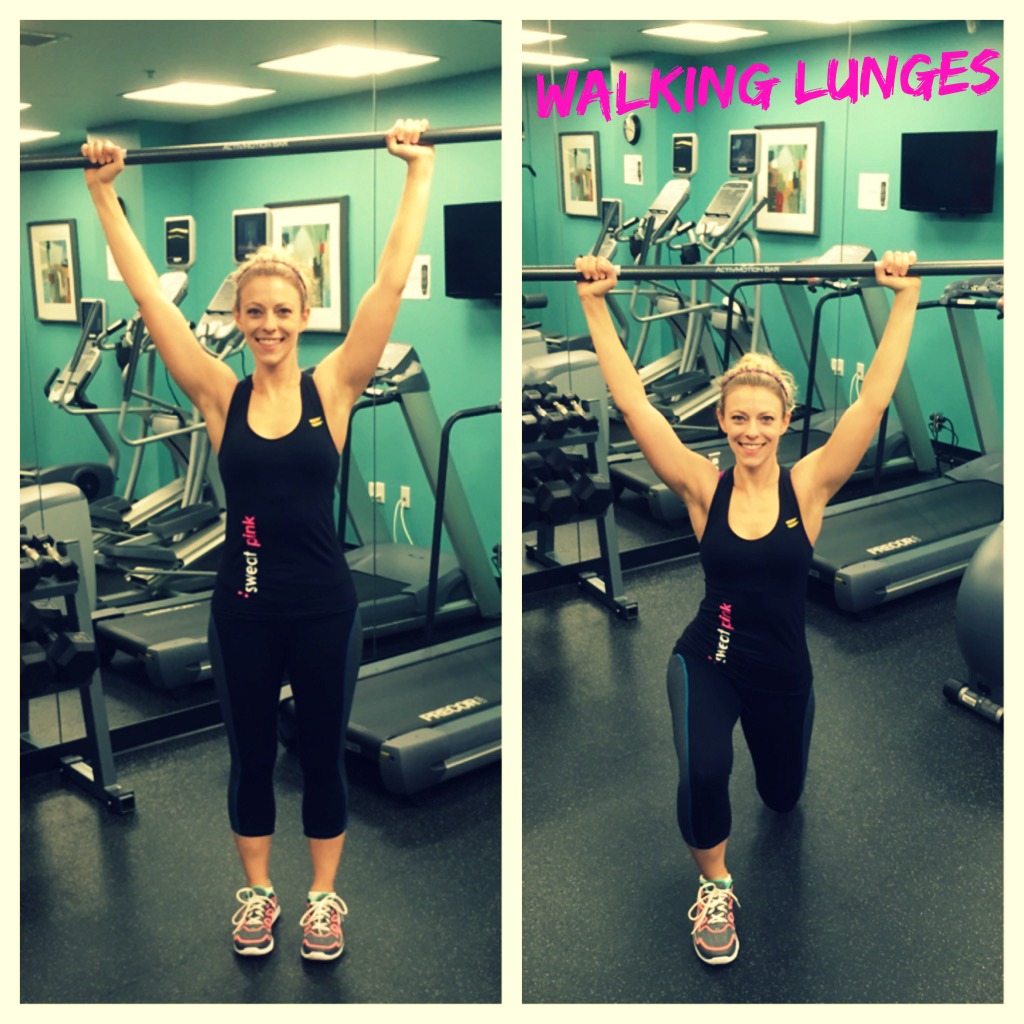
1. Walking Lunges
Stand tall with head and feet facing forward and core engaged. Raise bar straight above head, straightening arms but keeping shoulders down. Keeping abs and butt tight to stabilize yourself, slowly step out with right foot into a lunge.
Make sure your knee doesn’t go beyond your toes, and try to keep both legs at 90-degree angles. Pressing into your front heel, lift up to a standing position; alternate sides across the room for 60 seconds.
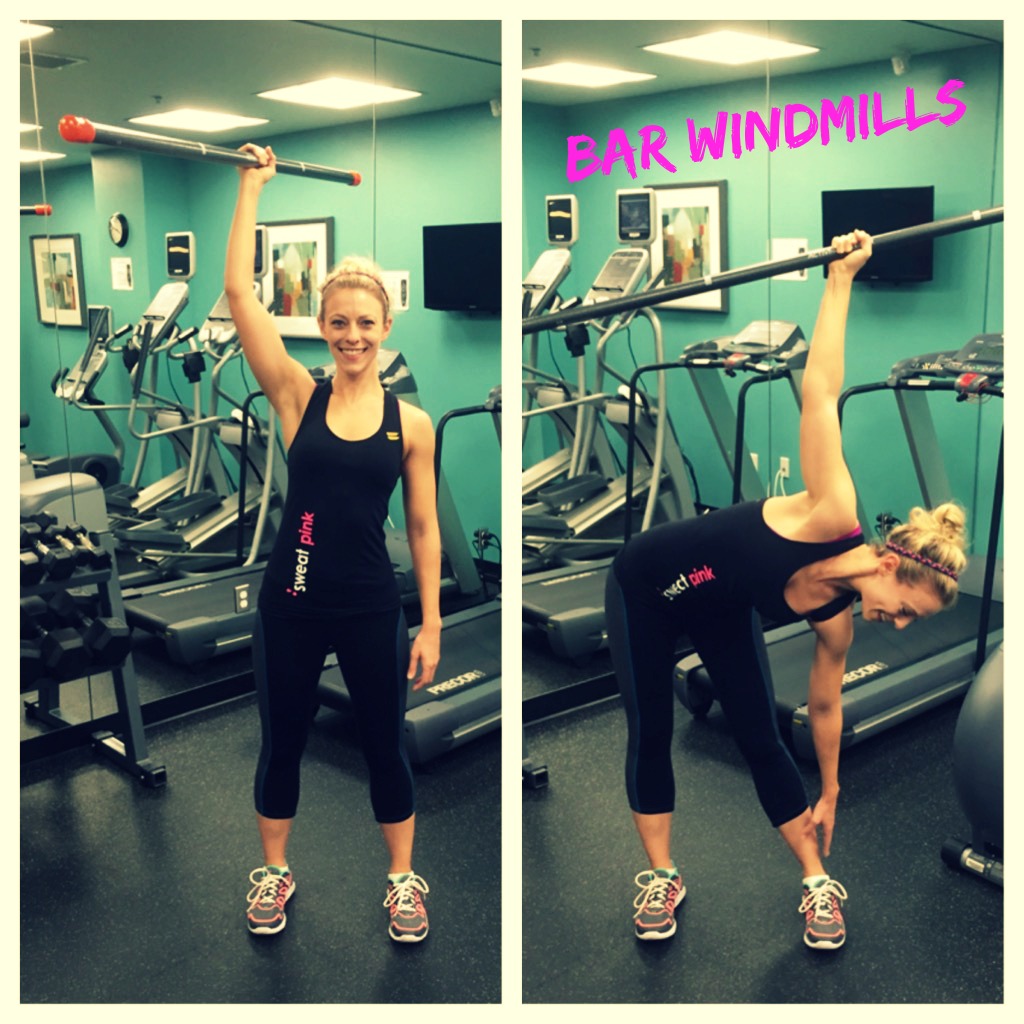
2. Bar Windmills
Again, start by standing tall with head and feet facing forward and core engaged. Press bar up with right hand, taking care to keep shoulder down and core engaged. Slowly bend to the left side, reaching for your left foot while keeping right arm directly above your right shoulder.
Pause for a beat before rising carefully back to a standing position. Repeat pattern for 30 seconds before switching sides and raising your left arm while bending to the right.
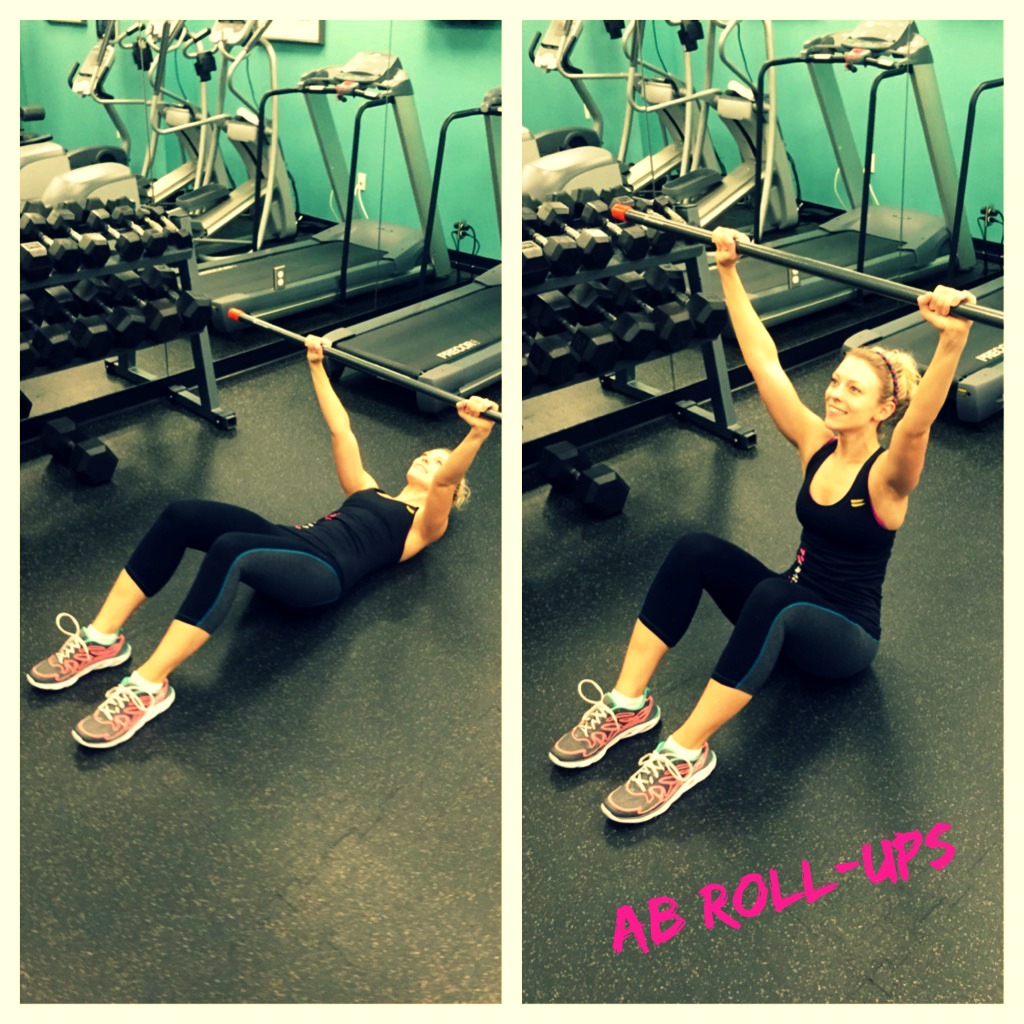
3. Ab Roll-Ups
Lie on the floor with our feet shoulder-width apart, soles of your feet touching the ground, knees bent and core engaged (think about pulling your belly button through your spine and down to the floor). Using both hands, raise the bar above your shoulders — try to keep some softness in your elbow so you don’t lock out the joint.
Slowly roll up, one vertebrae at a time, keeping bar lifted toward the ceiling and core engaged. Once you’re sitting up, slowly lower back down through each vertebrae, keeping bar raised. Repeat for 60 seconds.
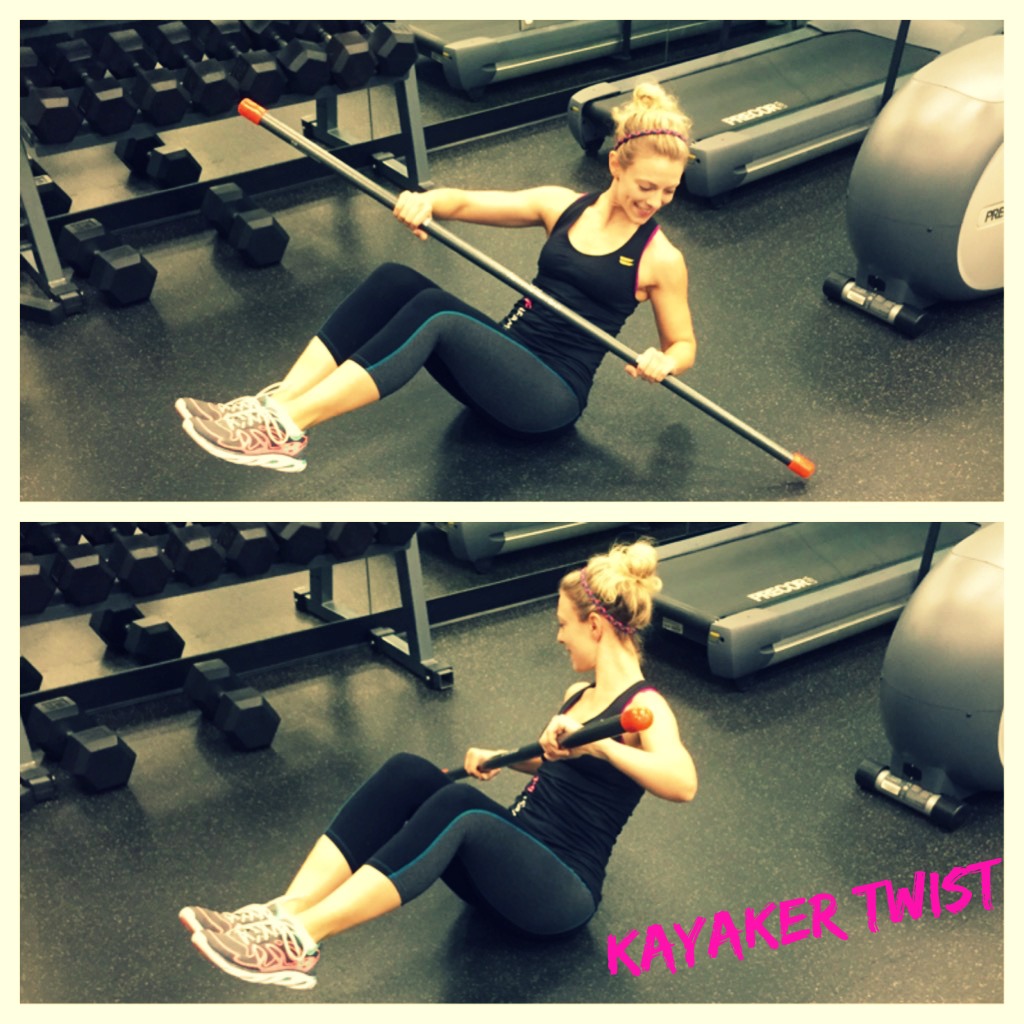
4. Kayaker Twist
Sitting on the floor with your feet out in front of you and your knees bent, lift feet a few inches off of the floor (option to modify: keep feet on floor). Lean back slightly, but be sure to use core to keep spine straight — no hunching forward or arching your back.
Hold bar in both hands, and with a steady rowing motion, slowly turn to left side and dip the bar toward the ground. Lift back up and through center before twisting to the right and letting bar dip down on that side. Alternating sides, repeat for 60 seconds.
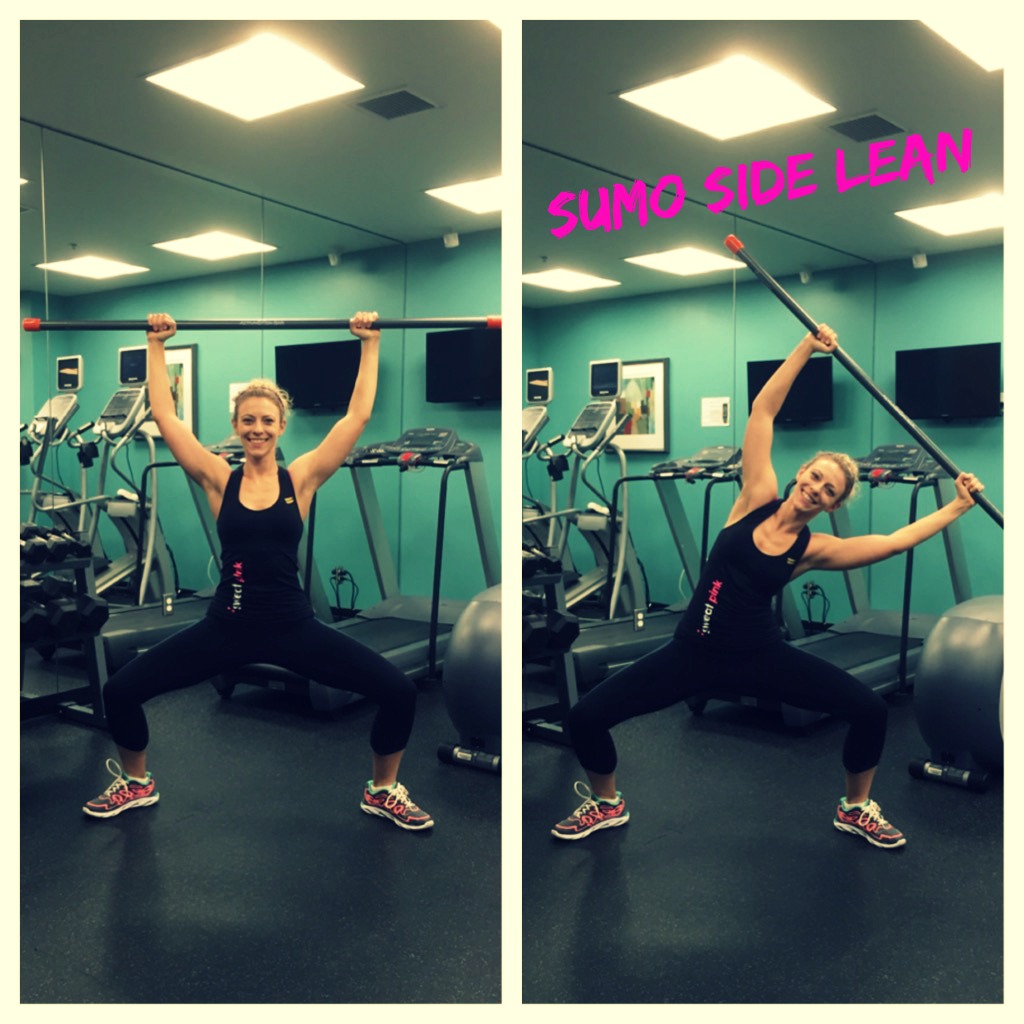
5. Sumo Side Lean
Take a wide stance with feet slightly turned out. Raise bar straight above head with both hands, taking care to keep shoulders down and back straight. Lower into a sumo squat, checking to make sure that knees are in line with ankles and don’t extend beyond toes.
Slowly lean to left side without twisting; your body should remain in one plane when viewed from the side. Return to starting position and, keeping bar above head, lower to the right side. Repeat, alternating sides, for 60 seconds.
For more information on this product, check out ActivMotion Bar’s website here.
Disclaimer: You’re doing these exercises at your own risk, so please be careful. If you’ve got an injury or concern, it’s best to consult with your health care provider and/or trainer to make sure you’re cleared to work out and are using proper form.
The next stop on my tour of Portland’s fitness hot spots? Barre3, a fusion workout in which ballet barre meets yoga and pilates.
For someone with a background of being in toe shoes and tutus for almost a decade and a half while growing up, this should be a piece of cake…right?!
Nope; quite the contrary, as I quickly found out…
Barre3 evolves the dancer’s workout by combining “the grace of the ballet barre with the wisdom of yoga and the strength of Pilates” to deliver a total-body workout designed to burn fat, build muscle and transform the body.
The goal is to promote balance, strength and flexibility equally through a signature three-step sequence of:
1. Isometric holds to work muscles to their deepest points for strength and endurance.
2. Controlled movements to heat the body, increase core strength and rev metabolism.
3. Dynamic moves to flush muscles, lift heart rate, improve circulation and re-energize.
Basically, this means that you’ll be performing a sequence of postures set to an upbeat soundtrack at a fairly vigorous pace.
After a quick warm-up in the middle of the room, we took our places at the barre for two segments of deceivingly-difficult moves (leg lifts, holds and pulses). The final segment was a series of seated exercises on the mat that left my core crying, “Uncle!”
Never have I moved so little yet had all of my muscles shake so much, but it’s a good sign because it means that they’re being put under a new kind of stress that they aren’t used to (i.e. they’re getting stronger!).
Barre3 is also low impact, so it’s especially handy if you’re injured or easing back into an exercise program. Our class had people of all ages and ability levels, yet we struggled just the same since moves can be modified different ways. And, yes, it got my sleepy glutes firing.
What I really love about this workout, though, is that it’s super functional: Barre3’s goal is to teach alignment principles that apply to everything from sports performance to holding kids to sitting at a computer.
Although you’ll feel the effects during workouts, it’s much more about being able to bring a more balanced body to what you’re doing the rest of the day!
Want to get your barre on? Visit Barre3’s website here for more information.
Bring your workouts closer to home for 2015 — meaning, in it. No matter how small your space or budget, it’s easier than you think to build an effective gym without breaking the bank.
Here are five ways to become a healthier homebody — and for shrinking your waistline, not your wallet — in the New Year:
1. Go weightless.
These aren’t your father’s push-ups and sit-ups; today’s body weight exercises are high-performance maneuvers designed for building and maintaining muscle strength and endurance, along with interval training. Don’t believe me? Check out this video and tell me that’s not an intense workout!
2. Think DIY.
Function often trumps form when it comes to gym gear, so before you buy it, try making it on the cheap. Use hot water bottle bladders under your feet in place of a pricey Bosu balance trainer, tap into your woodworking skills to build your own plyo boxes, and make medicine balls from old basketballs and some sand, for example.
3. Buy secondhand.
Wait a few more weeks, and plenty of New Year’s resolutionists will be hawking their (barely used) exercise equipment on Craigslist. But don’t stop there: Visit stores such as Play It Again Sports to snag a deal on pre-owned gear, scout your local gym for used equipment sales after yearly upgrades or ask for discounts on floor models at retailers.
4. Press play.
There’s an app for that — or a video game, a gadget, a DVD, etc. Whether it’s tracking activity with a Runtastic Orbit, turning your smartphone into you own personal trainer with Nike Training Club or popping in a video from home-fitness giant Beachbody, harness technology to keep you healthy and active throughout the day, not just in the confines of a gym.
5. Embrace co-op.
Finally, if your motivation comes in the form of group fitness, consider creating a co-op gym space with relatives, friends or neighbors. Split the cost of equipment (either by machine or overall, depending on how your crew wants to divvy it up), and store everything at one home where everyone can congregate for workouts.
Have you fallen prey to the “Grinch Who Stole Fitness” this season? Well, the good news is that there’s still time to turn things around before 2015.
If your goal is to celebrate without completely abandoning your regimen, I’ve got six simple strategies for staying on track so you won’t have to dig yourself out of a hole come January 1st:
1. Get the worm.
Figuratively, that is. Being at the mercy of friends’ and family’s schedules isn’t always conducive to regular workouts, so force yourself to develop a healthy morning routine. Prioritize exercise, and not only will you be more likely to get it done, but you’ll also reap the benefits of extra energy throughout the day.
2. “Run” your errands.
Or walk them. Or park farther away. Or take the stairs. Or lap the mall. However you do it, the idea is the same: Incorporate some additional activity into your to-do list to kill two birds with one stone.
3. Ditch the all-or-nothing attitude.
I used to think I needed an entire hour in order for a workout to count, but that led to too many skipped sessions during the holiday time crunch. So now I take a different approach: Commit to just 10 minutes of cardio or one mile on the treadmill, and then reassess. If you’re still not feeling it, then stop, but there’s a good chance you’ll keep going once you get some momentum.
4. Make it a family affair.
There’s no need to sequester yourself in order to break a sweat; instead, make a new tradition of embracing the great outdoors together. Whether it’s ice skating, snow shoveling, sledding or a snowball fight, the whole family can get in on the action. And give each other the gift of a healthy habit in the process.
5. Embrace bribery.
Sometimes I’ll end my long run at the coffee shop or inspire myself to hit the gym by testing a new piece of gear. The trick is to find out what motivates you, and use that in your favor. Numbers-driven? Try hitting a daily pedometer goal. Competitive? Challenge a friend to a 30-day fitness routine. Bored? Commit to trying something new each day between now and the New Year.
6. Book a race.
If you’re a regular reader here, this last one shouldn’t come as a surprise to you…because it’s my solution to almost everything. Not only can a holiday-themed race help keep you on your toes, cardio-wise, this time of year, but there’s also no better way to kick off the New Year than with a January race.
And when all else fails, there’s always another of my favorite holiday workouts…
In light of this week’s announcement from Coeur Sports — I’m thrilled to be a part of the team again in 2015! — and in honor of our “heart & courage” rallying cry, I figured it’d be an opportune time to talk about something I’ve shied away from until only very recently: heart rate training.
Why? As much as I love to quantify my fitness, somewhere between doing the heart rate zone math, finding the correct workouts to hit my zones and then licking attaching the device and syncing up to whatever software is needed, I inevitably drop the ball. Let’s face it, adding another element of discipline can be tough when the alternative is to just lace up and head out the door.
But the wiser older I get, the more I’ve realized that there are some terrific benefits to taking heart rate into account when training. Here are a few of the reasons why I’m starting to incorporate it into more of my workouts:
1. Train smarter. There’s a good chance that, like me, you tend to overdo your easy days and don’t push quite hard enough when it is needed.
2. Change focus. If you’re in an exercise rut, it’s fun to add a gaming element with heart rate workouts by setting some specific, measurable goals.
3. Recover effectively. Are you sure you’re not undercutting recovery days? Heart rate monitors can be incredibly helpful in helping you rein things in.
4. Stay healthy. Over-training and improper pacing can knock you off your A game, leaving you susceptible to both overuse and acute injuries.
5. Get better. Whether you’re looking to raise your level of fitness, stick to a program or race faster, fine tuning your workouts by heart rate can help.
Ok, you’re probably thinking, that’s great, but how do I get started? Well, here’s a four-step cheat-sheet that simplifies the process:
First, determine your maximum heart rate, which can be done with a reasonable amount of accuracy by subtracting your age from the number 220 (for men) or from 226 (for women). There are a number of other equations that can be used, but that one’s a good rule of thumb.
Second, establish your resting heart rate, which should be done first thing in the morning with your feet still between the sheets. Find your pulse, count the number of beats that occur in 10 seconds, and multiply that number by six to find your rough count for beats-per-minute.
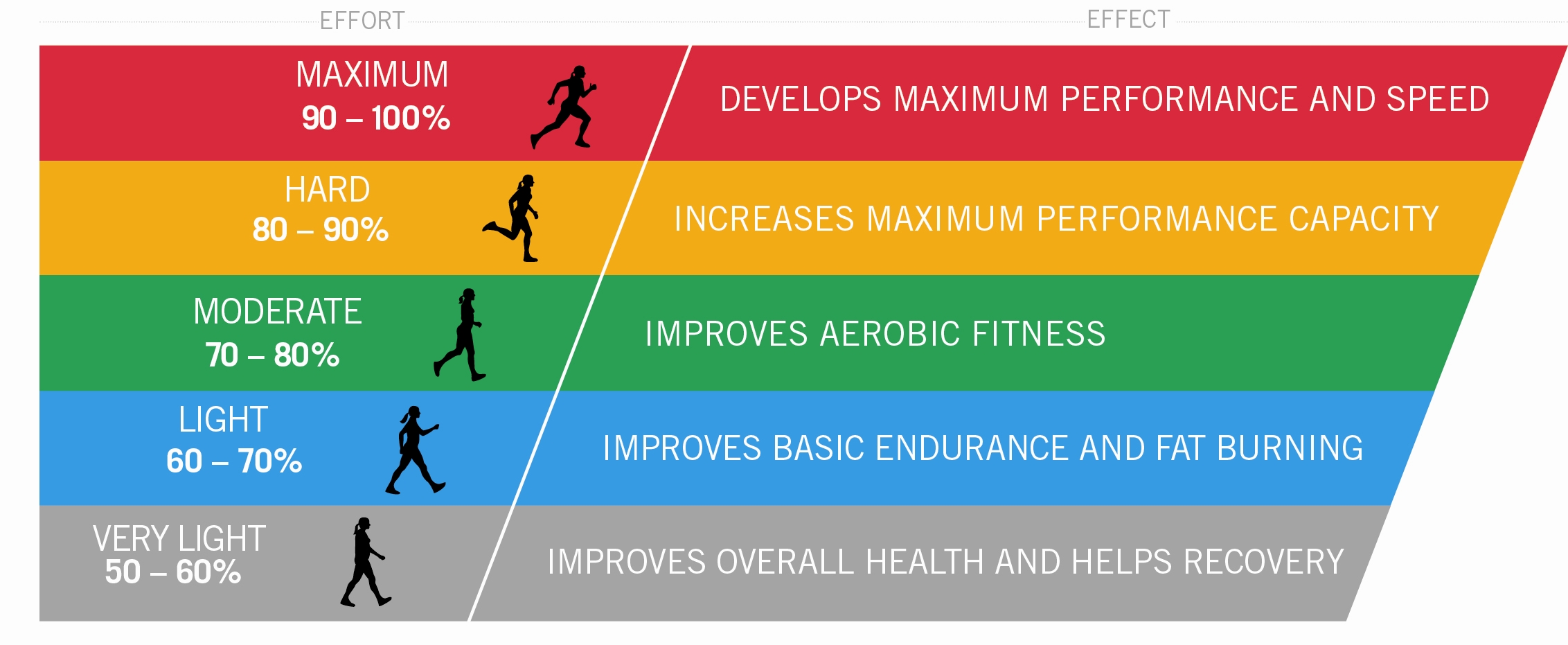
Third, calculate your training zones, which will allow you to customize your workouts to your heart rate and current fitness level. You can do the math according to the chart below, or use this handy calculator to do it for you.
Now that you have your heart rates and zones, the fourth and final step is to create a training program and track results. This, of course, will vary according to your ultimate goal(s), but here’s a great article that outlines the different types of workouts you’ll want to consider when creating your program.
The best part is that you don’t need any fancy equipment, aside from two fingers and a jugular, to get started. If you decided to stick with it, though, I’d strongly advise purchasing a heart rate monitor, which will deliver consistent readings and track your workouts for you.
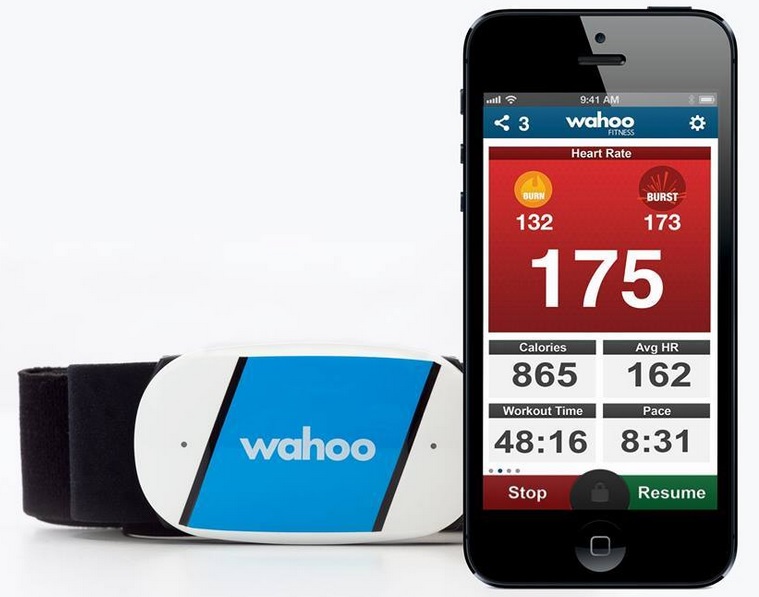
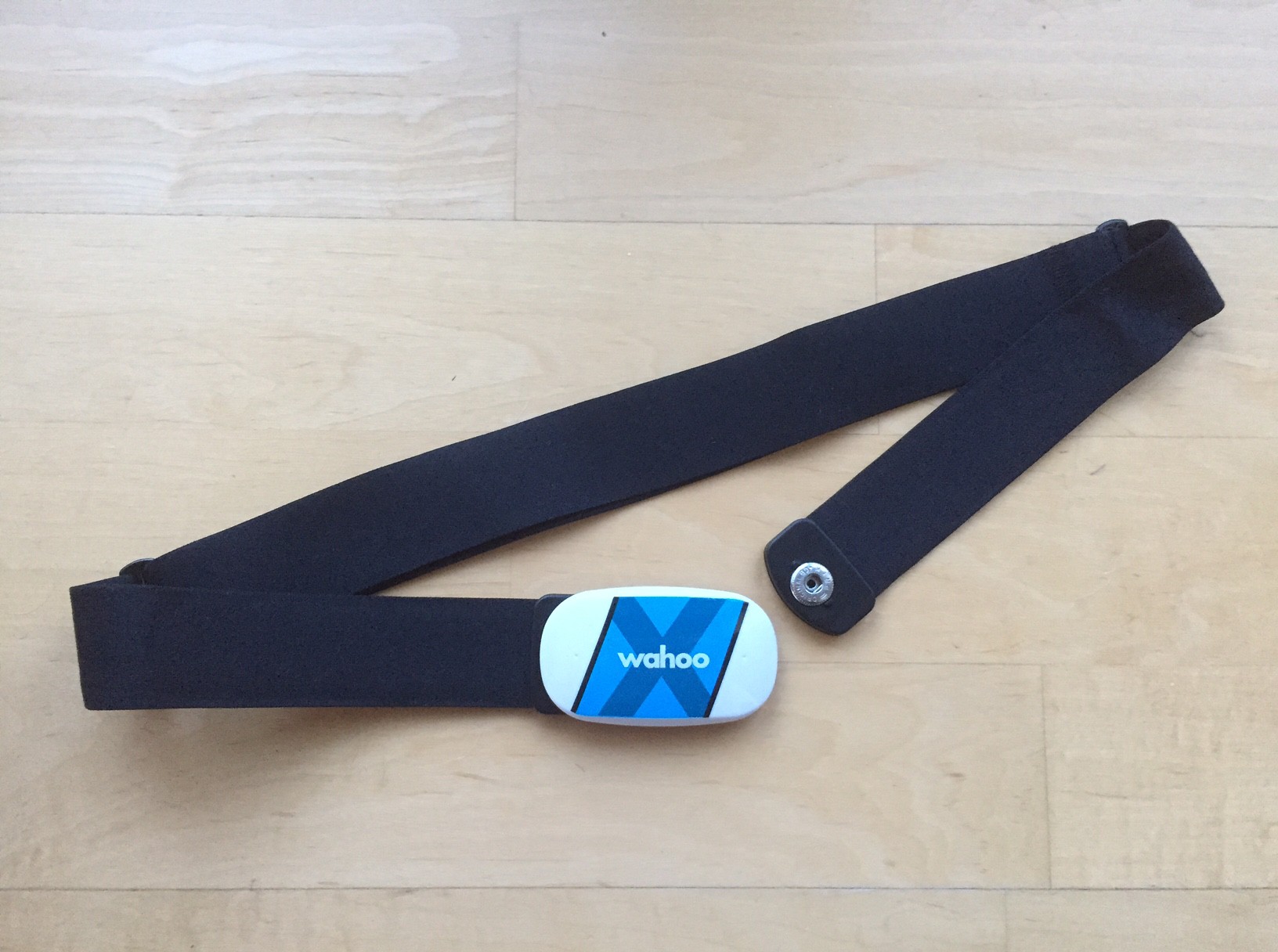
My favorite right now is the Wahoo Fitness TICKR ($100). Not only does the built-in memory mean you have the freedom to train without a phone, but I also find the motion analytics (measures running form across three dimensions; click here for details) fascinating because I’m looking to improve my form and become a stronger runner.
As for my verdict on this type of training, the jury’s still out. I’m by no means an expert, meaning I’m still playing around with it and trying to learn as much as I can, but from what I’ve been reading I do think it could help give me an extra edge to stay healthy in 2015.
The only downside so far is that — for someone who has always set goals based on pace — I’ve had to check my ego at the door for pretty much every workout thus far. Effort-wise I feel great, but the monitor says I’m training at levels where I’m exerting myself too much, which (contrary to what you’d think) doesn’t actually serve me well in the long run.
So what can you expect if you try this at home? Well, surprisingly, the biggest shift may be more of a mental one that physical. Gone are the subjective “run by feel” workouts; using a heart rate monitor gives you a very concrete, objective way to gauge exertion and progress.
Other than that, get ready to slooow down. Almost painfully so, as you’ll likely add a few minutes to your per-mile pace initially. But by taking back control of your workouts, you should start to see progress fairly quickly — in the form of being able to do more while maintaining a lower heart rate, which means you’re becoming an aerobic machine!
After struggling with injuries last season and feeling like I’ve hit a plateau with my speed, I’ve got nothing to lose: It could work like a charm or (what I’m really afraid of) end up slowing me down, but either way, I figure I’ll learn a lot in the process!
Do you train with a heart rate monitor? Any feedback and/or tips to share?















 Kinetic Fix