Round Out Your Training with an Obstacle-Based Workout

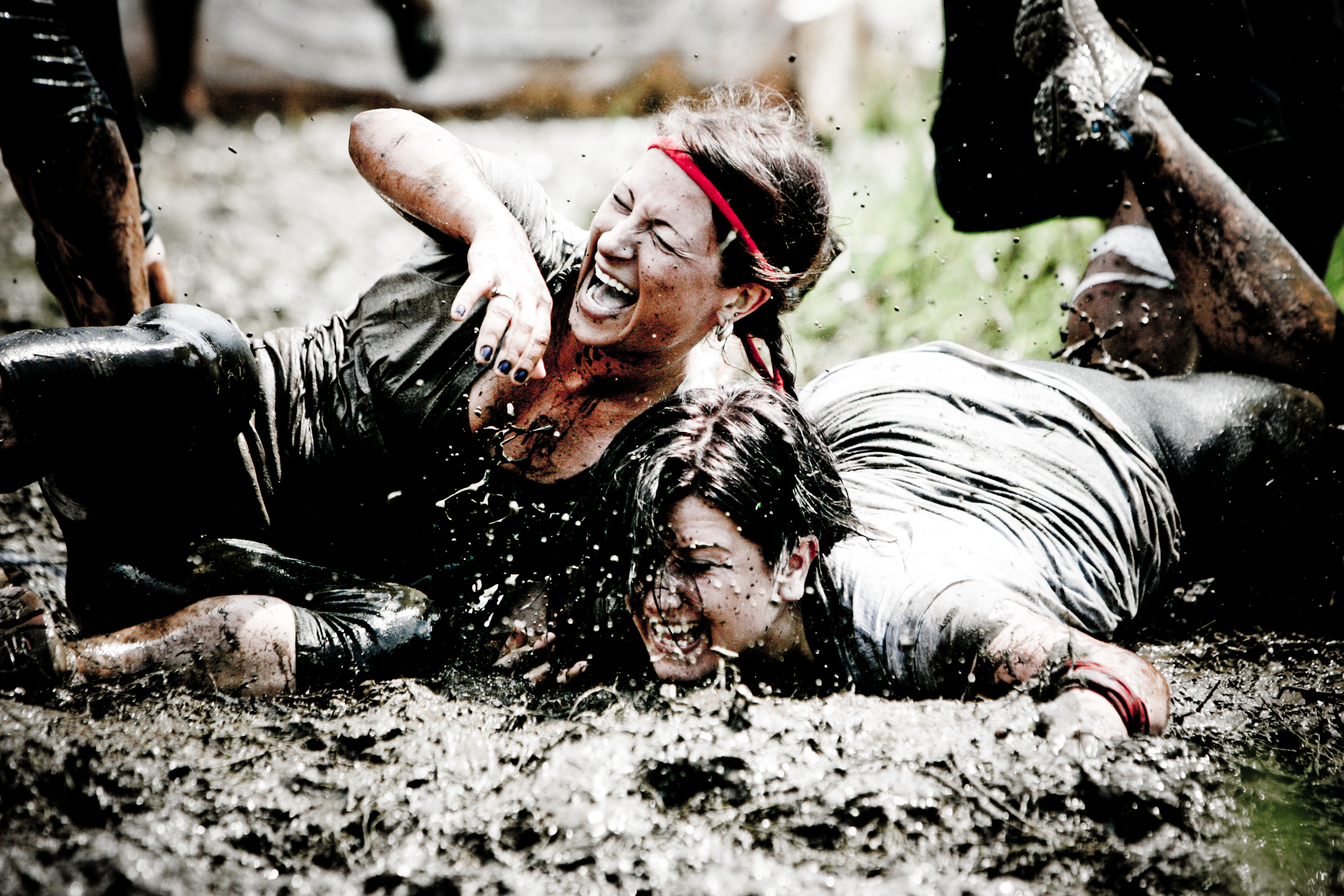
Brent Doscher's Best Action Pics

Source: Brent Doscher

Whether you’re planning on tackling a Tough Mudder or simply thinking about switching up your workouts this summer, obstacle-course-style training can offer a whole new way to hone your strength, power, balance, coordination and strategy.

Because the physicality required to navigate obstacle courses mimics functional, whole-body movements of our ancestors and presents complex challenges, the focus shifts from being the best athlete to becoming the most well-rounded one.

The upside of all this work? Workouts are full of fun and variety, both your mind and body become more adaptable and, as a result, you get into kick-ass shape.

Of course, if you have a particular event in mind, you’ll want to choose a race-specific training program that mimics the actual physical demands of the race. But if you’re looking to just dip your toes into the obstacle course waters, here’s an ideal workout to help you get going.

Start with one session per week with the exercises below, and gradually work your way up to two sessions. Adjust the distance of the runs based on your conditioning level and the length of your race.

Obstacle Course Training Guide
Source: Fix.com

Need more of a challenge? Feel free to swap some of the exercises below into the strength-training portion — or change up your exercises during each of the different sets, which will create an even more well-rounded workout.

  • Walking lunges
  • Front and/or side planks
  • Squat jumps (or box jumps)
  • Mountain climbers
  • Push presses
  • Body-weight rows
  • Weighted carries
  • Crawling (hands/knees, hands/feet, or army)

If that’s still too easy, consider implementing some different types of workouts into your weekly training regimen to help develop the skills needed to excel at obstacle-based events. This could include, but certainly isn’t limited to:

  • Trail running: To simulate the muddy, rocky, hilly terrain of an obstacle race
  • Hill repeats: To build endurance and strength
  • Cross country races: To test your race-day skills on both trails and hills
  • Fartleks: To get used to changing gears and running at different speeds
  • Parkour: To practice balance and agility for challenging movements

You don’t have to be a super-human athlete to complete, compete or even train for these types of events; all that’s required is an open mind, a positive attitude and the willingness to identify and work on your potential areas of weakness.

Now, go forth and dominate!

What’s your take on obstacle races: yay or nay?  

April Goal Check-In

Source: Fast Company

Source: Fast Company

First things first: Yes, it’s mid-May. And we’re talking about April.

Better late than never!

Plus quite a bit has changed since I last touched base with my goals, so I wanted to be able to address it in this month’s recap.

Wondering what this is all about? Read more on the five goals toward which I’m working this year.

So here’s my update on how things have been going:

1. Seeking Balance

Quality over quantity. Quality over quantity. If I keep repeating that to myself, it will (hopefully) one day become second nature.

Unable to contain my excitement over living in what still feels like a “new” city, I got over-excited and over-committed myself this summer. Whoops.

Between work, travel, training, LUNA coaching, family events and other obligations pretty much every.single.weekend…the pressure’s started to build.

I’ve been feeling it in my gut with each additional ‘yes,’ but only recently did this start to register in my head. So in an attempt to stay true to this goal, I made some hard decisions this past month and had some even harder ‘no’ conversations…both with myself and others.

Like, revealing to Ben that I don’t think I’m up for both the century ride and a 50K within two weeks of each other this month. Or telling my Ragnar Utah team that I won’t be joining them for next month’s event.

And examining my other summer races in the process. Not just the whats, but also the hows and, most importantly, the whys.

I can’t help but feel some sense of failure — like I’m letting others down, as well as myself. But the fact that there’s a small victory to be found in reclaiming ownership of my schedule — and the relief that comes with that — is also not lost on me.

Balance, I’m realizing, requires bigger-picture focus. And as I get clearer on the vision I have for myself — outside of just training and racing — I feel like I’m getting closer to that sweet spot of being able to keep moving forward and challenging myself without throwing the rest of my life out of whack.

2. Training Smarter

Another motivating factor has been my SI joint, which has been extremely vocal as of late about me needing to reassess my activities in the short-term. Although I’m cleared to run, per my doctor, I’m not able to race or do speedwork without pain, so being more deliberate in my approach to workouts and events will no doubt serve me well.

In the meantime, I’ve been religiously going to the chiropractor, getting monthly massages and hitting plenty of yoga classes. And, thanks to ClassPass and this guy, I’m still focused on all that good strength and mobility cross-training to build a strong core and activate those glutes.

3. Facing Fears

Ben and I we so proud when we mustered up the motivation to hit the pool one Saturday for an early morning workout. Everything was awesome — until we got to the gym and realized it wouldn’t open for two more hours.

Needless to say, with everything else that’s been going on, swimming’s been on the back burner. Although I hope that it’ll be different this month; I do think some time following that black line would be a welcome change for both my body and mind.

4. Pushing Myself

The 50K is fast-approaching on May 25, so that’s exciting! I’m half pumped and half nervous to tackle this event with Ben, however, as it’s our first ultra-distance together…and more than double his longest race distance to-date (13.1 miles).

Most of April has been spent pushing myself on the non-physical front, though. Through the HUSH Meditation community, I met a wonderful friend/coach/mentor, and we’ve been helping each other — me, helping support the amazing work she does; her, helping me better define my ‘why,’ as well as my career vision.

I’ve been feeling scattered as of late; don’t get me wrong — there’s no shortage of great stuff going on, but I’m in the process of wrapping my head around how it all ties together. As a result, it’s made for a more contemplative, less hard-charging month, which is pretty much a theme across the board for late April and early May.

5. Giving Back

Finally, we’re a little more than a month in to Team LUNA Chix Portland Run’s 2015 season, and I couldn’t be more proud to be a part of this group of women. We’ve been doing weekly workouts, and we also just hosted our first clinic of the season — a yoga and nutrition workshop to raise money for our charity, the Breast Cancer Fund (more on that in an upcoming post).

The team is gelling, we’re working on getting the word out so we can grow in size and make more of an impact, and we’ve been getting a consistent group of ladies each week who rally through a few miles together. See for yourself via our Facebook, Twitter and Instagram accounts — and come join us Monday nights at 6:30 p.m. at the Duniway Park Track in Portland!

How are your 2015 goals coming along? 

8 Tips for Ditching Runner’s Trots for Good

To quote that infamous childhood book, “All living things eat, so everyone poops.”

True enough, especially if you’re a runner. And if that’s the case, there’s a good chance you know this all too well, having likely discussed it extensively with a handful of close runner friends.

The Diarrhea Dilemma

While we like to think our workouts are accompanied solely by philosophical conversations, some inevitably spiral into war stories about bodily functions. But as prevalent as these intestinal issues (aka “Runner’s Trots) may be, it’s a topic that’s not addressed in all circles.

So what’s a trot-troubled runner to do?

Well, first, realize that you’re not alone — more than half of us have experienced exercise-related GI disturbances. And, second, there’s a lot you can do to prevent (best-case) and handle (worst-case) it. But it also helps to understand exactly what’s happening so you can make an informed plan of attack.

Desperately Seeking…A Restroom

According to the Gatorade Sports Science Institute, “there are three main causes of GI symptoms: physiological (reduced blood flow to the gut), mechanical (bouncing effect of running, for example) or nutritional.”

As you exercise, the body diverts blood flow away from internal organs to support working muscles and cool the surface of your skin. Combine that with intestinal “jostling” and heavy/fatty/fiber-filled/sugary foods, and you’ve quite literally got a ticking time bomb in your gut.

Avoiding The Runs on Your Runs

Don’t want to make “that” emergency call during a long training run or veer off-course for a mid-race porta-potty pit stop? The former used to happen to me frequently, and the latter got me at mile 16 of the 2002 Chicago Marathon…sans TP; ’nuff said. 

poster_96_fullsize

Here are my eight tried-and-true tips for taming those tummy troubles for good.

1. Develop a pre-run routine. Develop a system (mine’s coffee) to “get things moving” before you head out the door, and you’ll drastically decrease your chances of a mid-run meltdown.

2. Hydrate before, during and after. Dehydration compounds stress on the GI tract, so be kind to your colon and it may just return the favor.

3. Avoid common triggers. Things like NSAIDs, ibuprofen, sugar and fiber are known to irritate or stimulate your intestines, so refrain from ingesting ’em in advance of workouts.

4. Track your habits. Keeping tabs on what you ate and how it affected you during a run can be quite revealing! I know that quinoa, for example, leaves me doubled over…while I can eat potential triggers like dairy, beans, dried fruits, etc. with no issue.

5. Experiment with fuel type. Again, what works for a runner and his/her digestive system can vary from person to person, so take the time during training to see what agrees with you — and what doesn’t.

6. Play with fuel timing. Some people start jogging while chewing their last bite of breakfast, while I prefer to give myself a few minutes to digest before heading out the door. It may take some trial and error to find your rhythm, but it’s well worth the time.

7. Slowly increase intensity. Going too fast or too far too soon can result in GI backlash. Allow your body to acclimate to the stress of speed workouts and long runs by easing in with a warm-up and building a foundation before going all-out.

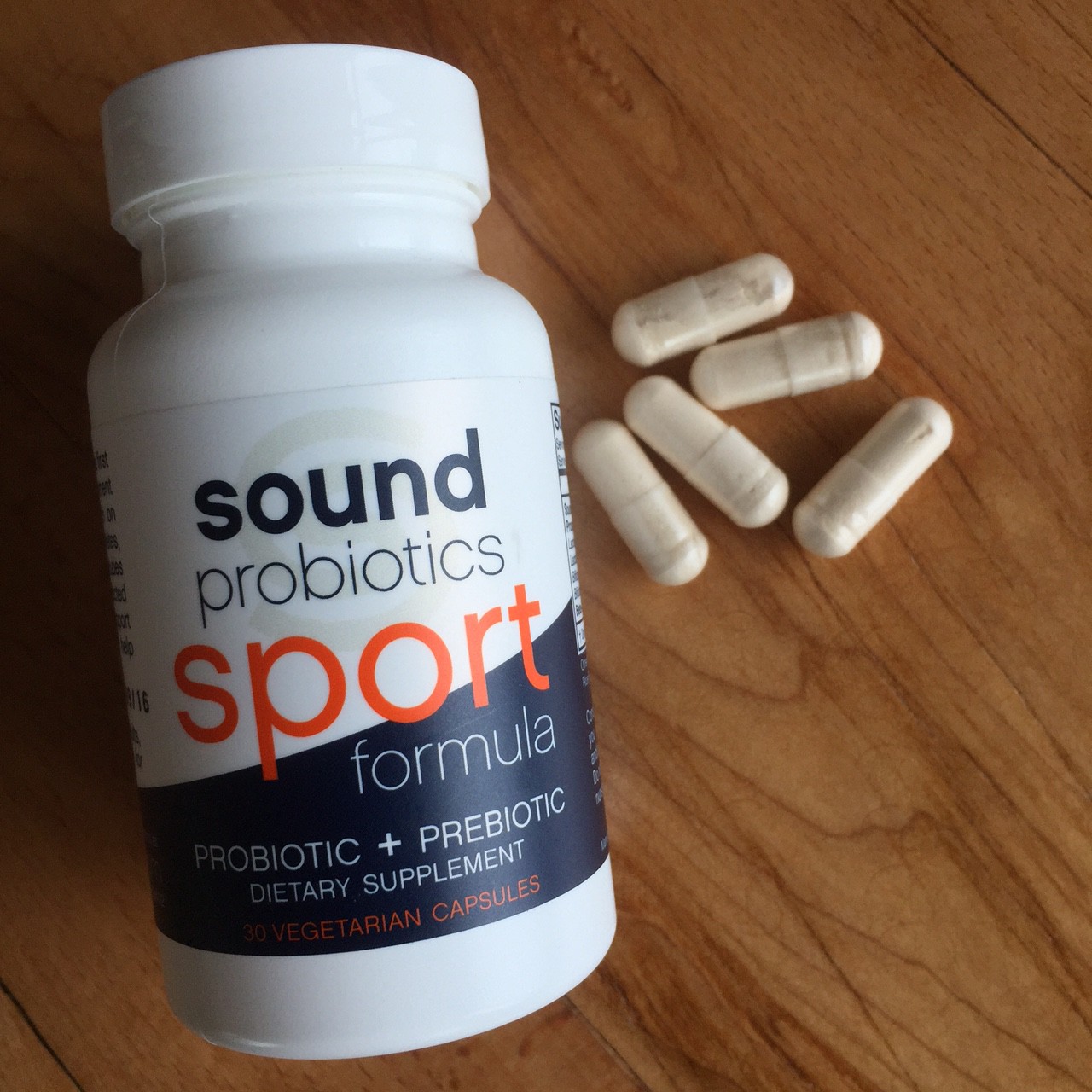
8. Whip your gut into shape. I consider probiotics my secret weapon for not just gut balance, but also overall health. After experiencing success with them over the past few years (i.e. long runs that bring joy instead of fear), I’ve been taking Sound Probiotics, which came highly recommended from my Coeur pal, Erin, who’s also an accomplished Iron(wo)man.

A little PSA: Sound’s the first probiotic engineered for the competitive athlete.

Why’s this important?

Well, during training you’re more susceptible to illness and fatigue due to the sheer amount and intensity of exercise. And since as much as 80 percent of your immunity resides in your digestive tract, I consider these little pills my insurance policy for optimizing training and recovery.

After an initial adjustment period (very mild bloating), I’ve been thrilled with the results. Not only have I been able to up my mileage without incident, but I’ve also managed to avoid all the nasty bugs circulating this season — which is especially impressive considering my daily ClassPass studio-hopping habit.

That’s a small investment for exponential results. Need more incentive? Use code KINETICFIX for 10% off if you want to try ’em yourself. 

IMG_5706

If all else fails, though, consider stashing some toilet paper and a few wet wipes in your run belt for peace of mind. Plotting routes with public restrooms also helps, but if you’re concerned it might be something more serious, consult with your doctor to check for underlying health issues.

And whatever you do, don’t underestimate the effect that soothing your gut can have your overall experience, let alone performance, during training and racing. After all, as marathon legend Bill Rogers once famously said, “More marathons are won or lost in the portable toilets than at the dinner table.”

How do you prevent those mid-run stomach rumbles? 

4 Tips for Using Caffeine to Help Crank Up Your Workouts

caffeine-makes-you-work-out-better-fiar616-616x300

Have you heard the buzz over caffeine’s ability to affect your workout performance?

Studies suggest that having a cup or two of coffee, tea or cola before exercise can reduce perceived exertion, as well as help muscles recover more quickly after a sweat session. But before you buy stock in Starbucks or drink an entire pot pre-run, there are a few things to consider on your quest for a java-fueled jolt:

1. Take Duration Into Consideration

Most reports suggest that caffeine should be consumed about 45 minutes to an hour before activity in order to experience maximum effects, but since it’s absorbed quickly and lasts for hours, the exact timing won’t make or break your performance. In general, however, expect that any pre-workout boost may help postpone fatigue and provide that extra kick needed to cross the finish line for events lasting two hours or less.

2. Experiment With the Amount

An Australian study found that runners who took 95 milligrams of caffeine (equivalent to that in a cup of coffee) improved their 5K running time by an average of 10-12 seconds.While the average American’s caffeine intake is about 200 mg/day, athletes are encouraged to aim for three to six mg per kilogram of body weight, or somewhere between 210-400 mg of caffeine for a 150-pound person, for enhanced performance with minimal side effects.

4. Don’t Use It As a Crutch

If you’re relying on caffeine as an energy booster because you’re dog-tired during workouts, get to the root of what’s really causing fatigue. Are you not getting enough sleep? Are you overexercising? Or perhaps you’re not getting enough quality nutrition? Either way, something’s out of whack, so get to the bottom of it in order to make progress — and see results.

4. Keep It Clean, People

Just because you’re cleared for a cup (or two) of coffee before your workout doesn’t mean you need a triple-grande-whipped-cream-caramel-sugar-bomb to get going. Instead, create your own concoction with almond milk and cinnamon instead of processed creamers, or whip coffee or tea into your morning fruit smoothie for a more nutrient-rich start to your day.

Finally, it’s also worth mentioning a quick disclaimer: While caffeine is a widely recognized as a safe substance, it tends to affect people differently (e.g. may make you feel jittery, have a slight diuretic effect, etc.), so hydrate with plenty of water, and err on the side of caution by consulting with your doctor before adding anything into your training regimen.

Do you use caffeine as a way to enhance your workouts? 

February Goal Check-In

fitness-goals

Two months down, 10 to go!

I wrote previously about the five goals toward which I’m working this year, and since this is my little corner of accountability on the Internet, here’s my update on how things are progressing:

1. Seeking Balance. I’m actively restraining myself from signing up for #AllTheRaces this year — which is difficult when you’re in a new state! — so you’ll see that my schedule for 2015 is still very much a work in progress. My strategy is to try to target new events, and I’m trying to mix things up rather than build toward a specific A race this season.

2. Training Smarter. Heart rate training went out the window this month in favor of a metric ton of cross-training. I’ve been barre-ing my butt off at PureBarre in an attempt to build more glute and core strength, riding at Revocycle to make sure I’m road-bike ready come spring, and testing out all kinds of other classes via ClassPass (post with details to come). Variety is the spice of life…and fitness, right?!

Ben and I also completed our own version of Whole30 (more like Whole45 since we had two minor cheat weekends with company in town), so nutrition has also been a major focus this month. As much as I used to pride myself on being able to eat whatever I wanted, I’ve got to admit that I feel so much better eating clean, unprocessed food and cutting down on added sugar.

3. Facing Fears. Ok, you got me — there’s not much progress to report on the swimming front. I haven’t been making regular weekly sessions, and although I’ve got a few standing offers for technique guidance, I haven’t had a chance to drag Ben to the pool to take videos of me in action. Hoping to remedy this in March!

4. Pushing Myself. I’m officially registered for my second ultramarathon — a 50K in May. I’m also eyeing a century ride earlier that month, as well as trying to decide between a sprint triathlon or Olympic duathlon in June. Throw in two overnight relays, and it’s looking to be an active summer!

5. Giving Back. We’re still in our pre-season for the Team LUNA Chix Portland Run team, so fundraising hasn’t started quite yet for the Breast Cancer Fund. However, we’ve been so excited to get going that we’ve gotten a jump on things by holding group runs once a month to touch base.

In the meantime, our potential century ride has fundraising component for the American Lung Association, so if we decide to bite the bullet on that event, Ben and I will be hitting up our friends and family to donate for another great cause.

Other than that, we’re looking forward to March coming in like a rainy lion and out like a damp lamb here in the Pacific Northwest…how about you?!

How are your 2015 goals coming along? 

Be a Better Shredder: 3 Exercises for Snowboarders

Dec 2014 Snowboard Training 071

Forget all the fancy gear; do you really have what it takes to stay on your feet and avoid injury while hitting the slopes this season?

Mimic instability and build endurance by adding a few new moves to your existing workout routine, and it just might mean the difference between a great day of runs and having to call it quits early.

Billy Polson, founder and co-owner of DIAKADI (San Francisco’s largest personal training gym) recommends the following three exercises to condition, strengthen and help prevent injury prior to making your way to the mountain.

The best part? All you need is a BOSU ball, a balance board (or short plank of wood) and two weights.

1. Lean with it, rock with it

Place the balance board on top of the BOSU ball (flat side down) and hop up on it, spacing your weight evenly between both feet. Bend your knees and rock side to side, shifting your weight slowly, holding your core tight to maintain balance. Do this for 60 seconds.

2. Take it up a notch

Grab your two heavy weights, and step back up onto the board, finding your balance and holding in a squat position. Holding your arms at your sides, start lifting weights slowly up to shoulder height, then back down, while maintaining and proper form. Perform 2 sets of 15.

3. Practice your moves

After your last rep, drop the weights, go into a deeper squat, and hold. Practice shifting weight onto your toes, just like you are taking a turn on the mountain. Add some toe turns, move your weight into your heels, then back to your toes. Shift from side to side, practicing your turns and conditioning your legs for long runs. Do this for another 60 seconds.

Here’s a video of Billy demonstrating some of the moves. Happy shredding!

Have you hit the slopes yet this season? 

My 5 Goals for 2015

2015Goals

Aside from freezing my butt off (#packingfail) while running around Michigan over the holidays, I had some time to think about goals for 2015.

2014 was pretty epic. It would be hard to top, and to try would likely be setting myself up for trouble. So, in light of my evaluation of last season and my “train smarter, not harder” mantra for 2015, I’m on a mission to build a solid foundation for a further (50M?), faster (sub-4 marathon?) 2016.

My 2015 goals are as follows:

1. Seek Balance. One of my goals for 2014 was to race roughly once per month, and while I enjoy motivating and challenging myself this way, I want 2015’s racing schedule (still TBD) to be based on quality, not quantity.

2. Train Smarter. I sound like a broken record with this one, but I want to take 2014’s lessons and apply them in 2015 — namely, building an aerobic base using heart rate, continuing strength training and pre-hab to activate glutes, along with regular cross-training for flexibility and functional fitness.

3. Face Fears. 2014 was the year of #bikelove — I went from never having clipped in to competing in an Olympic triathlon to completing a 50-mile solo ride and loving.it. — so I want to make the same strides as far as swimming goes. Gulp.

4. Push Myself. Nothing’s set in stone yet, but I’m tossing around a few ideas for challenges to keep me stoked and give me something for which to strive in the New Year, including a duathlon, another 50K and a century ride.

5. Give Back. It’s easy to get lost in your own little training world each season, so in 2015 I’m leading the Team LUNA Chix Portland Run crew in order to help inspire and encourage women to get outside and play, all while raising money and awareness for the Breast Cancer Fund.

Have you set your goals yet for 2015? What are they?

Race Report: LifeTime Fitness 2015 Indoor Triathlon

IMG_3603

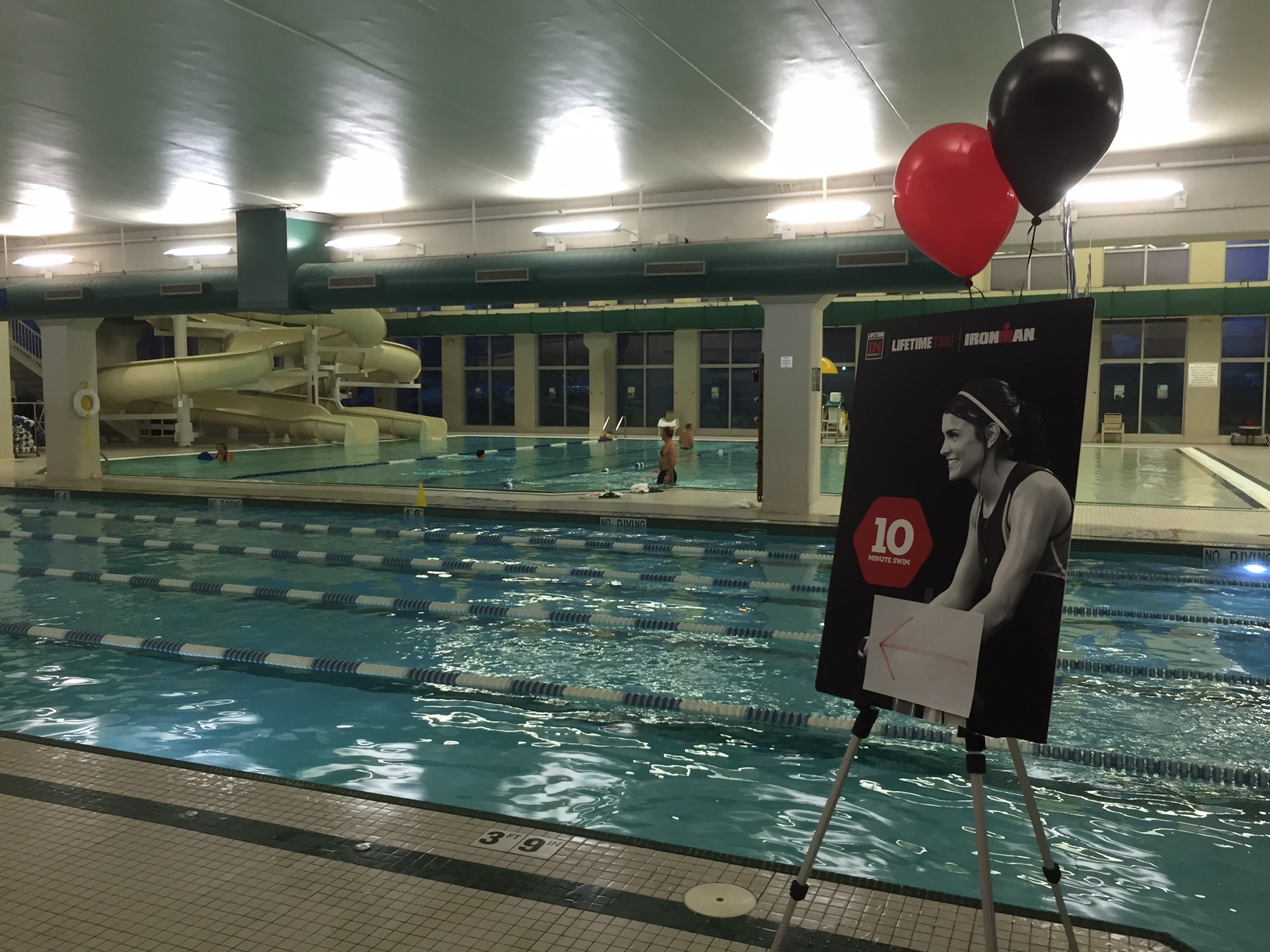
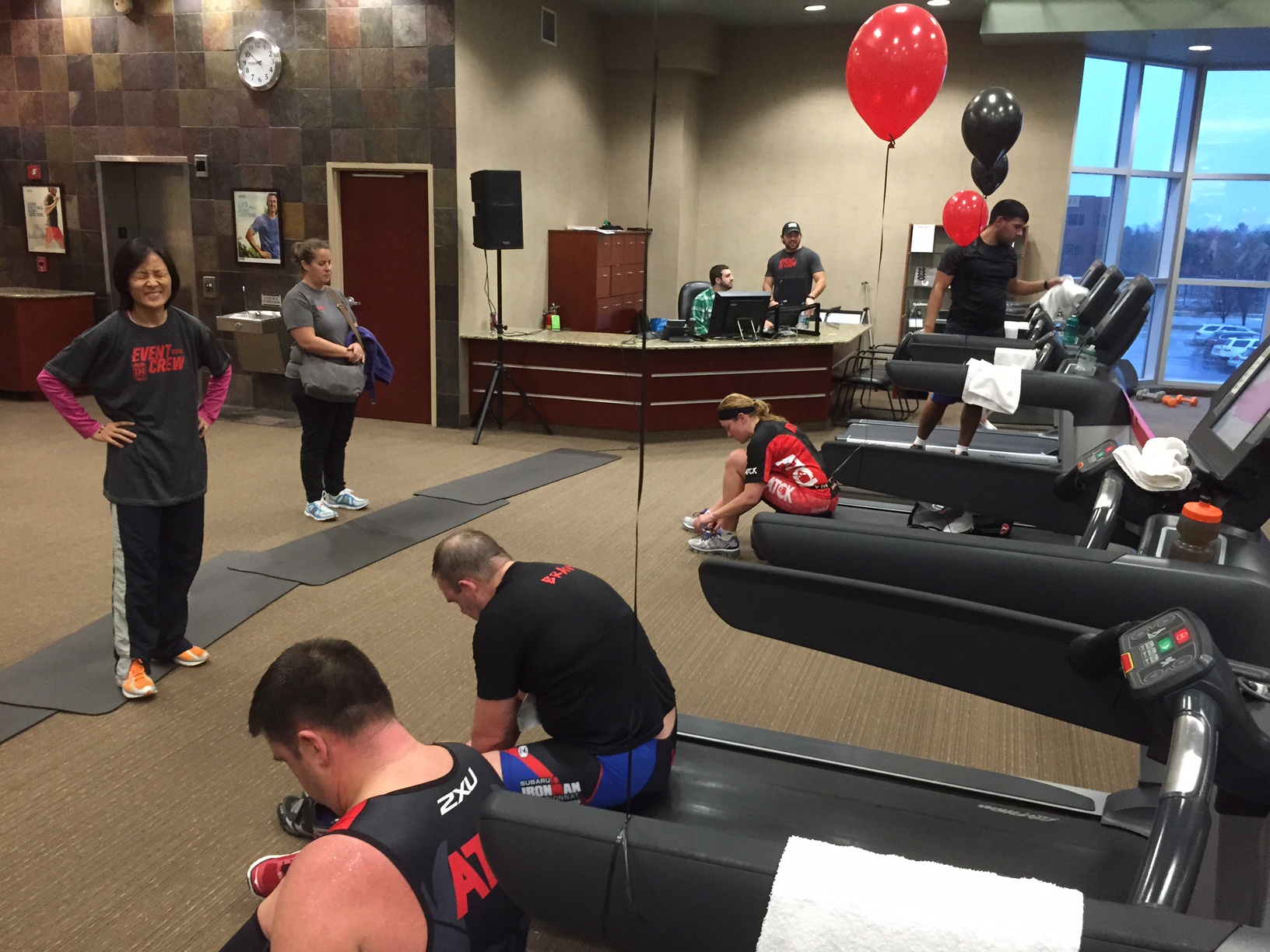
Although I said I’d hold off on registering for another triathlon until I work on my swim, I couldn’t help myself when I found out that the Indoor Triathlon Hour powered by Life Time Tri and IRONMAN would be happening while I was in Michigan.

In an effort to inspire the community to consider and commit to racing triathlon in 2015, LifeTime Fitness created the event as a way to offer an inspirationally-charged, safe and indoor environment for athletes of all fitness levels to experience the nation’s fastest growing sport of triathlon.

I did a similar event last year at a different location, and while my distances were slightly shorter this time for the same time-frames (damn!) — 10-minute swim/30-minute bike/20-minute run — I can’t complain too much because my training has been consistent but not particularly focused lately.

My wave — the first of the day — started promptly at 8 a.m., so I arrived about 20 minutes early to check in, get my cap and number and get organized in the locker room transition area. And then it was go time!

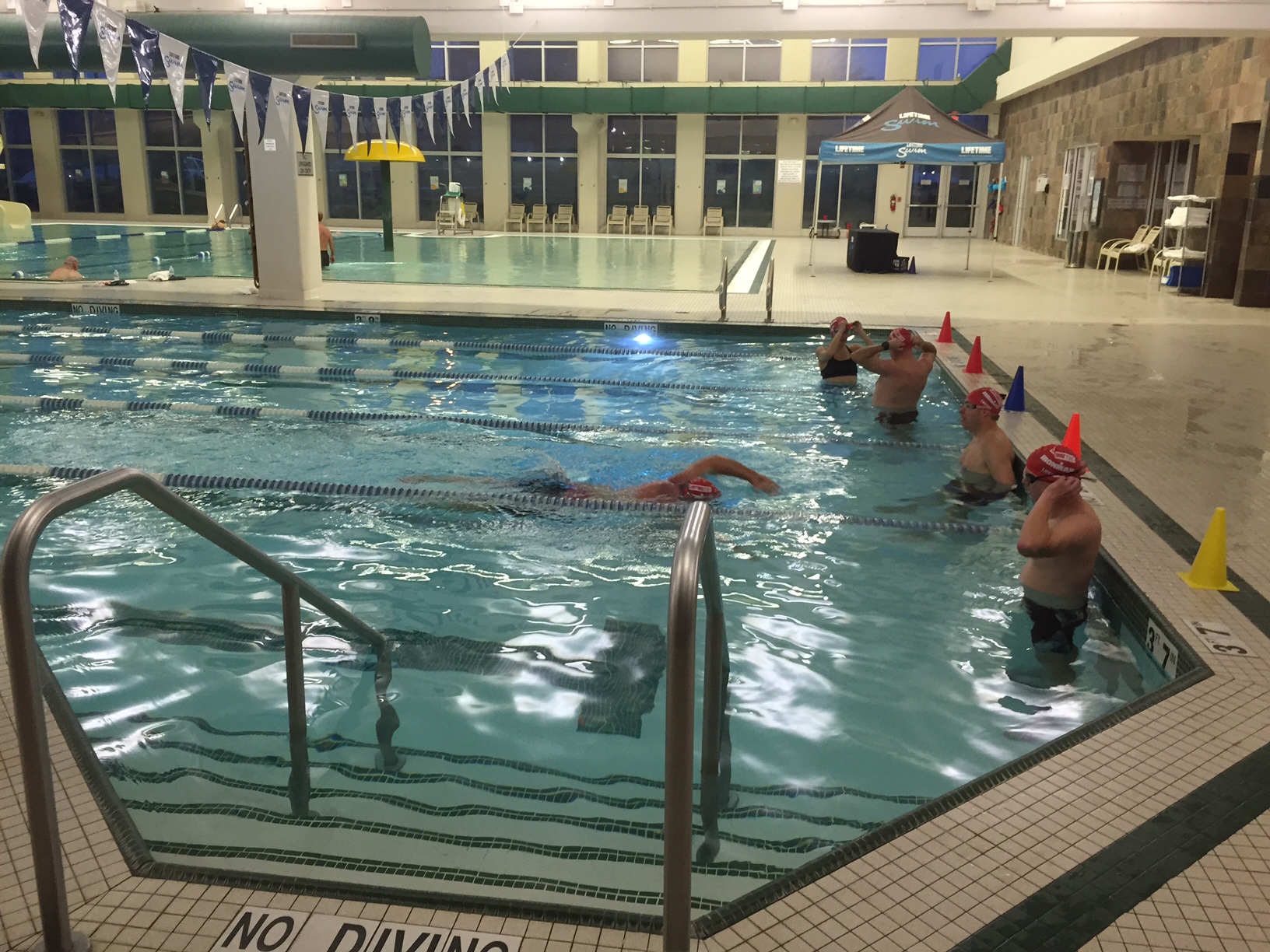
Swim: 10 minutes = 17 lengths

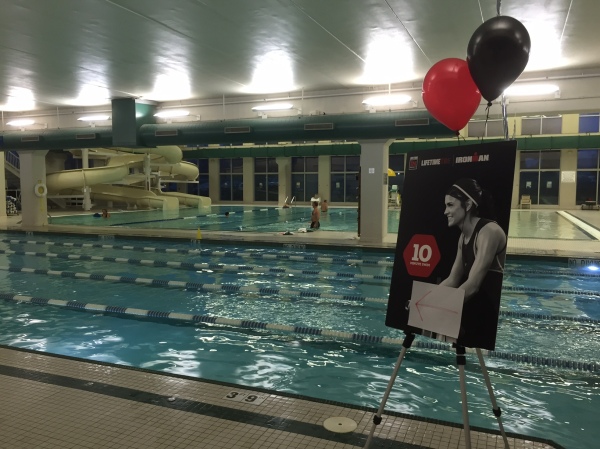
Clean, clear water and only two people to a lane? Now, that’s how I start to get my swim mojo back.

And apparently my lane buddy, Eric, had the same idea. He’d done outdoor triathlons before but had a bad swim experience recently, as well, so both of us joked about just wanting to just get through that part of every race.
IMG_3595

Since the lap pool there has five lanes, they limited each heat to 10 people. By the time I had arrived, people were already starting to warm up, so I hopped in and swam one length to try to get the pre-race jitters out.

This is about when I also noticed that my wave-mates were a pretty athletic looking bunch. I was one of three ladies, and I could tell quickly that this wasn’t a group who was trying triathlon for the first time; these people were here to kick off their seasons, so I figured I’d just try to keep up.

IMG_3594

My adrenaline didn’t work in my favor because I went out way too quickly. And the combination of being against the wall (aka swallowing back-splash) and getting bumped a few times took me right back to my Olympic triathlon back in April, and I could feel myself start to panic.

This is where the giant countdown clock came in handy, though, because I’d raise my head at the end of the lane and think, You can do anything for five more minutes. Gradually, I got my rhythm back and, thankfully, the whistle blew for us to stop after I’d gotten 17 lengths under my belt.

Bike: 30 minutes = 7.7 miles

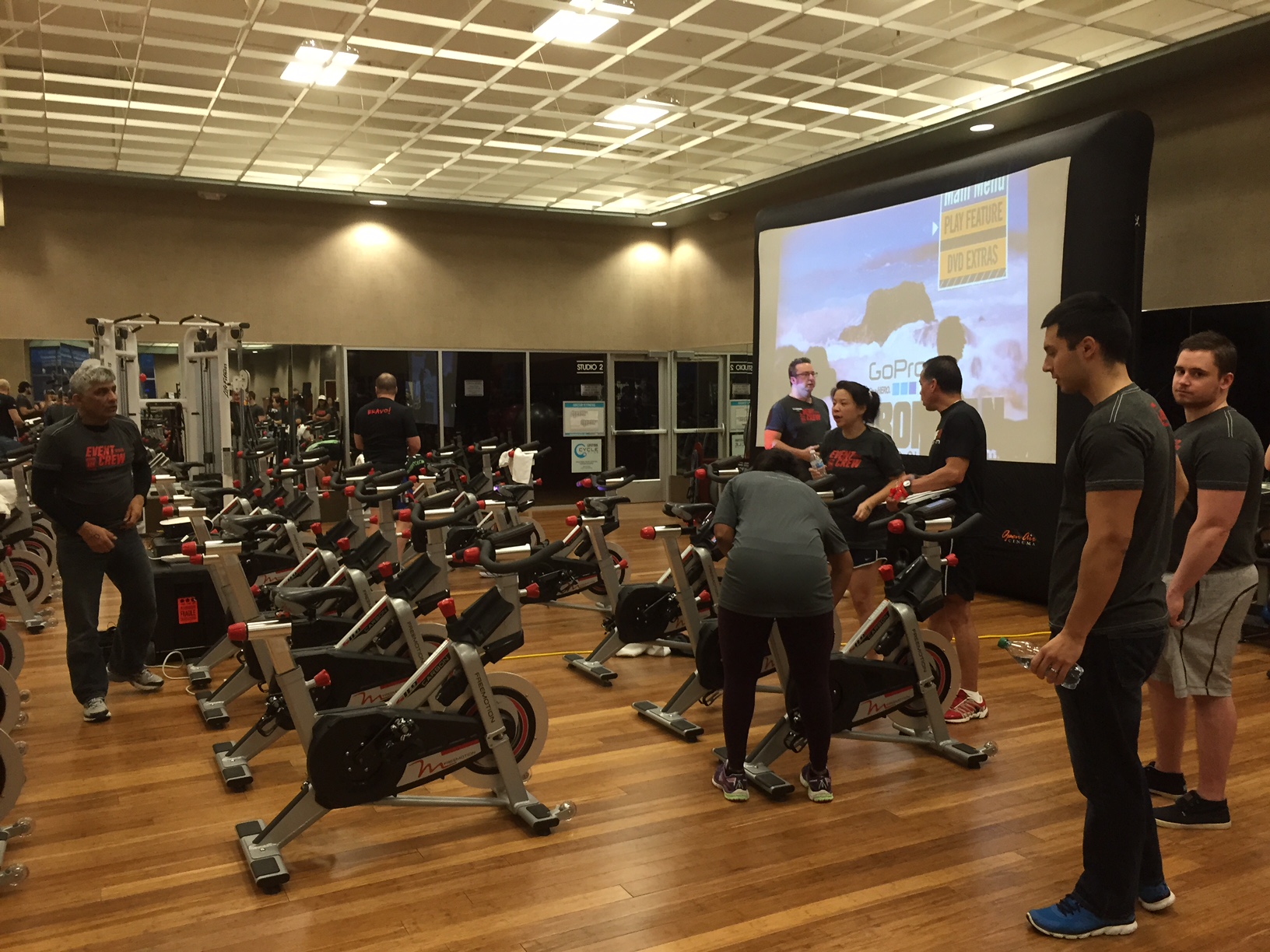
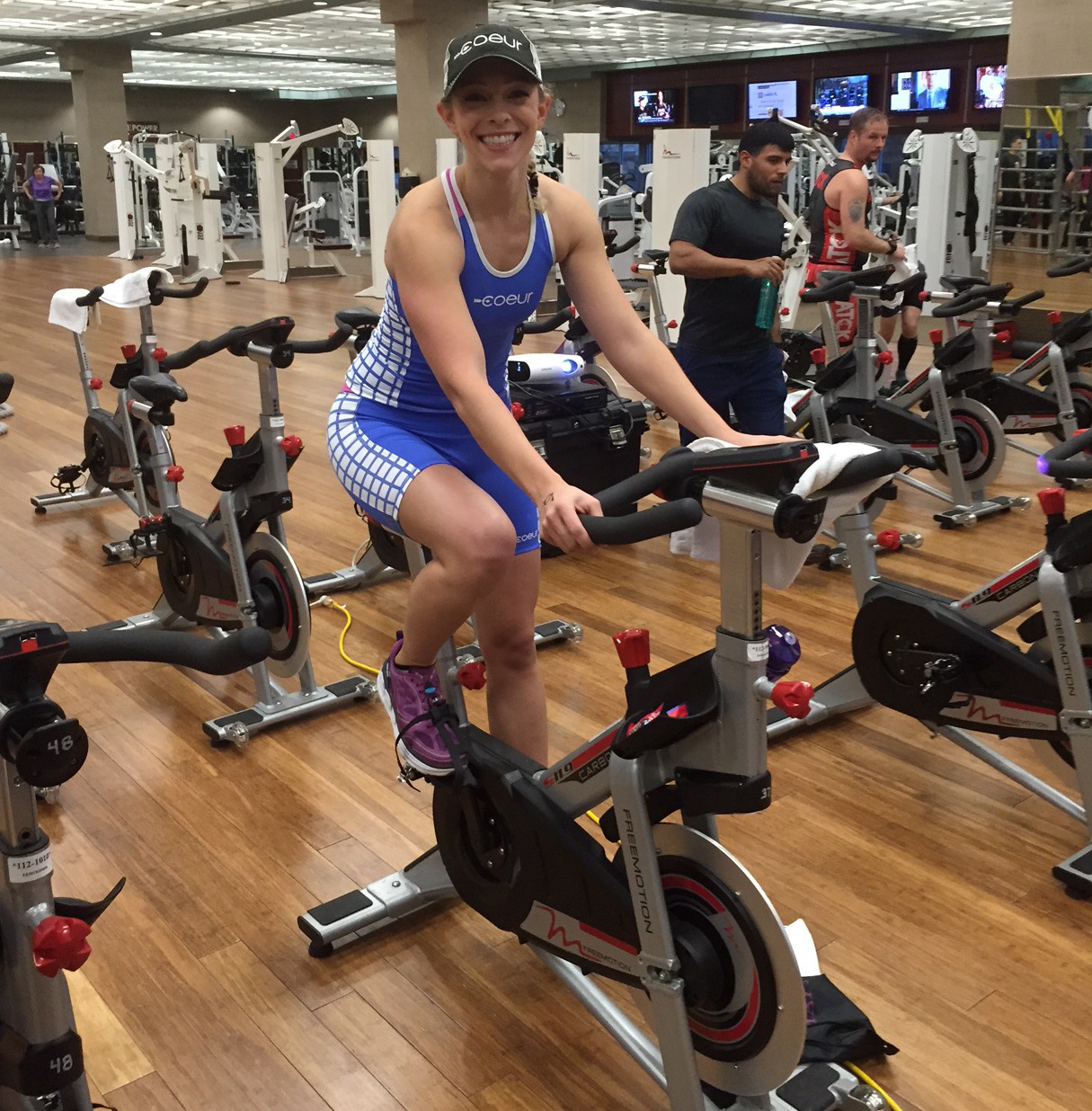
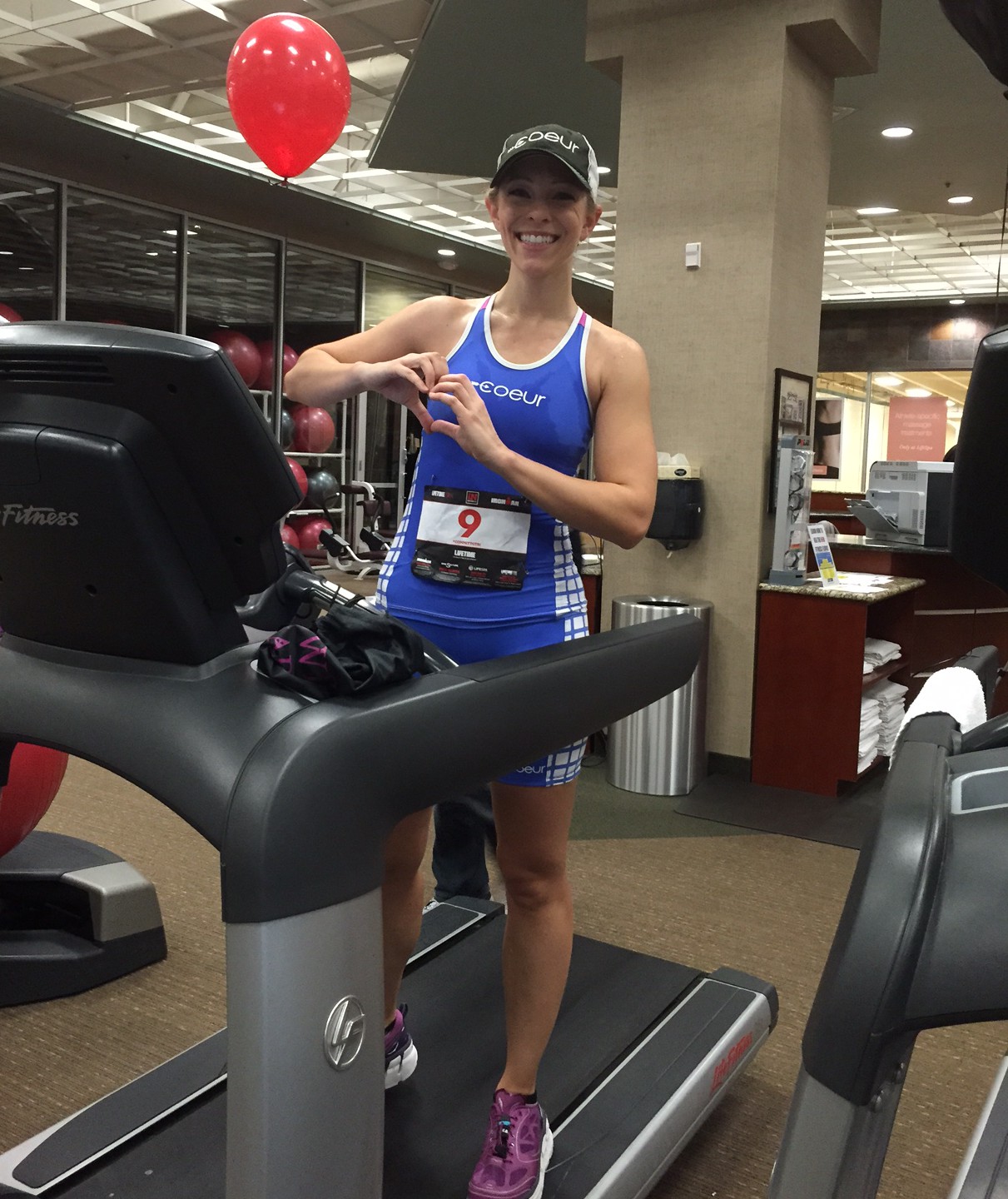
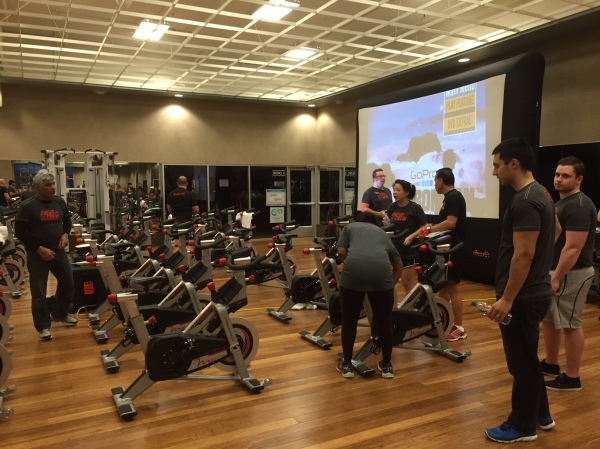
Although they gave us a generous 10 minutes to transition from the swim to the bike, the time flew by. I tugged off my suit in the locker room, threw on my Coeur kit and headed upstairs to the bike area that they had sectioned off by the cardio equipment.

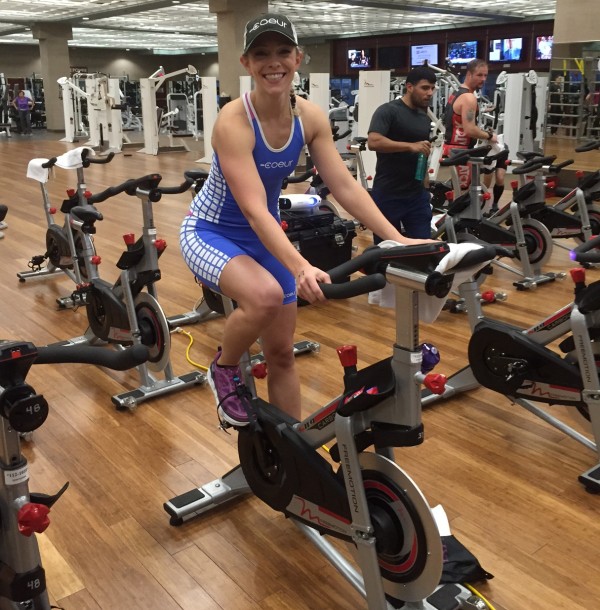
For some added motivation, we could watch Ironman videos on the projection screen, so I snagged a front-row seat for the action. I didn’t have my bike shoes to be able to clip in, so I secured my running shoes in the pedals and prepped my nutrition: a bottle of water and a trusty Chocolate Peppermint Stick LUNA bar.
IMG_3596

And we were off again! The music pumping nice and loud, so I tried to ride to the beat and turned down my resistance as much as possible to gain some of the ground I lost in the pool.

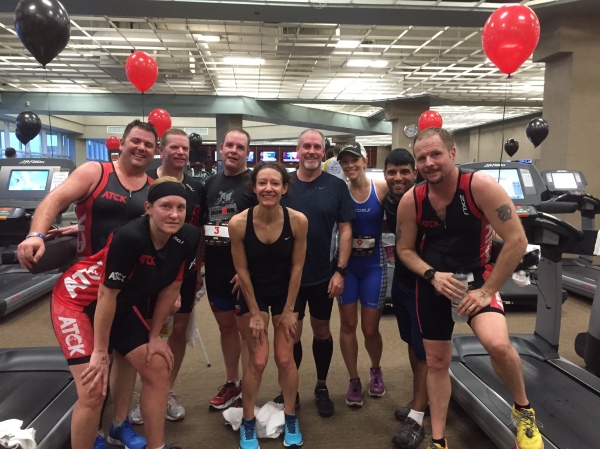
I got the feeling that a few of my heat-mates train together because they rode in a group and were encouraging each other throughout the ride, which was inspiring to hear. We pedaled furiously as a small crowd gathered to watch us push onward, still dripping a bit from the pool, but smiling from ear to ear.
IMG_3598

I think the bikes may have been calibrated differently from last year’s race because my just-under-eight-miles seemed like a conservative estimate for how strongly I felt like I was riding (especially after getting a comment form one of my heat-mates to the same effect). But, regardless, I stayed pretty steady throughout, ate and drank consistently, and was proud of my overall effort.

The second wave came up to join us with about 10 minutes to spare in our ride, so we pedaled as a large group for the final portion. Their energy was a breath of fresh air after hammering away on the stationary bike, and just a few minutes after they got settled the whistle blew for our final transition.

Run: 20 minutes = 2.69 miles

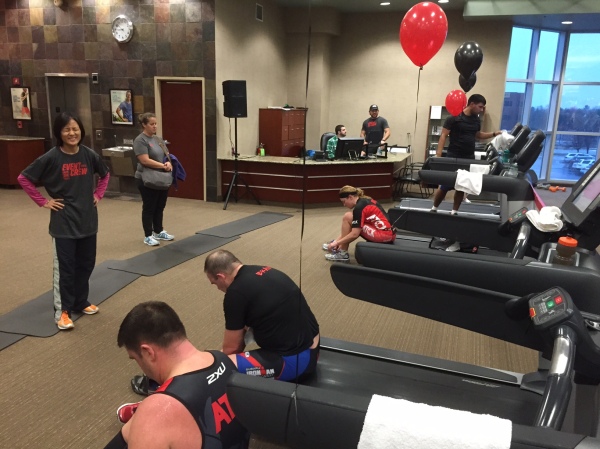
We had five minutes to get from the bikes to the treadmills, but they were just a few yards away, so I grabbed a towel and got situated quickly because I already had my Hoka Conquests on.

My heat-mate next to me had a treadmill malfunction at the very last second, so he scooted over to another machine just as they started a countdown to the third and final portion of the event.
IMG_3601

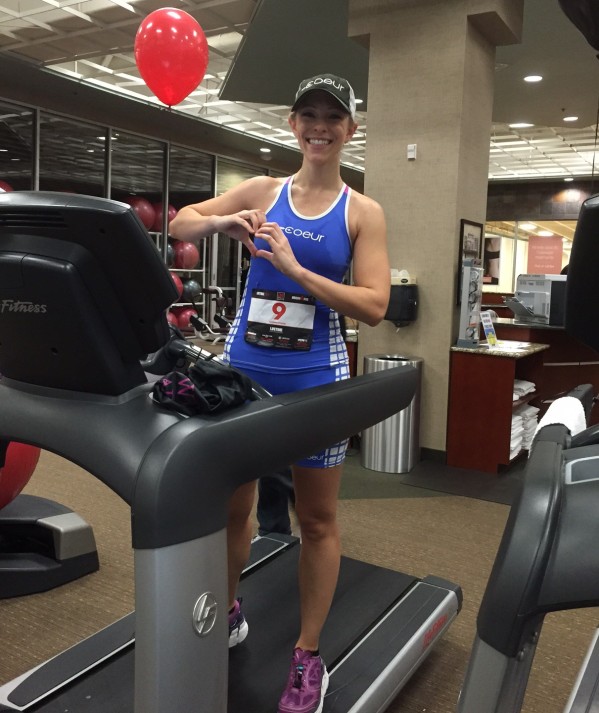
Because I’ve been managing what I’ve self-diagnosed as some SI joint pain (note to self: must continue to work on my lack of ankle mobility, which is likely the culprit!) since my marathon, my plan was to run a conservative first 10 minutes and then gradually increase my speed over the next 10 minutes to warm up properly.

I started off at 6.8 mph and increased to around 7.5 when one of the volunteers came by, daring me, “I think can go faster than that.” Yep, she was right; I wasn’t really out of breath, so I pumped it up a few tenths of a mile every minute or two until I was up to 8.5 mph 15 minutes in.
IMG_3599

I was hoping to inch up the speed to 9.0 mph like last year, but I started feeling a little lightheaded with three minutes to go, so I gritted my teeth and ran on. Maybe increasing the speed wasn’t an option, but I sure as hell wasn’t backing down at that point!

When the final whistle blew, I ended at 2.69 miles. Not PR territory, but a solid performance with an average pace of 7:26/mile, so I’ll take it…especially considering I’ve eaten my weight in Christmas cookies over the past few weeks.

It was also a wake-up call: Fitness-wise, I’m close to what I was last March, so I’m happy to have been able to maintain. Training-wise, however, I’ve got to dial things in better if I want to progress. And, nutritionally, I think I did ok, but probably could have used some extra oomph for the run in the form of Osmo or Tailwind in addition to the LUNA bar.

All in all, it was an event I’d highly recommend, especially if you’re looking to kick off your training with a low-pressure race and get a baseline in place.

Congrats to everyone who participated, and cheers to a successful 2015 racing season!

5 Reasons to Factor Some ‘Heart’ Into Your Workouts

Coeur2015

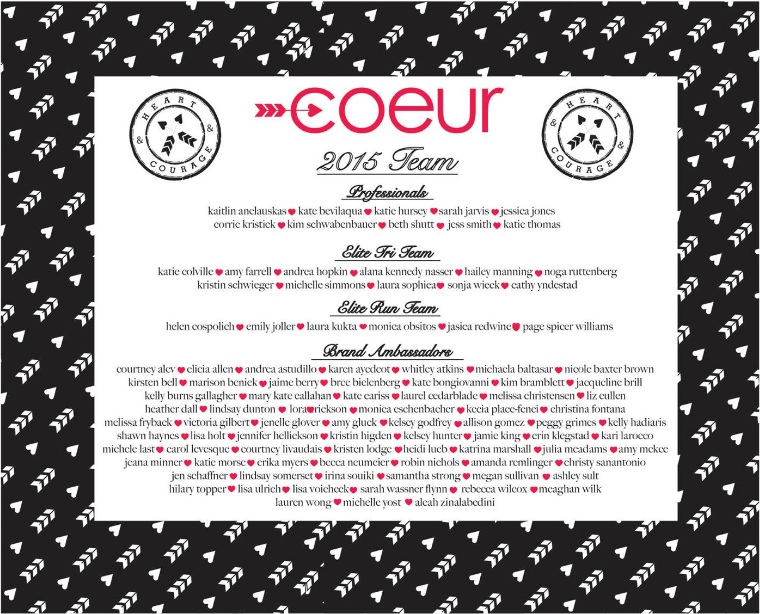
In light of this week’s announcement from Coeur Sports — I’m thrilled to be a part of the team again in 2015! — and in honor of our “heart & courage” rallying cry, I figured it’d be an opportune time to talk about something I’ve shied away from until only very recently: heart rate training.

Why? As much as I love to quantify my fitness, somewhere between doing the heart rate zone math, finding the correct workouts to hit my zones and then licking attaching the device and syncing up to whatever software is needed, I inevitably drop the ball. Let’s face it, adding another element of discipline can be tough when the alternative is to just lace up and head out the door.

why-tickr-free

But the wiser older I get, the more I’ve realized that there are some terrific benefits to taking heart rate into account when training. Here are a few of the reasons why I’m starting to incorporate it into more of my workouts:

1. Train smarter. There’s a good chance that, like me, you tend to overdo your easy days and don’t push quite hard enough when it is needed.

2. Change focus. If you’re in an exercise rut, it’s fun to add a gaming element with heart rate workouts by setting some specific, measurable goals.

3. Recover effectively. Are you sure you’re not undercutting recovery days? Heart rate monitors can be incredibly helpful in helping you rein things in.

4. Stay healthy. Over-training and improper pacing can knock you off your A game, leaving you susceptible to both overuse and acute injuries.

5. Get better. Whether you’re looking to raise your level of fitness, stick to a program or race faster, fine tuning your workouts by heart rate can help.

Wahoo2

Ok, you’re probably thinking, that’s great, but how do I get started? Well, here’s a four-step cheat-sheet that simplifies the process:

First, determine your maximum heart rate, which can be done with a reasonable amount of accuracy by subtracting your age from the number 220 (for men) or from 226 (for women). There are a number of other equations that can be used, but that one’s a good rule of thumb.

Second, establish your resting heart rate, which should be done first thing in the morning with your feet still between the sheets. Find your pulse, count the number of beats that occur in 10 seconds, and multiply that number by six to find your rough count for beats-per-minute.

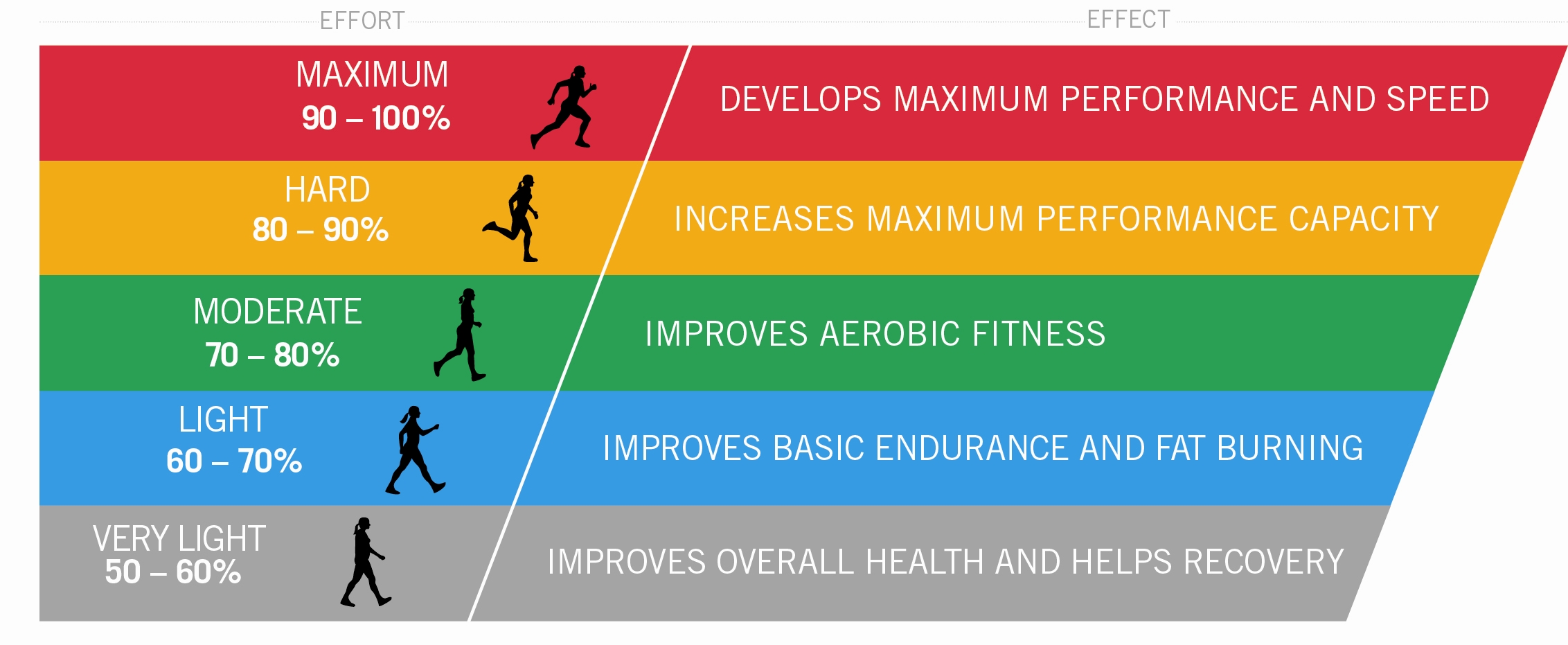
Third, calculate your training zones, which will allow you to customize your workouts to your heart rate and current fitness level. You can do the math according to the chart below, or use this handy calculator to do it for you.

Training_Zone_Diagram

Now that you have your heart rates and zones, the fourth and final step is to create a training program and track results. This, of course, will vary according to your ultimate goal(s), but here’s a great article that outlines the different types of workouts you’ll want to consider when creating your program.

The best part is that you don’t need any fancy equipment, aside from two fingers and a jugular, to get started. If you decided to stick with it, though, I’d strongly advise purchasing a heart rate monitor, which will deliver consistent readings and track your workouts for you.

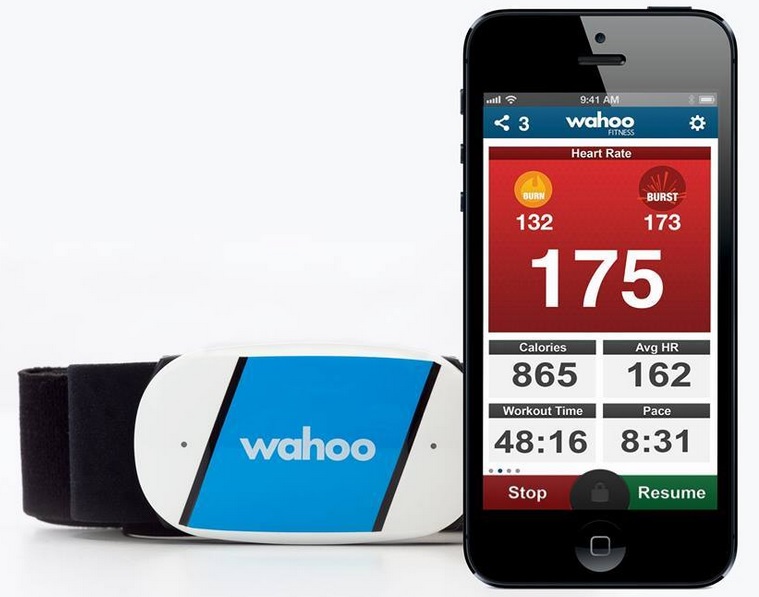
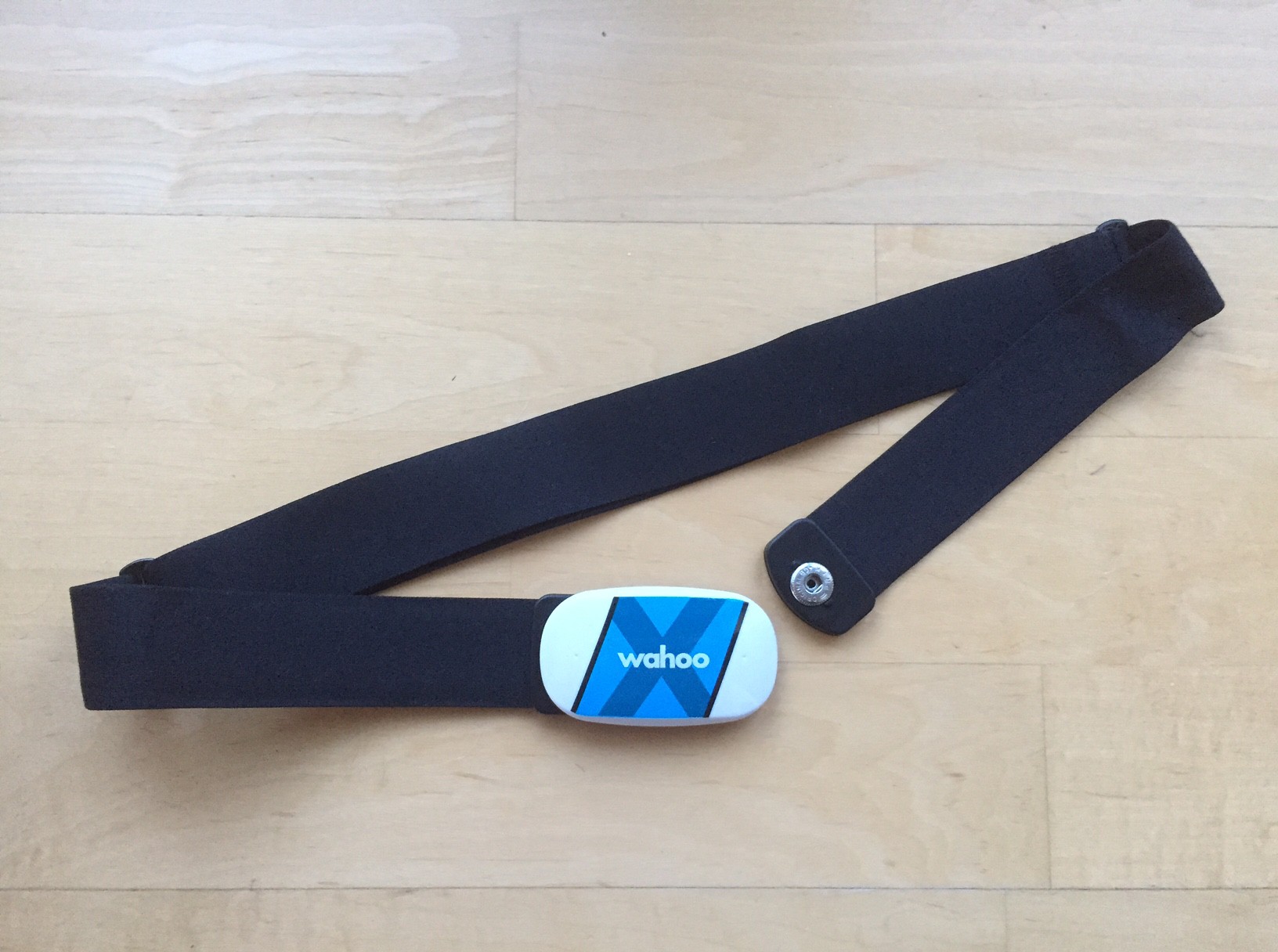
My favorite right now is the Wahoo Fitness TICKR ($100). Not only does the built-in memory mean you have the freedom to train without a phone, but I also find the motion analytics (measures running form across three dimensions; click here for details) fascinating because I’m looking to improve my form and become a stronger runner.

Wahoo

As for my verdict on this type of training, the jury’s still out. I’m by no means an expert, meaning I’m still playing around with it and trying to learn as much as I can, but from what I’ve been reading I do think it could help give me an extra edge to stay healthy in 2015.

The only downside so far is that — for someone who has always set goals based on pace — I’ve had to check my ego at the door for pretty much every workout thus far. Effort-wise I feel great, but the monitor says I’m training at levels where I’m exerting myself too much, which (contrary to what you’d think) doesn’t actually serve me well in the long run.

IMG_3185

So what can you expect if you try this at home? Well, surprisingly, the biggest shift may be more of a mental one that physical. Gone are the subjective “run by feel” workouts; using a heart rate monitor gives you a very concrete, objective way to gauge exertion and progress.

Other than that, get ready to slooow down. Almost painfully so, as you’ll likely add a few minutes to your per-mile pace initially. But by taking back control of your workouts, you should start to see progress fairly quickly — in the form of being able to do more while maintaining a lower heart rate, which means you’re becoming an aerobic machine!

After struggling with injuries last season and feeling like I’ve hit a plateau with my speed, I’ve got nothing to lose: It could work like a charm or (what I’m really afraid of) end up slowing me down, but either way, I figure I’ll learn a lot in the process!

Do you train with a heart rate monitor? Any feedback and/or tips to share?

Making a game plan for the Detroit Marathon

IMG_1622

It’s no secret that things haven’t gone as smoothly this training cycle as I would have liked. But rather than getting angry at my body and blaming it for not being able to hold up to the rigors of a tough running schedule, I’ve accepted responsibility for a combination of faulty mechanics and inattention to the finer points of injury prevention.

As such, my original goal time of 3:50 — which seemed well within reach based on my pacing prior to injury — is pretty much a pipe dream at this point. After taking a month off from running to heal my medial tibial stress response (aka almost-a-stress-fracture), I’ve come to grips with the fact that I’ve got to reset my race-day expectations.

fbd80343beded84c14e7a6717711620f

Frankly, I’m not sure exactly what will happen between when the gun goes of and when I (hopefully) cross the finish line, which both excites and terrifies me. Why? Well, a lot can happen over 26.2 miles.

But after giving it some thought, I’ve made the following goals for Sunday’s race to keep myself motivated and moving forward:

1. Good Goal: Cross the finish line, healthy and injury-free, regardless of time

2. Better Goal: Finish somewhere between four and five hours, depending on how the run/walk ratios go

3. Best Goal: Finish with a new personal record (anything under 4:07:46). Yeah right, but a girl can dream?!

Although my run coach and I have been discussing strategy this past week, I’m still digesting his suggestion for a 10 run/1 walk ratio. There’s a delicate balance between taking it slow and taking it too slow, so I’m trying to figure out the right mix of pacing and duration of runs to get me to the finish line as quickly as possible and in one piece.

Overall, though, I think I’m going to treat it like an ultra — over-prepare and find a steady pace so I can finish strong. My plan is to see how my final runs go today and Friday before finalizing the run increments, which I’ll probably end up tweaking during the race based on how my legs and lungs are holding up.

IMG_1621

Am I bummed about not being able to “race” this race? YES. But there comes a point where you have to not only deal with the reality of a situation, but also be appreciative of what you can do instead of what you can’t. Plus, three things have really changed my perspective on this race in the past few weeks.

First, one of Hubby’s and my most beloved friends passed away late last month. To describe him as the successful businessman, doting husband and loving father he was just doesn’t do him justice, however; he was one of those one-in-a-million people who made an impact on the life of everyone with whom he crossed paths.

So I’m dedicating this race to Burt Baptiste. And to his beautiful family — his wife, Danielle, and their two daughters, Milla and Emme. Their strength, poise and positive attitudes in the midst of tragedy have inspired so many of us, and I hope that I can have some small part in helping to make sure that his memory is never forgotten. #RIPBB

91dc8d2af5fadad089803f3a918fef50

Second, one of my running heroes, Kara Goucher, wrote a terrific blog post on handling setbacks with grace, patience and perseverance. The entire piece hit home with me (well, aside from the whole ‘professional athlete’ part), but one line in particular struck me as she was describing her injuries, disappointments and what has been a long road on her return to racing:

“Instead of stressing about how far behind we are, we need to focus on the progress we are making and continue to make….I may not be where I want to be, but I am so grateful to be here at all.”

With a laser focus on planning, training and prepping for a goal race of the season, it’s so easy to lose sight of the bigger picture. But even with our setbacks, our injuries, our derailed training plans, it’s important to keep things in perspective and find joy in the journey because you never know exactly where it’ll lead — or what you’ll learn in the process.

06fad4faa17f92d97b3a902ed137be31

Third, my friend Doris Steere has unknowingly served as inspiration by example while she’s been on her own journey this season. After dealing with similar calf issues eight weeks out from her goal race, she proceeded to break a rib three weeks out. But rather than give up, she hit it hard with rehab work and ended up at the starting line of Augusta 70.3, saying:

“I make no promises for race day except to try and do my best with the hand I’ve been dealt….without quality training sessions to look back on, I’ve got to rely on muscle memory, experience, determination and pure grit.”

And she did just that, managing to nab a new PR despite a blown-out tire, poor road conditions and an aggravated rib on race day. Now, if that isn’t motivation enough to keep on going when the going gets tough, I don’t know what is.

d5042a196e8f155d502ee76d8c240fe0So, final thoughts going into the race this weekend? Getting to the start line is victory enough this time, and even though I’m not sure exactly what shape I’ll be in when I get there or how the race will go, I do know the way in which I want to finish.

My week 18 recap will go up Friday, and I’ll be posting race updates on social media this weekend before the official recap goes up Monday. Thanks, again, for following along…here goes nothing!