Body after baby: Tips for shedding pregnancy pounds

Photo credit: MountainBuggy.com

Photo credit: MountainBuggy.com

Between all-hours feedings, a steady stream of diaper changes and endless loads of laundry, finding the time (and motivation) to make it to the gym when you have a new baby can be difficult, to say the least.

Because during those first few whirlwind weeks, you’re too overwhelmed – and exhausted, frankly – to care.

But allow yourself some time to get in a groove, and eventually you’ll want to get your groove back.

Only now you may find yourself stuck in that stubborn limbo between maternity wear and your old wardrobe….so, what’s a new mom to do?

Here are a few tips to help jump-start your ‘body after baby.’

1. Go easy. 

Congratulations, you just made a human! Now, give your body a break. Stop comparing yourself to that celebrity who has access to (and an unlimited budget for) a team of people to whip her into shape. Allow at least six to eight weeks for recovery, depending on your delivery, and clear it with your doctor before starting any exercise regimen.

2. Make goals. 

Think of your your weight loss as a journey, not a destination. So rather than immediately snapping back to pre-baby shape, expect to make a few pit stops along the way. Just make sure those increments are reasonable, attainable and measurable – say, losing one pound per week – which will help keep you motivated to keep going.

3. Get moving. 

Find an activity you love – whether it’s walking, swimming, jogging or yoga – and hold yourself accountable by signing up for a class at least once per week. Not only will it get you out of the house, but it’ll also establish a good habit. As a mom, you’re also a master multitasker, so squeeze more activity into your daily routine by walking to errands, taking the stairs or parking farther away.

4. Team up. 

Whether it’s your partner or a pregnant friend, the power of a pal should not be underestimated. Get out and meet new people in a “mommy and me” type class or gather a group of local ladies to lean on each other for support. Either way, strength in numbers will help keep you motivated and focused on your goal of losing the baby weight.

5. Eat well. 

When you’re tired, it’s tempting to grab whatever’s handy and stuff it in your mouth. But with a little planning, you can stay a step ahead: Keep your pantry and refrigerator stocked with nutritious foods (fruits, veggies, whole grains), limit the amount of junk food brought into the house, practice portion control and eat only when you’re hungry.

6. Get sleep. 

The sleep equation is a simple one: Get enough, and you’re less compelled to binge on high-calorie, high-sugar foods for energy. Easier said than done when a baby breaks your sleep cycles and upsets your metabolism. But get on the same nap schedule, and you can help prevent a long-term sleep deficit, which will keep energy levels up and cravings in check.

7. Lift weights. 

Contrary to popular belief, lifting weights will lean you out not bulk you up. Incorporating strength training into your fitness routine not only speeds up your metabolism, but it’ll also help get your guns prepped for hauling around that growing baby! And if you’re not ready to hit the gym or invest in a set of dumbbells, try improvising with household items, such as a milk jug or canned goods.

8. Follow through. 

A final word when it comes to keeping those postpartum pounds in check: Consistency is key. Stick with your new schedule until it becomes routine, celebrate your wins, and learn from your losses along the way. Focus on what you’ve accomplished so far (um, like having that adorable bundle!), and always remember: You can look fabulous at any weight with the right attitude.

Stay tuned for part two of this post where real-life moms offer their favorite secrets for slimming down after baby…
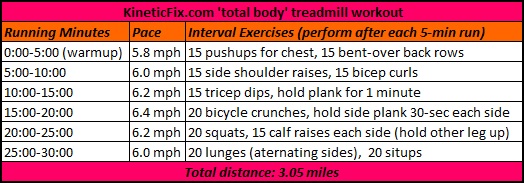
30-minute(ish) total body treadmill workout

While I can’t promise the entertainment level (or cool factor) of this ‘dancing treadmill guy,’ I do have a workout that’ll help make your next trip to the gym a lot more efficient.

It’s a cardio-strength hybrid where you’ll be hopping off the treadmill every five minutes to complete a few moves, so find a spot where you can easily maneuver back and forth without losing your machine between sets.

Before you know it, you’ll have three miles and a total body strength training session under your belt.

Now, that’s something Treadmill Guy can get behind.

KineticFixTotalBodyTreadmillWorkout

Three stability ball moves for a stronger core

Ballast_ACEfitnessdotorg

Photo credit: ACEfitness.org

“Hard core” is more than just a workout mantra; it’s a way of life for those who not only want a better beach body, but who also want to prevent injury, enhance balance and increase stability during all sorts of activities.

Whether you’re swinging a golf club or sweeping the floor, the necessary motions either originate in your core, or move through it; so it’s important to spend some time on this oft-overlooked area.

But if you’re dreading the thought of thousands of crunches, there’s another option for strengthening abs and back: Enter the stability ball, which first burst on the fitness scene in the 1960’s with regular use by the physical therapy industry.

A versatile and budget-friendly tool, the inflatable orb then went mainstream in the late 1980’s and has been used regularly since to improve balance and posture while targeting key muscle groups.

Use it at the gym or buy one for your home, and try these three beginner-friendly moves from American Council on Exercise (ACE):

Supine trunk curl

  1. Start with the top of the ball beneath the center of the back.
  2. Press the lower back into the ball and tighten the abdominals as you curl the rib cage toward the pelvis.
  3. Slowly return to the starting position and then repeat.

Supine oblique curl

  1. Start with the top of the ball beneath the center of the back, then stagger feet and rotate hips to one side.
  2. Anchor the lower hip to the ball and move the rib cage at a diagonal direction toward the legs (for example, right elbow to left inner thigh).
  3. Making sure neck and pelvis are stable, contract and repeat.

Forward transverse roll

  1. Kneel on the floor and place your forearms on the ball, making sure your hips and arms form a 90-degree angle.
  2. From this starting position, roll the ball forward as you extend your arms and legs simultaneously.
  3. Contract your abdominals to help support your lower back, which should not be strained.
  4. Roll as far forward as possible without compressing the spine, drooping shoulders, or rounding the torso.
  5. Return to starting position and then repeat.

If you’ve got a few sizes from which to choose, ACE suggests the following guidelines for finding the ideal diameter to suit your frame:

  • Under 4’6”: 30 cm ball (12 inches)
  • 4’6”–5’0”: 45 cm ball (18 inches)
  • 5’1”–5’7”: 55 cm ball (22 inches)
  • 5’8”–6’2”: 65 cm ball (26 inches)
  • Over 6’2”: 75 cm ball (30 inches)

Ready to add more moves to your stability ball repertoire? Check out these 20 super-effective stability exercises from Greatist.

Wanna get lucky? Run as a couple, says survey

Happy National Running Day!

In honor of the holiday, Brooks Running Company released some fun findings from their recent Brooks Run Happy Nation Report, including tidbits related to relationships, running while traveling and runner pet-peeves, including:

Hit the street more often for a better time between the sheets? Photo credit: MesHealth.com

Hit the street more often for a better time between the sheets?
Photo credit: MensHealth.com

Bringing Sexy Back

  • The longer you run the better your sex life, the survey found, as nearly half (49 percent) of couples who run six or more miles together claim it pays dividends in the bedroom
  • Runners from the West (42 percent) are most likely to claim that running increases their time spent rolling in the hay versus the South (38 percent), Northeast (33 percent) and Midwest (32 percent)

Sweat-time Gets Social

  • More than three-quarters (76 percent) of men surveyed passed the miles by discussing their team’s latest victory (sports, 51 percent) or a cool new gadget (34 percent)
  • Ladies, on the other hand, choose to use their running time as therapy – they are most likely to talk about relationships (47 percent), both the good and the bad
  • When it comes to a favorite late-night running partner, Jimmy Fallon (27 percent) steals the spotlight, with Chelsea Handler (22 percent) and Jimmy Kimmel close behind (22 percent)

On the Road Again

  • As for their favorite running city, runners say the hills of San Francisco make their heart race (46 percent), followed by Portland (34 percent), Boston (32 percent), Boulder (30 percent) and New York City (30 percent)
  • Runners are committed! More than three-quarters of those surveyed (78 percent) maintain their run schedule while traveling, and men are more likely to keep up the routine than women (82 percent vs. 73 percent), as are those who are parents (82 percent vs. 74 percent)

No Sounds of Silence

  • Eighty-seven percent of runners like to listen to something to keep them motivated, whether a booty-shaking playlist (music, 78 percent), audiobooks (11 percent), even meditations (10 percent) or motivational speakers (9 percent)
  • Just 13 percent feel that silence is indeed golden and choose no audio companion

Pet Peeves!

  • Difficulty dressing for the weather is a bigger pet peeve for females (30 percent) than males (17.3 percent)
  • Runners are torn about the worst type of runner they encounter on their favorite trail or running spot:
      • The Spitter (30 percent claim this is their “most hated runner” category): runners who spit or hock a loogie while running;
      • The Double-Wide (29 percent): runners who run in a group and take up a lot of space;
      • The Superhero (14 percent): runners  decked out in unnecessary gear;
      • The Flasher (14 percent): runners who don’t wear enough clothes when it’s cold out

“We hear from runners every day about how hitting the road is an integral part of their daily routine, and wanted to test just how big a part running played in their relationships, travel habits and friendships,” said Heather Snavely, Brooks senior director, Brand Marketing. “The results of the report were both fun and surprising. And I have to agree with those surveyed; I personally would love to join Chelsea Handler for a martini 5K in San Francisco.”

Check out the accompanying infographic below, and to see more of the survey results, click here.

Happy running!

image001

Dare to go bare: 6 tips for embracing barefoot running

Would you dare to go bare on your next run?  Photo credit: Shape.com

Would you dare to go bare on your next run?
Photo credit: Shape.com

Runners all over the world have bucked the traditional cushioning and orthotics of athletic shoes in favor of taking it all off – their feet, that is.

Inspired in part by Christopher McDougall’s book “Born to Run,” which chronicles the Tarahumara Indians’ ability to run long distances injury-free without shoes, the barefoot trend is gaining in popularity yet remains widely-debated.

Chris McDougall demonstrates his barefoot technique Photo credit: ChrisMcDougall.com

Medical minds are divided and the jury’s still out in the running community, but thanks to the endorsement of a few top athletes who swear by going bare, many weekend warriors are wondering whether or not they should join in on the ‘bare boom.’

But while the allure of improved running form, fewer impact injuries and better balance makes trying barefoot running seem like a no-brainer, there are a few potential challenges to consider, such as hygiene issues, overuse injuries and protection from sharp objects and extreme climates.

As with any new athletic endeavor, the best approach is always to keep an open mind, take it slow and see what works for you. Every runner’s body mechanics are as unique as their respective fingerprints, which means there’s no telling how your body will react and which combination of benefits and/or drawbacks you’ll experience.

So if you decide to go bare, do so with these tips in mind:

  1. Consider your environment. Where and when you run barefoot is very important, so be sure to protect feet properly in extremes and take precautions that correspond to the area in which you’re running – whether it’s urban, suburban or rural.
  2. Aim for variety. Training on hard, rough surfaces toughens feet and teaches you to run lightly to minimize impact, while soft surfaces are a welcome respite during the transition. Get creative and widen your repertoire of surfaces, including beaches (hard and soft sand), sports fields, running tracks, parks (pavement and grass), trails and sidewalks.
  3. Ease in with a minimalist shoe. If you’re not ready to completely lose your shoes (like me), try minimalist footwear that gives the feeling of a bare foot with the benefit of some light support and protection. 
  4. Allow time to transition. As tough as all runners like to think they are, everyone making the shift to barefoot will need to be patient as the body adjusts to this new activity. Avoid too much too soon; opt for short bursts of barefoot during or at the end of your current routine, which will decrease the chances of short-term injury.
  5. Gradually increase time and distance. Barefoot doesn’t translate to “injury-free,” so it’s important to build a solid foundation on which you re-work your running style. Switch from barefoot intervals during workouts to entire runs with your feet in the buff, working up to as many days running ‘footloose and sneaker-free’ as you are comfortable.
  6. Above all, use common sense. Barefoot running is not for everyone, so listen to your body and stop if you’re noticing more drawbacks than benefits. Avoid barefoot running if you have had serious injuries such bone fractures, bone disorders such as arthritis or conditions such as diabetes, which may limit the ability to feel foot pain.

And one final word of caution: Don’t forget to consult your physician before starting any new exercise regimen.

Otherwise, what have you got to lose? Well, besides your shoes 🙂

Paddle your way to a beach body this summer

Photo credit: Marco Garcia for The New York Times

The couple that paddles together…
Photo credit: Marco Garcia for The New York Times

If you’re concerned about summer’s heat causing a slump in your fitness routine, there’s a workout that will have you getting fit while having fun under the sun: Stand-Up Paddleboarding, or “SUP” for short.

There’s a reason it’s the fastest-growing water sport in the world, poised to overtake kayaking and canoeing: It’s so much fun, it’s borderline addictive.

After debuting in Hawaii nearly a decade ago, paddleboarding spread quickly up and down both coasts here on the mainland before landing as a summertime staple in the lakes of the Midwest, as well.

And although it’s roots are in surfing, the sport is known as a more beginner-friendly way for people of all ages and abilities to ease into getting comfortable on a board in water.

It’s also an awesome workout – one that not only engages major arm, leg and core muscles, but also tests your balance and activates secondary stabilizing muscles for a full-body challenge.

Average calorie burn ranges from 500-1,000 calories per hour, which is another reason for the recent explosion in popularity of this super-efficient, low-impact, joint-friendly activity.

Paddleboarding instructor Cody White  Photo credit: MensFitness.com

An action shot of paddleboarding instructor Cody White
Photo credit: MensFitness.com

Undoubtedly, the paddleboarding craze has also been propelled by a host of celebrity devotees who have been photographed trying their hand at it in various destinations round the world (Owen Wilson, Jennifer Aniston, Matt Damon, Rihanna, Kate Hudson and Cindy Crawford, to name a few).

According to experts, it takes about an hour to learn the basics, so whether you’re testing the waters on vacation or venturing to a local body of water to give it a shot, the odds are good that you’ll be up and paddling like a pro in no time.

Interested in learning more? REI provides a terrific overview of stand-up paddleboarding basics here, including necessary gear and techniques for getting started, along with instructional videos and helpful FAQ’s for beginners poised to take their maiden paddle voyage this season.

5 tips for building a budget-friendly home gym

homegym

Photo credit: BusinessWeek

The only thing worse than not using the gym membership you signed up for way back in January?

Paying steep monthly fees for the rest of 2013 while it remains unused.

So before you shell out any more unnecessary cash, cut your losses and bring your workout closer to home (meaning, in it).

No matter how small a space or budget, it’s easier than you think to build an effective gym without breaking the bank. Here are five tips to becoming a healthier homebody – and for shrinking your waistline, not your wallet.

  1. Go weightless. These aren’t your father’s push-ups and sit-ups; today’s body weight exercises are high-performance maneuvers designed for building and maintaining muscle strength and endurance, along with interval training. Don’t believe me? Check out this video and tell me that’s not one intense workout!
  2. Think DIY. Function often trumps form when it comes to gym gear, so before you buy it, try making it on the cheap. Use hot water bottles under your feet in place of a pricey Bosu balance trainer, tap into your woodworking skills to build your own plyo boxes, and make medicine balls from old basketballs, a drill or awl and some sand, for example.
  3. Buy secondhand. Certainties in life: Death, taxes and the fact that there will always be people hawking their (barely used) exercise equipment on Craigslist. But don’t stop there; visit stores such as Play It Again Sports to snag a deal on pre-owned gear, scout your local gym for used equipment sales after yearly upgrades or ask for discounts on floor models at retailers.
  4. Press play. There’s an app for that – or a video game, a gadget, a DVD and more. Whether it’s tracking your calories burned throughout the day with Fitbit, turning your smartphone into you own personal trainer with RunKeeper or popping in a video from home fitness giant Beachbody, harness technology to keep you healthy and active throughout the day, not just in the confines of a gym.
  5. Embrace co-op. Finally, if your motivation comes in the form of group fitness, consider creating a co-op gym space with relatives, friends or neighbors. Split the cost of equipment among the group (either by machine or overall, depending on how your crew wants to divvy it up), and store everything at one home where the group can congregate for workouts.

Hills: Your not-so-secret trick to better running this year

Photo courtesy of WeDoRunRun.Blogspot.com

Photo courtesy of WeDoRunRun.Blogspot.com

There’s no denying that runners have a love/hate relationship with hills.

Most begrudgingly regard them as a necessary evil, others plot routes to avoid them altogether, and a small sliver actually step up to embrace the challenge.

I like to think of hills as the “vegetables” of a running regimen: They may not be the most appealing thing on the menu, but respecting and learning to love hills can make you a stronger, fitter and faster runner.

Yes, hills can hurt – both the body and the ego – but as much as they are a runner’s nemesis on the roads, they’re are also one of the ways in which runners can dramatically improve technique. But before you add them into your weekly runs, attacking them with abandon, think differently about approaching hills in order to see maximum results.

Start by following the lead of professional runners who deploy more efficient techniques for tacking hills:

  • First, rather than giving an all-out effort, try metering your exertion on the way up. The goal is not to expend all of your energy on the ascent
  • Next, fight your natural instinct to breathe that sigh of relief at the top and hold back on the descent in an attempt to recover. Instead, let the hill work for you on the downslope, and push yourself to keep pace
  • Finally, think about maintaining an even leg cadence on both sides of the hill, which will help you level out your effort. To accomplish this, you’ll have to vary speed and stride length (which, on the plus side, may just help distract you a bit from the pain).

Developing good form takes practice, so slowly add hills into your training routes and consider devoting one day each week for hill-specific drills.

In addition to evening our your exertion over the hills, be sure to maintain good posture and watch ahead for changes in terrain so you can adapt your speed and stride seamlessly. The last thing you want to do is to expend too much energy switching “gears” mid-hill.

Runners, got any more tips for mastering those mighty inclines? Feel free to share with us!

Top 10 exercises to torch calories in front of the TV

Don't be a couch potato - use the time during commercial breaks to fight flab

Don’t be a couch potato – use the time during commercial breaks to fight flab

Got a day where you’re glued to the tube? You’re not alone. American women spend, on average, more than five hours a day watching TV.

But you can use that time wisely by taking advantage of commercial breaks to fight flab. Try some of these calorie-blasting moves to work in a workout without having to stray too far from the couch:

  1. Sets of stairs – Channel those glory days and pretend you’re running bleachers at the stadium; race the kids, take steps two at a time, or even go backwards (but hold onto the rail!)
  2. Jog in place – Alternate “high knees” and “butt-kicks” (heels to your behind) and play with different patterns and speed intervals
  3. Jumping jacks – Traditional doesn’t have to be boring; start with 30 seconds in the standard stance, and then add in sets of “squat-jacks” (keep legs bent) for an added challenge
  4. Show off your chops – Unleash aggression by kicking, punching, jabbing and pummeling away with a series of martial arts-inspired moves
  5. Get hardcore – Pop a squat on the floor and alternate sets of these moves: Bicycle (cycle legs in the air), plank (push-up position on your elbows), superman (belly on the floor, arms and legs raised) and crunches
  6. Flex appeal – Grab the nearest weighted object (milk gallon, soup can, exercise band, small child) and alternate sets of bicep curls, chair dips, side/front shoulder raises and overhead shoulder presses
  7. Pump yourself up – You can’t go wrong with basic upper-body-building moves such as push-ups (alternate hand position), lawnmowers (add weight for more effect) and pull-ups (get a doorway bar or use the kids’ jungle gym!)
  8. Get down with it – Work your way to a better bottom half with calf raises (alternate where your toes point every set – out, forward and in), squats and lunges in place (ok, walking lunges to the fridge and back count, too)
  9. Dance-off – Challenge your friends to a competition where you see who can choreograph the best mid-commercial dance moves
  10. Stretch it out – Wrap up with this important, but oft-overlooked part of every regimen. Simple positions, held for 30-60 seconds each, help to ease sore, tense muscles and increase range of motion while enhancing circulation and coordination

Pregnancy & exercise: What you need to know about working out for two

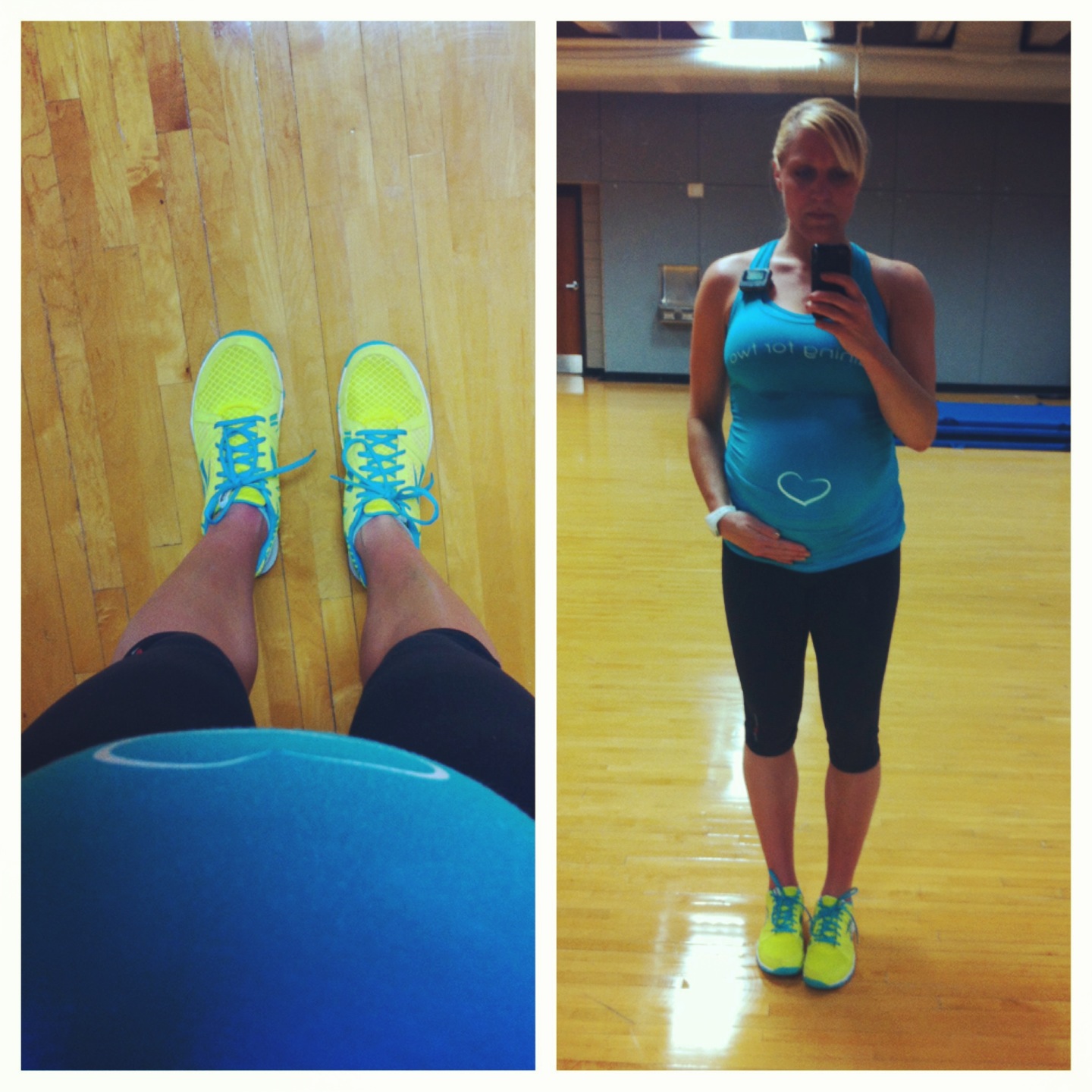
Jess shares a few shots on how she stays active during her pregnancy

Jess shares a few shots now that she’s working out for two!
Credit: Jess Allen/BlondePonytail.com

You can’t read a celebrity magazine nowadays without seeing some kind of commentary on pregnancy and weight gain, whether women are being criticized for being too thin or too heavy.

All this attention on the pregnant figure got me thinking about the changing attitudes toward exercise and pregnancy and how we still have a long way to go in debunking popular myths about staying active while expecting.

To learn more (the topic hits close to home; my sister gave birth March 18), I sat down with blogger Jess Allen of BlondePonytail.com, a personal trainer, group fitness instructor, adjunct exercise science instructor, CrossFit fanatic, coach’s wife and former Stanford softball player (whew!).

Allen is not only in the final few weeks of her pregnancy, but she’s also uniquely qualified to address some of the most common concerns when it comes to working out for two.

Kinetic Fix: How do you think the views toward exercise during pregnancy have changed over the years?

Jess Allen: Thankfully, our society has embraced fitness and pregnancy in recent years. No longer is pregnancy a sentence for sedentary lifestyle. We are seeing women stay active throughout their pregnancy continuing to run, strength train, CrossFit, with modifications, for the duration!

Why is it important for pregnant women to maintain their fitness routine?

While pregnancy isn’t the time to make gains or set PR’s, maintaining one’s strength will help support the impending weight gain that occurs. I think maintaining one’s fitness throughout pregnancy not only promotes an easier delivery (I sure hope this is the case with me!), but women can recover much faster postpartum by staying active.

Walk us through your own experience: Did you amp up your workouts in anticipation of pregnancy, or did you take a wait-and-see approach?

To be honest, this pregnancy was a bit of a surprise! However, I was in the best shape I’ve been in since college, and that has played a huge role in how great I have felt during this entire pregnancy. My energy level and strength have been consistent. As a result, my weight gain has been manageable, and I’m still teaching classes! However, with some workouts, like CrossFit, I have reduced my intensity and expectations.

What’s been the biggest benefit of working out while pregnant?

By practicing a “fit-pregnancy,” I have received many compliments from women telling me how empowering it is to see! That excites me! I want to continue to set a healthy, active example for my future daughter. Staying fit is simply a lifestyle.

Has anything surprised you about exercising with your “new” body?

My lack of mobility! Now that I have a growing belly, I simply don’t have room to bend and move like I used to!

What’s the biggest myth you’d like to dispel about fitness and pregnancy?

The prescribed heart rate (140 bpm) is merely a ball-park figure. Listen to your body. If you can talk and exercise, you are probably fine to keep going. Likewise, be realistic and forgiving; you won’t be able to push yourself like you did pre-pregnancy, so adjust expectations accordingly.

Any favorite exercises for expectant moms that you can share with us?

Even though the mid-section is growing in girth at this time, planks and the many plank variations, help pregnant women support a growing belly, strengthen upper body, and maintain a strong core. Additionally, I love kettle bell swings for a full-body strength move that gets your heart rate up!

Have you made any plans for getting back to your pre-pregnancy level of fitness once Baby Girl arrives this summer?

I have thought a lot about this already! I know I must be adaptable to a new schedule and routine with a baby, but my plan is to utilize the HIIT (high intensity interval training) home workouts I have created in the past and take advantage of my home “gym.” These workouts are efficient but VERY effective, so I don’t need to spend hours working out. Because it will be summer, I anticipate spending time outside, walking my dog and gradually incorporating running and CrossFit back into my routine. Additionally, I plan to breastfeed, so my food choices will revolve around healthy, nutrient-dense foods so my daughter and I both benefit!

Interested in learning more about exercise while expecting? Check out Jess’s blog, Blonde Ponytail, for great workout tips, training advice, nutrition information and more.

And stay tuned for my post-pregnancy interview with Jess…we’ll discuss her workout and weight-loss plans after Baby Girl Allen makes her debut in just a few short weeks!