Dad Knows Best: Must-have advice for life…and working out

Dad

Happy Father’s Day to dads everywhere!

Moms may have gotten nominated as having the #WorldsToughestJob, but dads don’t necessarily have it easy either.

So listen up, and heed all those words of wisdom from over the years…if not for life, at least for your next workout or race. You can thank him later.

“Use common sense.”

Pause, even if just for a second. Think before you act, and respond rather than react.

Common sense is a biggie with my dad, and taking a moment to think something through — whether it’s a project at work, a plan with a friend or a race-day strategy — can help you avoid costly mistakes and missteps.

“Money doesn’t grow on trees.”

Sad, but true — which is why it’s important to prioritize and spend resources (time, money, energy) on what’s most important to you.

At first glance, it may seem limiting. But, in fact, it can be freeing to focus on quality over quantity, be it trips, toys or even race entries.

“Just try your best.”

You don’t really know what you’re capable of until you try. And in the grand scheme of things, as long as you know you gave it your all you can — and should — be proud.

In fact, there’s a great running quote about this that I love: “Dead Last Finish is greater than Did Not Finish, which trumps Did Not Start.”

“Actions speak louder than words.”

Another quote to consider: “There are wish bones, jaw bones and back bones. Those who dream about doing things, those who talk about doing things, and those who actually accomplish things.”

Don’t waste a bunch of time talking about things. Just. Do. It. (Thanks, Nike!)

“Eat your vegetables.”

A side effect of growing older (and smarter)? Coming to the realization that sometimes what’s best for us isn’t always the easiest or most appealing option (at least at first).

But you know what? A little delayed gratification can be good; in fact, it builds characte, strength and an appreciation for the process, whether you’re saving up for a special treat or training for months in anticipation of a big race.

“Always have something to look forward to.”

It’s easy to slip into a bit of a lull now and then — especially after a big life event or the completion of a major race.

So to avoid the blues, I always try to plan my next race or event as soon as possible. Make a game plan to improve upon past mistakes, and give yourself a new goal to which you can look forward and work toward.

“Never regret the choices you make in life.”

This one’s always a work-in-progress, but I’d like to think of life less as a path of “wrong” and “right” turns and more as a series of opportunities to learn.

Of course, this is often much easier said than done! But all you can really do is take what you know, and try to grow from it.

What’s your favorite advice from Dad?  

Mom Knows Best: Can’t-miss advice for life…and breaking a sweat

Mom

Happy Mother’s Day to moms everywhere!

No vacations, no salary, screaming bosses, dealing with poop and vomit. It truly is the #WorldsToughestJob, as evidenced in this recent ad.

Haven’t seen it yet? It’s definitely worth a watch — and, wow, I guess it also goes without saying that Mom has probably picked up a few pointers for dealing with some discomfort, disappointment and delayed gratification along the way.

Which is why we need take her up on that advice…if not for life, at least for your next workout or race. You can thank her later.

“When God closes a door, he opens a window.”

Got injured and had to drop out before that big race? Been there. Didn’t hit your paces or snag that PR…again? Done that.

As frustrating as it feels when things don’t go as planned, try to roll with the punches, keep an open mind and find the growth opportunity in every situation.

“Always be curious.”

Without curiosity and learning there is no growth or forward motion, so don’t be afraid to explore.

Mix up your weekly workout regimen, add in a new form of cross-training, test out a different training program. You won’t know until you give it a shot, and you just may be pleasantly surprised with the results.

“Approach life with a light heart.”

From funny race photos to mid-workout flatulence, from getting lost on trails to losing your lunch in front of people, there’s a good chance something embarrassing will happen sooner or later while you’re breaking a sweat.

In every occurrence, find the funny. And surround yourself with like-minded friends who can help change these moments — or even your life — for the better.

“Don’t judge a book by its cover.”

Every time I race I’m reminded of this one. And as much as my ego gets bruised when I’m passed by the 70-year old man in sweats and an old-school pair of gym shoes, it also makes me smile.

The lesson here? As my grade school history teacher said, “Don’t assume anything. You only make an ‘ass’ out of ‘u’ and ‘me.'” No athlete is perfect, but perfection has never been the standard. Where’s the fun in that, anyway?

“You catch more flies with honey than vinegar.”

It goes without saying that you should be nice to others — but remember to hold yourself in the same regard.

Caught up in negative self-talk? Nip it in the bud, and tell that evil voice inside your head to take a hike.

“Never change who you are for someone else.”

When the gun goes off on race day, there’s an explosion of ego and adrenaline. It’s easy to get caught up in it and speed off…only to crash when your body realizes it’s moving at an unsustainable pace.

A better plan: Run your own race. Competition is good. It’s inspiring, and it can bring out the best in us. But real satisfaction comes from self-motivation, so don’t surrender control of this essential asset.

“Don’t underestimate the power of a nap.”

Classic trench coats. Fresh flowers. Good manners. Little black dresses. Some things never go out of style — and a decent nap is one of ’em.

It works like a charm, whether you’re three, 33 or 103. So if it ain’t broke, don’t fix it!

What are your favorite words of wisdom from Mom?  

What’s the deal with running?

bank-800

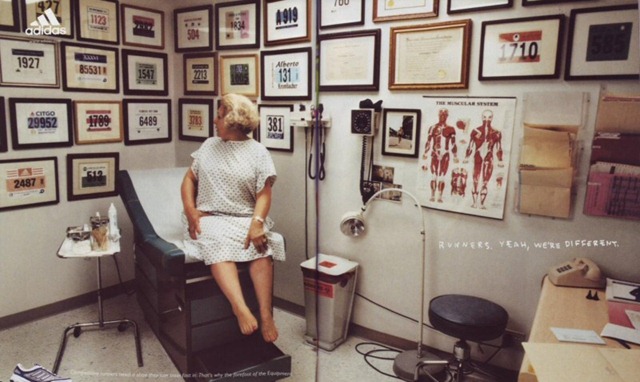
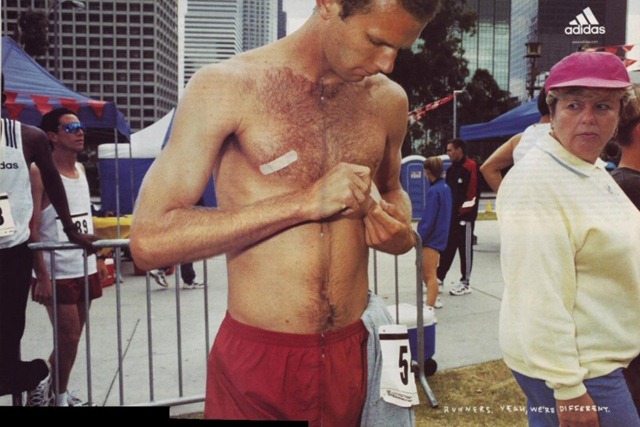
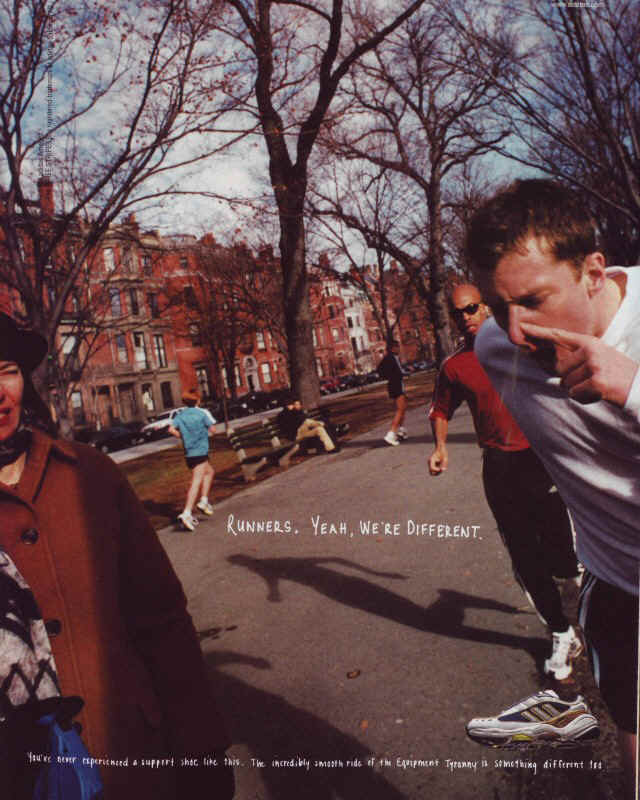
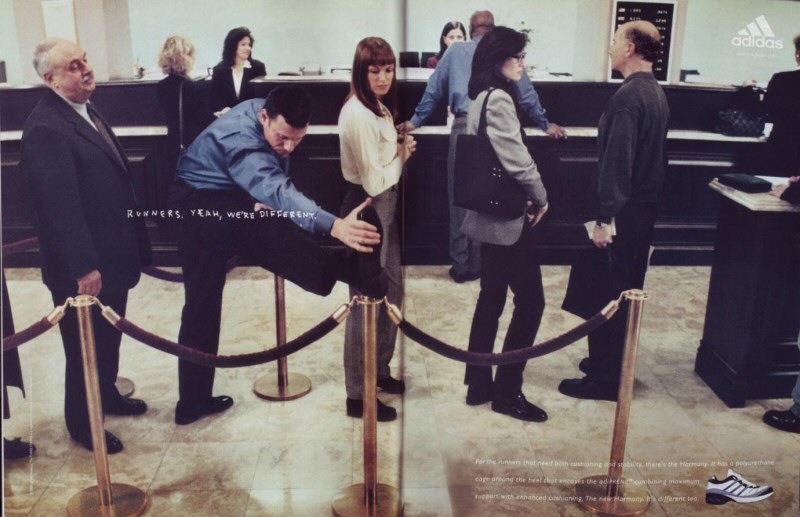
Runners….yeah, we ARE different, as the ads proudly state.

After exploring the quirks of swimming and cycling in honor of my recent triathlon training, I’m turning the mirror on myself and my swift-footed cohorts to examine some of the peculiarities of the third and final discipline, such as…

What’s the deal with the preoccupation with bodily functions?

Here’s a little running math for you: Whether it’s color and frequency of “number one” — or consistency and urgency (!) of “number two,” the telling of too much information goes up exponentially as either A) the number of runners or B) the length of any run increases.

droffice800

What’s the deal with the gross side effects?

I’ve seen plenty of pictures and run across the occasional telltale red dots on male runners’ shirts at longer endurance events, but it wasn’t until my 30K at Lake Chabot this past winter that I came face-to-face with the worst case of bloody nipples I’ve ever seen. My girlfriends and I had to hold back shudders as we watched a gentleman cross the finish line with red literally streaming all the way down to the hem of his shirt.

Another lovely unintended consequence of pounding the pavement? The dreaded black toenail — aka it’s-only-a-matter-of-time-’til-it-falls-off syndrome. I’ve been fortunate up until this point (knock wood), but it’s only a matter of time — or a combination of lengthy descents and ill-fitting shoes — until this happens to most of us.

tape800

What’s the deal with snot rockets and spitting?

Not only does a good run get our competitive juices flowing, but it also gets our bodily fluids going, as well. I envy the runner who can launch perfectly-formed pockets of spittle or blow a spray of snot with sniper-like accuracy. Whenever I’ve attempted to do so, I end up with a face full of spit — or worse.

snot-rocket-800

What’s the deal with race-day rituals and superstitions?

Whether it’s a special pre-race dinner, a lucky piece of clothing, a favorite pair of shoes, a particular way to tie shoelaces — or, like me, putting the left shoe on first — running tends to bring out the quirks, rituals and obsessions in every one of us.

The oddest part? We can tell you what it is, but we often can’t tell you why we do it. Because even we don’t know why; we just know it works.

696f4ebdfdf9ed2b85d2a4859e088c9d

What’s the deal with the fashion faux pas?

I’ll be the first to admit guilt here: Back in my high school track & field days, I was out there in my shorts, sneakers and (cringe) tall athletic socks, which were neither running nor compression socks, but rather the awkward mid-calf length cotton variety.

Other offenders here include shorts that are too short or too long (both bad for obvious reasons), blindingly bright colors (although great for night runs!), socks with barefoot shoes, obscene amounts of gear and other assorted fashion fails.

And don’t even get me started on our shoe collections… As my Twitter friend Peter Esko so eloquently put it: “The correct number of running shoes is n+1 where n is your current number of running shoes. #moreshoesmoremiles”

I couldn’t have said it better myself.

Any other running-related habits that you find humorous?

What’s the deal with cycling?

seinfeld_rect

In a recent post, I channeled Jerry Seinfeld and talked about some of the fun idiosyncrasies of swimmers in the style of his popular “What’s the deal with…?” routine. Well, now it’s time to turn to cyclists, the second discipline in the triathlon trifecta.

So without further ado, here are a few questions I’d like to pose to my fellow riders now that I’ve immersed myself in the cycling culture during training. For instance…

What’s the deal with aerodynamics? 

Ok, I know what it is and why it’s generally important. But spending thousands of dollars in an obsessive quest to shave off mere milliseconds? Sure, I get why the pros and age-group podium contenders do it, but let me be clear — I’m talking about us middle-of-the-pack racers here.

I’m competitive and I want to improve as much as the next person, but there’s a point where it starts to get a little silly. After all, as I overheard recently at a bike store, “The least aerodynamic part of the bike is the rider, and there’s only so much you can do with that.”

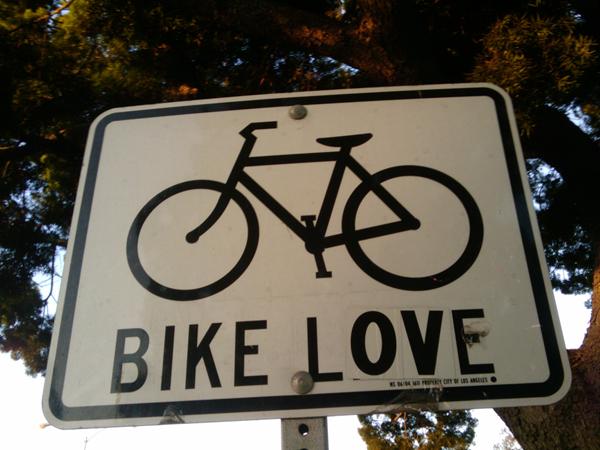
What’s the deal with “bike love?”

I never quite understood affection toward an inanimate object…that is, until I met Winnie.

My trusty Cannondale commuter got me through several sprint-distance triathlons just fine, but once I set my sights on longer races, I knew that an upgrade would be inevitable. What I didn’t expect was that my feeling toward biking would turn from ‘meh’ to maniacal as a result.

Quite simply, it was love at first sight. Not only is she beautiful, but every new adventure we tackle together has also been full of pure joy and exhilaration. Our relationship has been moving along quickly, but I’m hoping (with more time together) we can go even faster because I’ve got a good feeling about this one…

bike-love-sign

What’s the deal with clipping in?

Just like aerodynamics, I understand the reasoning behind it, but still think it’s a funny concept. Especially the fact that falling over in slow-motion while clipped in is a rite of passage for many athletes.

What’s the deal with helmets?

Nope, I’m not talking about those oddly-shaped aero ones (although that could be a whole other blog post); I’m talkin’ about the fact that while bicycle helmets do a good job of keeping our skulls intact in a major crash, they do almost zilch to prevent concussions and other significant brain injuries.

Wait — what?!

Yep, I didn’t know that either…until a friend of a friend at a bike store mentioned it during our conversation about cycling gear. This article in Bicycling Magazine is a must-read on the topic; it goes into detail about bike helmets and the current state of the industry with respect to research on concussion and brain injury.

The article’s author puts it perfectly: “The choices cyclists make with their money matter. You can pretend to protect your brain, or you can spend more money and get closer to actually doing it.”

What’s the deal with the etiquette (or lackthereof)?

Finally, from feelings of intimidation when walking into bike stores to feelings of indignation upon being yelled at by cyclists while running and trying to share the road, I found it tough, initially, to develop the warm-and-fuzzies toward a culture that felt, well, kind of cold compared to running.

Luckily, however, my stubborn streak kicked in…along with a healthy dose of curiosity and a determination to succeed. So, sure, I’ve still got days where I suffer from major imposter syndrome (a “runner in cyclist’s clothing,” as I call myself), but it’s usually overridden by those feelings of euphoria mid-ride.

And for every person who went whizzing by without so much as a, “You ok?” while my girlfriends and I were on the side of the road trying to troubleshoot our first tire change, there have been others who warmly welcome newbies with open arms. Case(s) in point: my Coeur teammates, who patiently took me on my first long ride (clipped in, no less) — not to mention Gethyn, my “bike matchmaker” from Hank & Frank Bicycles, who helped me navigate the first-real-bike-purchase process.

Thank goodness for them — otherwise, there’s a good chance I might have been trying to compete in next month’s triathlon on my old mountain bike!

Any other cycling eccentricities that make you go ‘huh?’ 

Swim musings: Channeling Jerry Seinfeld

jerry_seinfeld065

I’ll be the first to admit that we runners have our quirks (snot rockets, crazy tan lines and an affinity for talking about GI issues, to name a few), but like any healthy relationship, you take the good with the bad, right?

But now that I’m taking things to the  proverbial ‘next level’ with swimming and cycling, I’m starting to notice some funny peculiarities in the other disciplines, as well. And each time that happens, I smile to myself because I can hear Jerry Seinfeld’s voice in my head with his “What’s the deal with…?” schtick.

For example…

What’s the deal with goggles? 

I can never seem to get the suction just right; either they’re just a tad loose and water leaks in, or they’re airtight and sucking my eyeballs out of my skull. Then what follows is the lovely no-amount-of-makeup-will-cover-these under-eye circles that are anything but flattering.

What’s the deal with swim lane speeds?

I get it, it’s more of a suggestion than a hard-and-fast rule. But does anyone else get self-conscious about choosing a lane when it’s crowded and there aren’t many options? I’m not about to pretend like I can hold my own against the Michael Phelps-lookalike in the fast lane, but I certainly prefer not to bob and weave around the lady who’s taking up one whole end of the slow lane with her water aerobics routine.

What’s the deal with locker room etiquette?

It never fails — at the exact moment I’m wrestling out of my wet swimsuit or awkwardly hopping around trying to tug some clothes back on, someone shows up and needs to get into the locker right next to me. Urgently.

What’s the deal with getting into the zone?

Unlike running, cycling or even open-water swimming, where I can admire the scenery and entertain myself with the pursuit of a destination, staring at that black line for 45 minutes can get monotonous. But as soon as I focus on drills or — the opposite — get lost in my thoughts as a way to keep my mind occupied, I inevitably lose count of where I’m at in my workout.

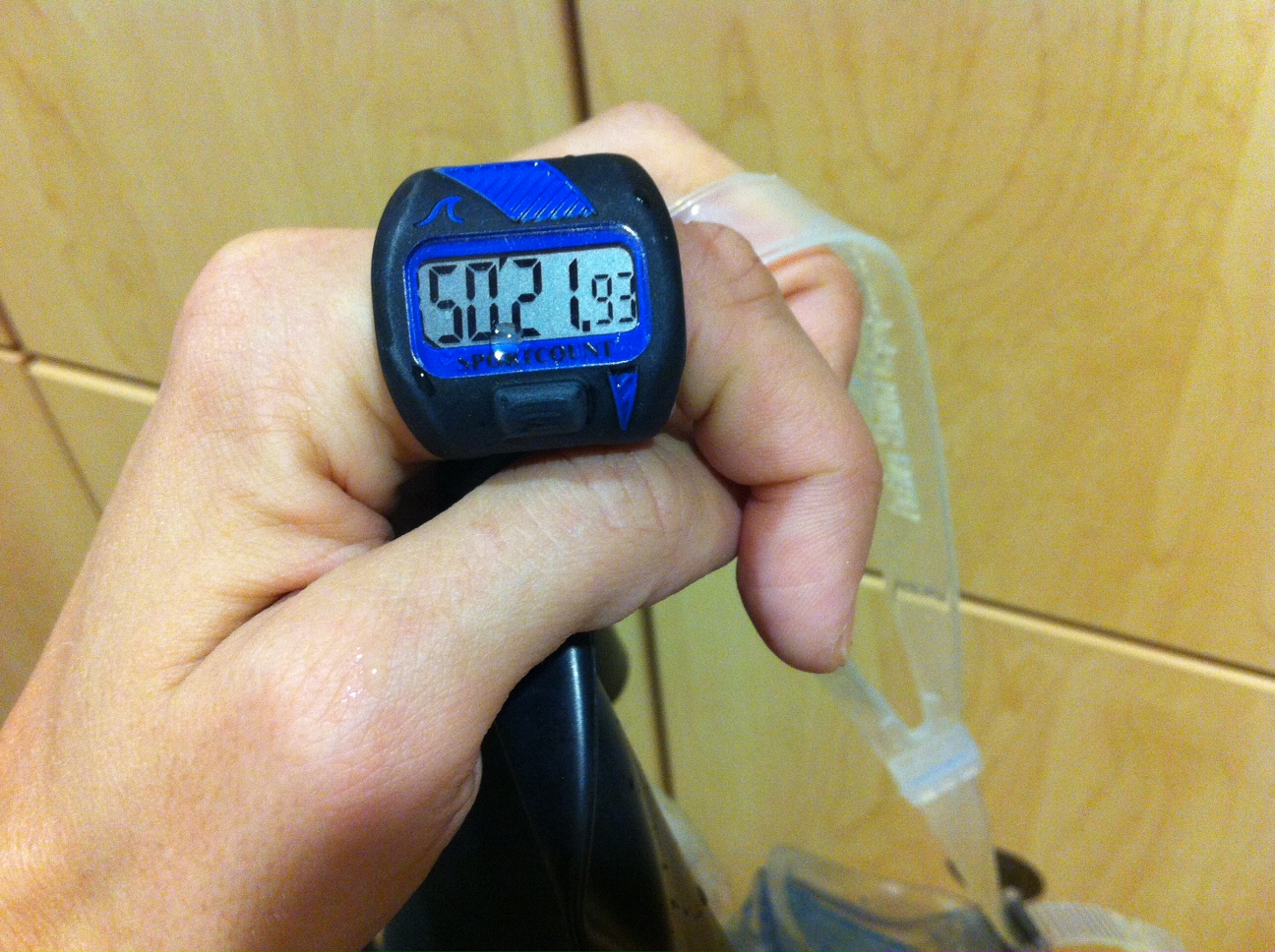
photo 3 (2)

Side note: I finally outsmarted myself here and got a SportCount (i.e. sanity-saver) so I can concentrate on things other than ticking down lap numbers. I just hit the button with my thumb each time I complete a full lap, and it keeps track of total time, number of laps and average time per lap (including fastest and slowest laps).

What’s the deal with training swimsuits?

It took me a good month of testing several suits to finally find a brand and style that worked well for my body type (read: opposite of your stereotypical swimmer). God bless you if you’re among the 0.5 percent who looks good in one of those one-piece Speedo suits.

I’ll stick to my Athleta tankini, thank you very much,  and will be in the medium-speed lane, if you need me!

Got any athletic eccentricities you care to share?   

OWS in OWS: Overcoming Weenie Syndrome in Open Water Swimming

Aquatic Park Source: Flatstar Design

Aquatic Park, my open-water nemesis (Source: Flatstar Design)

“Courage is being scared to death, but saddling up anyway.” – John Wayne

A few months back, when I signed up for my spring Olympic-distance triathlon, I figured I’d let “Future Jennifer” deal with figuring out all the swimming and biking details (i.e. the parts that confuse, intimidate and occasionally terrify me as a runner). Of course, this included the fact that I not only lacked the endurance and technique to complete the swim distance, but also the ability to do so in open water without having a full-on panic attack…so I knew I’d have my work cut out for me.

Fast forward a few months, and “Present Jennifer” now has the endurance portion covered and the technique in-progress, thanks to some time at the local pool and the patience of Hubby and our swimmer friends. But the open water part has been something I’ve been avoiding. Like the plague.

I eased into the process with the purchase of my first wetsuit, which I wore around the apartment one evening before promptly packing it back up and stashing it in the corner of my closet. Then I read a book on women in triathlon, researched training plans and even extended my swim sessions, but every time Hubby brought up the idea of a dip in the Bay, I’d conveniently come up with any an excuse.

That is, until our local pool closed for repairs, the weather spiked to 70 degrees, and I seemingly ran out of reasons not to go. So before I knew it, we were packed up and headed out for a swim this past Saturday in Aquatic Park.

photo-8

Pre-swim: Trying to channel “heart & courage,” but not so sure about this…

Now, I’ve done a few short swims (i.e. two sprint tris) in the quarry near where we used to live in the East Bay, but there were a few things that were especially concerning to me during this new foray into the unknown, including:

  1. Water temp, which was an ice-cream-headache-inducing 52 degrees
  2. Wet suit, as in I’ve never used one before
  3. Wildlife, meaning I love sea lions, but only from behind the glass at a zoo
  4. Visibility, or complete lack thereof
  5. Water quality…I’ve heard rumors of rashes, conjunctivitis, earaches and more

Nevertheless, I knew I had to saddle up sooner or later. So amid stares and comments from tourists (“I can’t believe there are people swimming in that water; it’s freezing!”), we readied ourselves on the beach, and Hubby gave me one last piece of advice before we set foot into the water: “You know it’s going to be cold, so whatever you do, don’t stop. Just walk in as fast as you can, and dive under.”

As he started toward the water, I found myself fighting the “flight” urge to turn and run off up the beach. But A) I can’t make a very quick getaway in a wet suit, B) I already went through the struggle of tugging it on, and C) I’d never forgive myself for letting fear get the best of me (not to mention, Hubby would never let me live it down). So into the water we went.

Aquatic Park: Can't complain about the scenery! Source: Marathonswimmers.org

Can’t really complain about this scenery, though (Source: Marathonswimmers.org)

My feet, hands and face were cold during the initial plunge, but it wasn’t unbearable. The temperature actually became less of a factor than some of the other items on my list — namely the lack of visibility and (the possibility — aka imminent threat — of) wildlife. After tracking the black line on the bottom of the pool for the past few months, losing all sense of sight in the murky green water really threw me.

But aside from a flock of birds floating on the surface of the water, there were no other signs of wildlife, thank goodness. Although that certainly didn’t stop my imagination from getting the best of me; I half expected to see a sea lion face emerge from the cloudy depths. As a result, my breathing was erratic, shallow and out of control, and I flailed around clumsily after mistaking a large stick for a snake, which Hubby found particularly amusing.

But I did eventually complete the down-and-back loop (1/3 mile) that I set out to do, despite an overwhelming and near-paralyzing level of anxiety. All technique was abandoned as I entered pure survival mode, alternating 10 swim-for-your-life crawl strokes with five breaststrokes in an effort to try to catch my breath (which I never succeeded in doing).

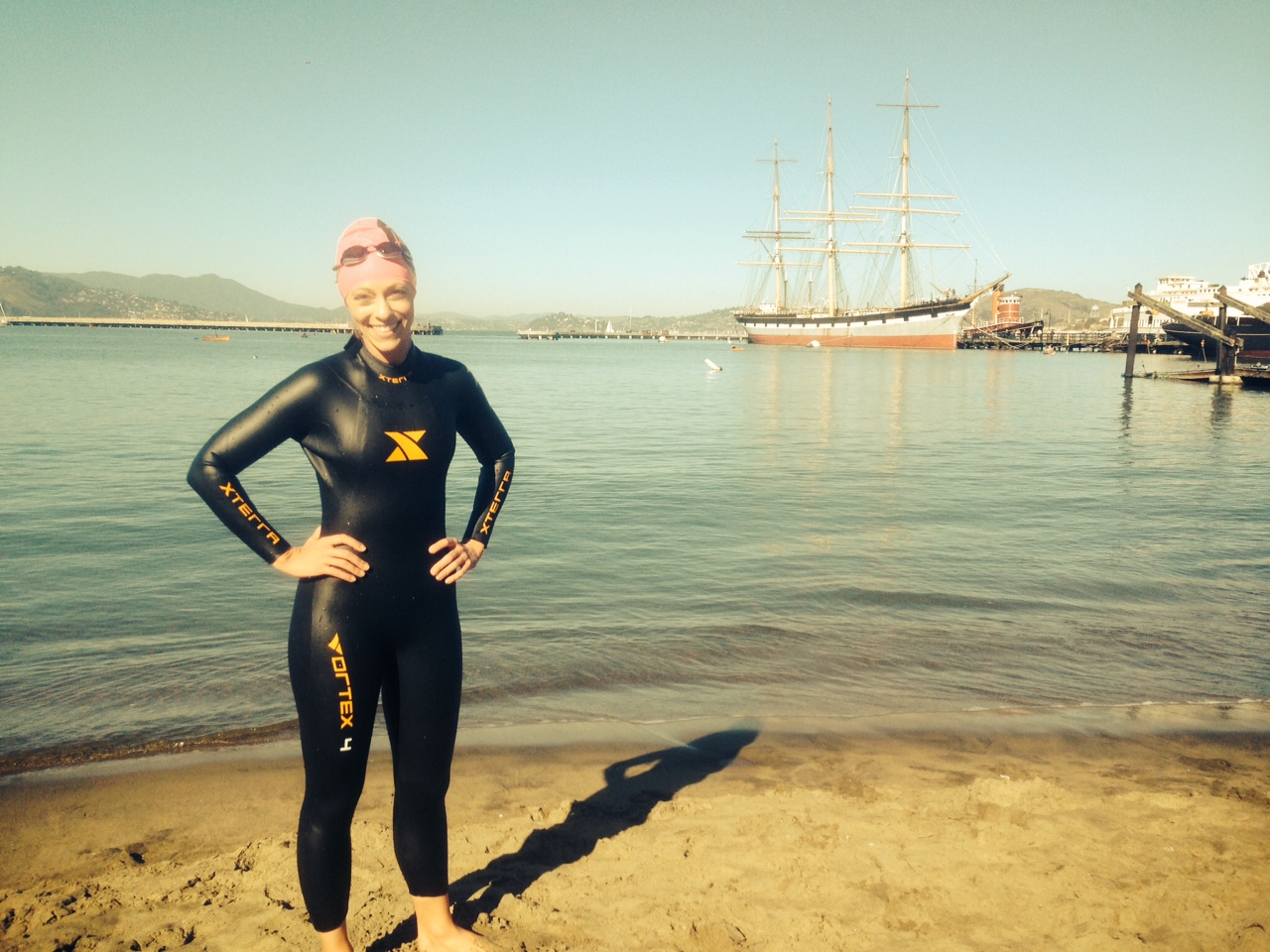
Post-swim: I survived!

Post-swim: Smiling; I survived!

The only small victory of the day was discovering that wet suit swimming, as it turns out, is awesome! I loved the added buoyancy, warmth and compression.

And now that I know I can handle a few of those factors (temperature, wet suit; the jury’s still out on water quality…), I’m hoping my anxiety levels will be a little lower the next time around. The trick will just be figuring out how to calm myself down enough to actually focus on proper breathing and form, which I’m guessing will come with time, repetition and familiarity.

And if all else fails, I may just have to perfect my dog-crawl technique…

Have you battled open-water anxiety? How did you cope?

Tri-ing something new for 2014

Source: Soles Inspired

Source: Soles Inspired

After a whole lot of time, training and trial and error, I was able to push hard, stay healthy and get a banner year of running under my belt in 2013 (i.e. PR’s in the 10K, half marathon and marathon distances). But in typical endurance athlete fashion, I found myself spending less time celebrating and more time thinking, “Ok…what next?”

Don’t get me wrong — I definitely savored every moment along the way, but each little win only added fuel to the fire within that had been smoldering ever since getting injured and having to drop out two weeks before a previous marathon. So after proving to myself that my body can handle it (plus, older = wiser when it comes to preventing injury), and with my confidence levels returning, the question then became, “Of what am I capable?”

Naturally, since running is my first love, a part of me wanted to give the sub-four marathon goal another shot after coming so close in October (4:07), while another part wanted to push my distance boundaries and try an ultra trail race (50K) to take a break from the roads, which gave my legs quite a beating this past year.

Ultimately, though, I decided to go in a different direction and “tri” something new for 2014.

Don’t worry; those running goals above are still in progress (as evidenced on my race page; the second half of the year is still TBD), but in the words of fellow Coeur Sports Ambassador Becca Wilcox, “2013 was my year to experiment, 2014 is where I grow.”

See, I like to think I’ve only casually dated triathlon so far; I’ve completed two sprint distances, muscling through them with minimal training, more as a method of staying in shape between major running events. But this year, my goal is to grow as a more well-rounded age-group athlete — more specifically, to train properly and compete in a middle-distance event (Olympic) to see if we hit it off and can get serious, with the hope of turning it into a long-term relationship (i.e. longer distances).

It hasn’t been an easy road so far — my first pseudo-Masters workout left me slinking under the lane dividers over to the slow lane after I could neither understand the workout lingo nor keep up with anyone, and my first long bike ride after a year-long hiatus left me terrified and with leg bruises, a black toenail and a jammed wrist after colliding with a runaway skateboard — but that’s part of the thrill of any new adventure, isn’t it?

As Nelson Mandela once said, “Courage is not the absence of fear, but the triumph over it.” So, it’s with that in mind that I start this latest chapter — inspired by athletes (in particular, two former high school cross country teammates-turned-triathletes, Terra Castro and Kelly Wilson, along with Meghan Manion, another friend who just completed her first Ironman) and in partnership with an amazing brand with which I completely admire and identify (Coeur Sports, where they’re all about heart and courage).

I’m currently in the process of finalizing my training plan, which I’ll be sharing shortly, along with all the thrills, chills and (hopefully not too many) spills along the way. I’ll also be soliciting advice and tips from my fellow Coeur teammates, many of whom are Iron[wo]men and know a thing or two (…or 15) about the sport.

Get pumped, guys; we’re only a few days in, and 2014 is already shaping up to be an exciting year. Here’s to aiming high, pushing hard and giving it everything we’ve got to reach our goals in 2014!

What challenges are you preparing to conquer in the New Year?

On marathoning and marriage

Source: Jordan Siemens

Source: Jordan Siemens

Between all the miles logged in training (i.e. time to think) and the fact that Hubby and I recently celebrated our seven year anniversary, I’ve been noticing some parallels between marathoning and marriage.

If you look at it as a race – not in the competitive sense, but in wanting to have a rewarding and successful journey – many of us get caught up in the ‘start.’ We struggle because ‘we’re young,’ ‘we don’t have any money’ or [insert whatever excuse here]. Truth be told, that’s a sprinter’s take on the subject when what would serve us better is more of a marathoner’s mentality.

See, sprinters know that the start is a critical element because time is of the essence when there’s little ground to cover; there’s no room for error. But marathons, on the other hand, are just the opposite. Even with a rocky start, we have the luxury of time to bounce back and ultimately have a great race.

Source: London Evening Standard

Source: London Evening Standard

Why? Because it’s not the start that’s important; it’s the endurance.

That change in focus can empower partners for ‘the long haul’ when it comes to pushing through conflicts without hitting the proverbial wall and quitting. No, there are no quick fixes to either marathons or marriage (and neither are painless!)…but I think we’d all agree that the potential reward is worth all the effort.

Now, I’m by no means an expert at either marathoning or marriage…but I thought I’d share a few of the nuggets of running wisdom that I believe just may translate into more moments of wedded bliss.

1. Have a goal in mind. 

Just as we choose races to stay motivated, it can help to set milestones for your marriage. Having common goals help both parties to get on the same page, and having something to work toward keeps you moving forward rather that getting stuck in a rut.

2. You get out what you put in.

If we want to get technical here, pretty much anyone who wants to do a marathon could probably cover 26.2 miles, but for the best possible experience, it’s smart to prepare properly. This means putting in the work up front to reap the rewards on the back end. There’s something to be said for a little hard work, dedication and delayed gratification – that means sticking to a training plan and putting some real effort into figuring out what it takes to whip your relationship into shape, as well.

3. Run your own race.

The most critical piece of racing advice is to not start out too quickly. Trying to keep pace with faster runners will only bite you in the behind in the second half of the race when you burn through your energy stores and hit the wall with a thud. The same can be said for marriage; just as every body is different, so is every union, so you’ve got to work toward your own personal best…not someone else’s.

4. Pace yourself.

If you’ve set a goal and trained toward it, it’s important to check in at regular intervals during the race to make sure you’re moving along steadily. The same goes for marriage. It’s not about showing your partner how much you love them in fits and spurts with the occasional grand gesture, but committing to treat each other well year-round because the little things really do add up.

5. Prepare for peaks & valleys.

For as many moments of triumph, there will be the inevitable time in the trenches. If you think you’re immune, you’re only fooling yourself, so it’s best to go in with a realistic approach and an open mind. Knowing that there will be ups and downs in your relationship will allow you to approach both with a good head on your shoulders. That way, you and your partner can ride the highs, work through the lows and realize that it’s all part of the experience – and not indicative of the final outcome.

6. Work through the wall.

It may be inevitable, but it doesn’t have to be fatal. Again, being aware of (and having a healthy respect for) the wall will help inform your plan of attack if/when it rears it’s ugly head. Instead of getting blindsided, throwing your hands up in the air and giving up, you’ll realize that sometimes it just takes a little extra push to work though what feels like hell – and that you may just come out better for it on the other side.

7. Rejoice in the journey.

Finally, in racing and in life, it’s all what you make of it. Having a sense of humor and not taking yourself too seriously (after all, I don’t expect to win a marathon…or a marriage-of-the-year award), helps keep things in perspective. One day, you’ll look back and realize that even though 26.2 miles – or whatever rough patch you may have been going though at the time – felt like it would never end, it was only a small segment in the grand scheme of your life.

What running wisdom do you apply to your relationships? 

I just ran 26.2 miles…now what?!

1394468_610296182347262_477887480_n (2)

If you read my race recap, you know that as soon as I crossed the finish line of my recent marathon, I actually told Hubby I never wanted to do it again. Ever.

But he called my bluff: “Ha. I give it two weeks, and you’ll be planning your next race.” 

As much as we joke (and he was right, by the way), it got me thinking about the inevitable post-event letdown.

You see, the marathon’s not over once you cross the finish line. Whether you ultimately rock it or it rocked you, there’s a lot of buildup to that big day. Those months of preparation become all-consuming and include hundreds of miles, a roller-coaster of emotions and a hell of a lot of commitment.

So how do you fight boredom, stay sane and find a sense of purpose once the intensity of training has ceased? It’s actually quite simple, when you think in terms of planning for it with as much care as you plan for everything that precedes the race…

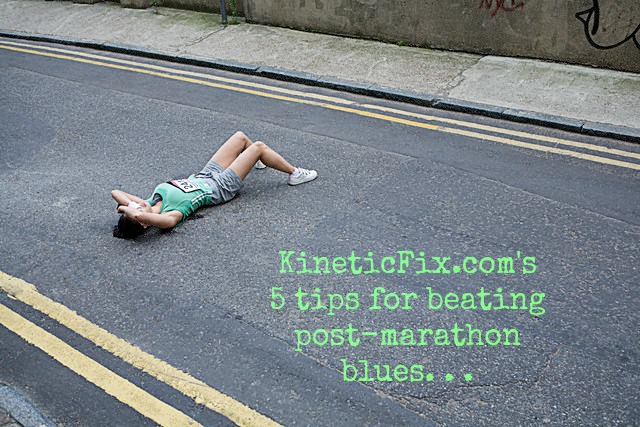
Women on Road laying down1

1. Replenish your body. Now’s the time to re-stock what you’ve depleted during months of hard training and a grueling race. Not only will it help move the recovery process along, but rewarding yourself with a favorite treat can also help lift the spirits (just don’t make a habit of it).

2. Kick up your feet. Although it feels counter-intuitive to avoid the very thing that helps you release stress and anxiety (working out), it’s important to let your body rest and recover because it sets the stage for your next round of training.

3. Set a new goal. Think both short- and long-term here. Start by assessing your race performance, then set a master goal, along with incremental goals to help get you there. Maybe one marathon was enough, so you choose a new distance and focus on training toward that. Perhaps you’re hungry to PR in your next marathon, so you focus on building speed and endurance to create a stronger base. Or if this marathon was a stepping stone to a longer race (ultras, triathlon), you can use it as a learning experience to inform your training going forward.

4. Ease back in slowly. Hit it too hard too soon, and you may end up setting yourself back with illness or injury. The general rule of thumb is to take an easy day for each mile you run in a race, so now is the perfect time to pick up a non-impact cross-training activity that will help strengthen your running down the road.

5. Listen to your body. Again, it can be tough to shift gears after months of putting pedal to the metal toward a singular focus, but make a concerted effort to quiet your brain and allow your body to lead the way. Did you notice any weak links during the race? Are you feeling lingering aches and pains in particular spots afterward? Now’s the time to address imbalances so you can “train up” those weaknesses for the next time you toe the start line.

So where am I at this point? Well, I’m happy it’s done, but sad that it’s over.

I’m thrilled with how my marathon went, although there are some things I might tweak next time around. Yes, I said “next time.” And no, I’m not signing up for one in the immediate future…but I’d be lying if I said I haven’t thought about giving that elusive sub-four goal another shot at some point.

For now, though, my main goal is to focus on increasing my speed so I can shoot for PRs at other distances — the half marathon and 10K, in particular. In terms of smaller goals in the interim, I crave the consistency of a regular training schedule, so I’ll be putting together a mix of speed-focused workouts, along with complimentary cross-training.

And, after allowing my body to properly bounce back, I’ll hopefully be ready to hit it hard in the next training cycle.

How do you beat the post-race blues? 

You might be a runner if…

Photo credit: Fleet Feet Sports

Photo credit: Fleet Feet Sports

Runners sure are a quirky bunch.

Age, distance and average pace aside, there are some things to which anyone who regularly laces up a pair of running shoes can relate.

Here are a few favorite idiosyncrasies that I’ve observed (and, yes, even participated in) over the years.

So, without further ado, I present:

You might be a runner if…

…you bond with people over the topic of poop.

…more than half of your laundry pile is workout clothes.

…you may forget birthdays and anniversaries, but you can instantly recall a PR or race date.

…you know what “PR” stands for (personal record).

…60 degrees and foggy sounds like the perfect SF summer day (for a run).

…you’ve stopped making fun of fanny packs because they closely resemble the belt/backpack you wear on long runs.

…there’s a dedicated space in your house for drying out your sweaty workout wardrobe.

…you think 50 Shades of Grey is a description of your pile of running socks.

…your monthly budget includes an allotment for race entries and travel.

…when people ask for directions, you gauge the distance based on your local running routes.

…your Nike+ monitor has more mileage than your car.

…you’ve gone from avoiding port-o-potties like the plague to being thankful when stumbling upon one mid-run.

…in the absence of said port-o-pottie, you’ve had to get creative with covert ops for relieving yourself.

…you pause for a moment when someone asks how old you are, but instantly state the age of your current pair of running shoes.

…several of your drawers are dedicated to old race shirts and medals that you’re not quite sure what to do with.

…you get excited when the latest Runner’s World shows up in the mail, and you save dog-eared copies for future reference.

…you’re actually excited to get older because it means you get to move up into the next age group bracket.

…when you see runners waving an arm waiting for their GPS watch to sync up before a run, you totally feel their pain.

…you can name the location of every free, public restroom within a running-distance radius.

…the first question you ask any doctor is, “So, when can I run again?”

…you can run miles and miles, no problem, but sometimes it’s a struggle to walk up/down stairs.

…forget “farmer’s tan;” you’ve got all sorts of odd lines from various socks, shorts and shirts.

…you religiously keep a training log to track your mileage, and you’d never dream of rounding a 3.75-mile run up to a “four-miler.”

…you don’t bat an eye at spending upwards of $150 on running shoes, but you refuse to buy dress shoes unless they’re on sale.

…you’ve apologized during a pedicure for the calluses and/or blisters all over your feet.

…there’s a special place in your pantry for protein powder, gels and recovery drinks.

…you pay close attention to the color of your pee.

…driving by a golf course, your first thought is, “That’d be a great spot to get in some hill work.”

…your favorite food group is carbs, and you can eat your weight in them.

…during training, your highest heels are your running shoes.

And, finally…you may be a runner if you made it all the way through this list and found yourself nodding along.

Did I miss anything? Feel free to add your favorites in the comments below!