No sleep ’til Seaside…or Calistoga

ragnarrelay

Every runner has a bucket list, whether it’s to cover a certain distance, reach a specific time goal or sample a new kind of event to keep yourself feeling challenged. And while the first two are usually moving targets (read: works-in-progress), the third is actually something you can feel the satisfaction of checking off the list.

That’s precisely why, when I was asked to join two 24-hour relays — one in Oregon and one in California — this summer/fall, I jumped at the chance for both.

Now, my idea of a fun weekend isn’t exactly jumping into a van with strangers, then depriving ourselves of sleep and running without showering three times over so we can cover 200 miles together… But you know what? I’ve heard that it’s a bonding experience, a chance to make new friends and create some pretty cool memories, so it’s something I’ve always wanted to try.

And I guess now I’ll just have twice the tales to tell afterward!

What is Hood to Coast?

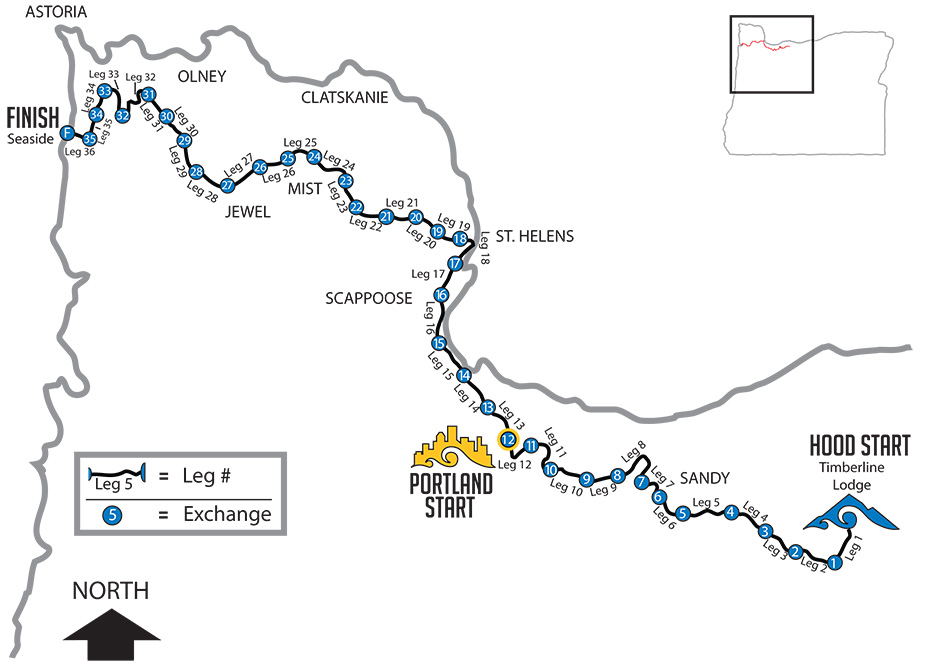
The “Mother of all Relays,” Hood to Coast is one of the longest and largest relays in the world with 12,600 runners (1,050 teams of 12) tackling a 200-mile course that runs from Timberline Lodge on the slopes of Mount Hood, the tallest peak in Oregon, through the Portland metropolitan area, and over the Oregon Coast Range to the beach town of Seaside on the Oregon coast.

course-map

Hood to Coast began in 1982 with eight teams and has filled the team cap on the opening day of registration for the last 16 years straight.

There’s even a whole documentary dedicated to the event, the Hood to Coast movie, which covers four unlikely teams on their epic journey to conquer the race. I watched it a few years back, and was instantly hooked; check out the trailer here.

What is Ragnar? 

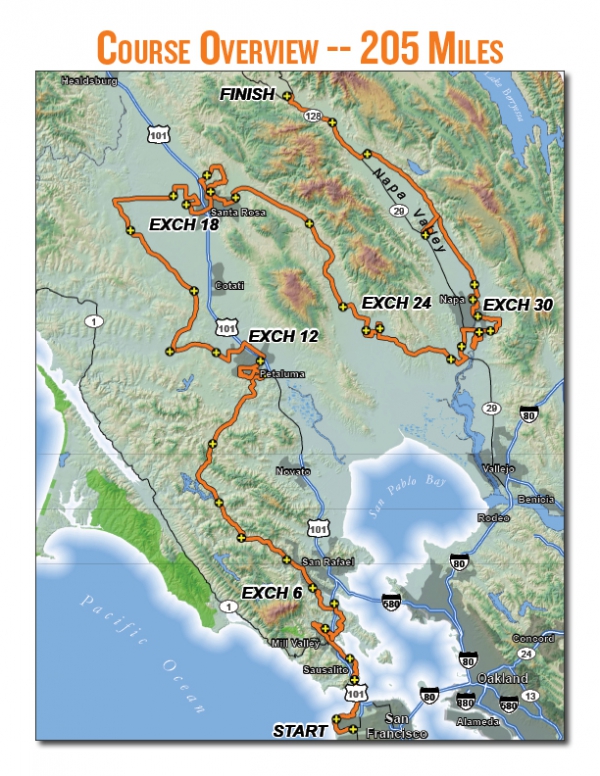
As the Ragnar Relay Series’ official “run now, wine later” race, Ragnar Relay Napa Valley is set in — you guessed it — Northern California’s wine region during harvest season. Teams start from San Francisco and race across the Golden Gate Bridge, then experience the rolling hills and farmland of Petaluma before heading toward the Valley of the Moon.

nevgg5xrmwbmtoao9ad1

Just as with Hood to Coast, teams of 12 are split evenly into two vans. Only one runner hits the road at a time, and each participant runs three times, with each leg ranging between three and eight miles and varying in difficulty. As they say, “Some call it a slumber party without sleep, pillows or deodorant.”

Yep. It’ll be run, drive, eat, sleep (?), repeat for 200+ miles as we trek through my old stomping grounds. Check out the promo video for the event here.

Two 24-hour relays in two months…are you crazy?!

The short answer: Quite possibly. But you already knew that, right?

The long(er) answer: I’d be lying if I said I wasn’t a little anxious about taking the plunge on not one, but two. I mean, I like my sleep, and if given the choice I’d prefer not to stink up a van with five others as we hang out in our filth for a whole day.

But…I’m also eager to switch up my racing routine, which will keep me motivated during this marathon training cycle. And if I’m looking on the bright side of not sleeping for 24+ hours (if there is one), these races will not only allow me to get more experience running on tired legs, but I can also cross two big items off my bucket list.

Although I’ll likely need a nice, long nap at the end.

Hood to Coast is August 22-23, and Ragnar Napa Valley is September 19-20. Stay tuned for race recaps with all the details as I cover almost 400 miles with my respective teams! 

Race Report: Beaverton Sun Run 10K

photo 1 (6)

Ok, let me cut to the chase — final time: 44:14 (1st age group, 6th woman, 20th overall).

First thought: Where the heck did that come from?!

Second thought: I guess I can’t complain anymore about the Hansons’ “cumulative fatigue” concept. 

But let me rewind and start at the beginning…

photo 2 (6)

Since we aren’t up in Portland just yet, Hubby and I had about a 90-minute drive to get to the race, which was slated to start at 8 a.m.

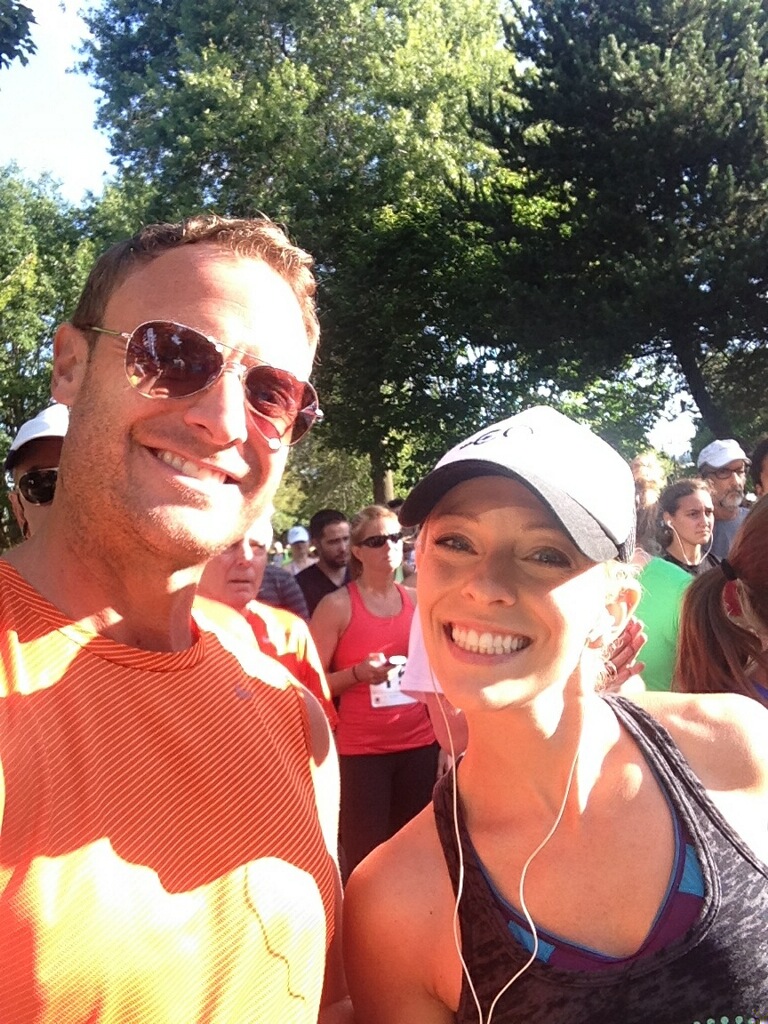
Factor in us not liking to hang around too much before the gun goes off with it being a more relaxed event (see start line shot above), and we arrived with 30 minutes to spare for packet pickup and a quick port-o-pottie pit stop.

At one point Hubby mentioned he’d like to try for a PR in an upcoming race, but that he was content to stick together for this particular one (he’s clearly the hare to my tortoise).

My response? I don’t think today is that day. Especially since I had been feeling pretty wiped out all week from the jump in mileage and accumulated fatigue in my legs.

So we agreed to keep the pace around 8:30-8:45 and play it by ear.

Famous last words.

photo 2 (4)

For the first mile, I had to talk Hubby down from going out too fast: We’ve got six miles to catch everyone who’s rushing out, I said. Let them go.

But after we settled into our own space and found a pseudo-comfortable rhythm, I looked down at my watch and saw that our pace was fluctuating in the 7:XX range. Huh. 

Despite my PF flare-up this week, my heel was feeling ok. And as we ticked off the miles, we kept checking in with each other. You good? Yep. Me, too. Cool.

So we held where we were at, and I saw 22:XX on the clock for the first 5K lap.

There’s no way I can maintain that for another three miles, I thought. We came out way too fast; we’re going to crash and burn this next lap. 

But we stayed steady and passed the time by thanking volunteers, shouting some brief words of encouragement to fellow runners and trying to figure out where we were in the pack as we focused on running the tangents.

I think all the San Francisco hills helped, too, because the course was super flat, fast and PR-friendly.

And before we knew it, we had the finish line in sight. Hubby started to pull away, but I had to save my last kick for the final 100 yards or so because I was battling a side cramp.

The best part? Seeing 44:XX on the clock and knowing we ran even splits, which means our pacing was on-point.

photo 2 (5)

There’s nothing like an PR early on in training to give you an extra boost of confidence, especially when I could feel myself slipping into a negative mindframe this week while fighting fatigue and injury.

As my Twitter friend Mike put it so well, “#CumulativeFatigue= sweet&sour.” 

Yep, I know that this training cycle won’t be easy, but the Hansons definitely know what they’re doing, so I’m putting my complete trust in their program from here on out.

I’m also looking to add an August race into my schedule! Anyone have suggestions in and around Portland for late in the month?

Iron(wo)man Meghan Manion on recovery, racing and relationships

MeghanManion2

Meghan Manion will tell you that her Ironman finish last fall is a testament to what an “average” person can do with with proper training and coaching, but I happen to think it’s more about someone who lives her life putting a little (or a lot) “extra” in the ordinary.

And, clearly, I wasn’t the only one inspired by my interview with her about that 140.6 race experience; it’s been one of the most popular posts, most likely because her positive attitude and outlook are simply infectious.

So I thought it’d be fun to sit down again with Meghan to check in on what she’s been up to since swim-bike-running her way around the Sunshine State.

KineticFix: Thinking back to those first few days (and weeks) post-race, can you walk us through the recovery process after your Ironman?

Meghan Manion: When I woke up the morning after my Ironman, I remember my eyes welling up with tears, just realizing that I had really done it. It all kind of sunk in at that moment.

My next thought was that I was hesitant to move for fear of intense pain! I moved slowly, and quickly realized that I was feeling just fine. No chafing, no soreness, no joint pain at all. I walked normally to the bathroom to brush my teeth. I did not expect that to be the way my morning went!

I’ll attribute the lack of chafing to four generous smearings of Chamois Butt’r throughout the day. The lack of pain….I’m still pondering that. I think the most likely answer is that Team Z just prepared me THAT well for the Ironman.

Photo courtesy of Gabrielle Petersen

Photo courtesy of Gabrielle Petersen

I definitely continued training after the race in all three sports, but at a much lower intensity. My motivation did start to fail as the winter arrived; however, I had signed up for the Goofy Challenge (Saturday half marathon, followed by Sunday full marathon) in Disney World two months after the Ironman to give me something else to work for through the winter.

That helped a little bit, but I definitely could have trained better for the race! In March, I ran the Shamrock Half Marathon in Virginia Beach, feeling not very prepared, but actually ended up with a PR that day!

Ironman does some crazy things to your body; it is incredible how much stronger I feel, even months later.

Photo courtesy of Felipe Wells

Photo courtesy of Felipe Wells

KF: I saw that you just completed another Half Ironman recently, too! What are your other race aspirations this year – triathlon, running, or otherwise?

MM: Yes! I did Ironman Raleigh 70.3 in June. I had raced Raleigh last year as a member of a relay team (I did the bike leg). After that race, I knew that I wanted to do the entire thing this year.

The swim there is fantastic. I had a rough day, including a complete tire blow-out about two miles from the bike finish! I carried my bike the last two miles that day. These things happen!

I’ll also be racing a Rev 3 Williamsburg on June 15. I’m doing the Olympic distance there, and I’m really excited to head back to Williamsburg. I raced the 70.3 last year, and it was my first half distance race.

Even more exciting, I met my fiancé Nate at that race last year, and we are both looking forward to reliving that first meeting. And after Williamsburg, Nate will be focusing on training for his first Ironman in Chattanooga in September, so I will most likely follow him around to whatever races he finds useful in his training.

Photo courtesy of Matt Koirtyohann

Photo courtesy of Matt Koirtyohann

KF: Speaking of…you two just got engaged (congrats!).  Any tips you can share for successfully balancing a relationship with training, racing and other commitments, since he’s a fellow triathlete?

MM: Nate and I were engaged on May 1, and we are planning our wedding on the beach in Florida in November! What an exciting year it has been.

We both love having triathlon as a shared interest, and we will always have it as the thing that brought us together. We aren’t able to train together much, because I cannot keep up with Mr. Speedy Pants. But every once in a while we will run together, or go on a casual ride.

We definitely enjoy racing together, or just being there for each other’s races. I think we motivate each other to get out and get the workouts in, too!

Photo courtesy of Stacie Edington

Photo courtesy of Stacie Edington

Thanks, Meghan, for taking the time to chat. And here’s wishing you just as much success and happiness in the second half of your year! 

10 tips for recovering from a 50K

CM50K_5.31

Let me be the first to say it: Finishing one 50K definitely does not qualify me as an expert in all things ultra marathon.

But I have been training for, running and racing all kinds of distances for almost 20 years now (crap, that makes me feel old), so I am somewhat of an expert on my body and how to help it bounce back from pretty intense endurance events.

This is by no means an exhaustive checklist; it’s just what I like to do to help kick-start the recovery process, which — if done properly — is where the real gains in your training can occur.

1. Celebrate — You just ran 31 miles! Accept that round of hugs, collect your medal, then take a load off for a few minutes…preferably in the shade.

2. Eat — Refuel your body so it can repair and rebuild. For me, this equates to fistfuls of candy at the finish, but I always follow it up with a good meal.

3. Drink  — Celebratory glass of Pomegranate Cider (see step no. 1) aside, I spend the rest of the day trying to rehydrate until my pee runs light yellow.

4. Assess — Do a head-to-toe check for injuries or issues. From blisters to poison oak to tweaked joints, it’s better to recognize it sooner rather than later.

5. Address — I pop Advil for aches, wear compression gear to soothe muscles, apply Tecnu, and bathe in ice or Espom salts to reduce inflammation.

6. Sleep — Restless legs may make it tough to sleep the night after the race, so two nights later I aim for a long, deep sleep to allow my body to reboot.

7. Rest — More than just sleep, this means taking a day (or two) off after a race that gives my body — and mind — and break from the training grind.

8. Reflect — Drafting up the race report while the event is still fresh in my head lets me figure out what worked well — and what didn’t — for next time.

9. Move — I start with light walking the day after and ease in with a gentle swim on day two. By day three, I follow it up with an easy session on the bike.

10. Plan — Last but not least, it’s important to continually set goals to stay motivated. This usually comes in the form of a new race registration!

What are your best strategies for recovering from a big event? 

Race Report: Canyon Meadow 50K

CM50K1

The short version? I LOVE TRAIL RUNNING!

The long version? I’m still processing things, and I don’t feel like words can fully give it justice, but I’ll give it a shot…

Wow. What an incredible day! I went into this race with a crazy mix of emotions: Excitement at attempting a new distance (my first ultra!), confidence at having an accomplished ultra runner friend pacing me, yet fear over the unknown of how my body would respond to a new distance over different terrain.

I set the alarm for 5 a.m. and even though I had crazy dreams the previous night — running naked through poison oak, for instance — I slept well and felt rested by the time my alarm went off on Saturday morning. I did my usual race morning prep, met up with Jamie (my trail angel), Casey (her fiance) and Maria (another ultra-awesome runner friend), and we were on our way.

The drive over to Oakland from San Francisco was uneventful, and we actually arrived early — a little more than an hour before the race was scheduled to start at 8 a.m. But by the time we did the three pre-race P’s (park, pee and packet pickup) we had just 15 minutes until go-time.

No corrals here; everyone just casually lined up for the start and we chatted with a few other friends who were running. I love how much more relaxed the environment is as compared to road races where the throngs of people only seem to increase my anxiety.

Right before we took off, Jamie and I got down to business and went over our game plan. As my pacer, she said her goal was to get me across the finish line without “bonking,” which would require a careful mix and continual monitoring of running strategy, smart nutrition and mental stamina.

After all, as the race distances grow longer, so does your potential chance of something going wonky. And Jamie was focused on having us run a conservative race to give me a great experience for my first ultra distance.

Loop One: Miles 1-13.1 (~2:37 total time)

We crossed the start line and immediately started climbing. And climbing. Jamie warned me not to get swept up in the crowd since we’d have to tackle this big hill two more times (at the beginning of each loop), so we stayed to the side of the path and went at our own pace, alternating jogging and walking.

cm_30_profile

After we cleared the top of that first huge ascent, things leveled out a bit and we got to enjoy running through some rolling hills. The weather was a perfect 60ish with a mix of fog and clouds, so we crossed our fingers and hoped that it’d stay cool as long as possible.

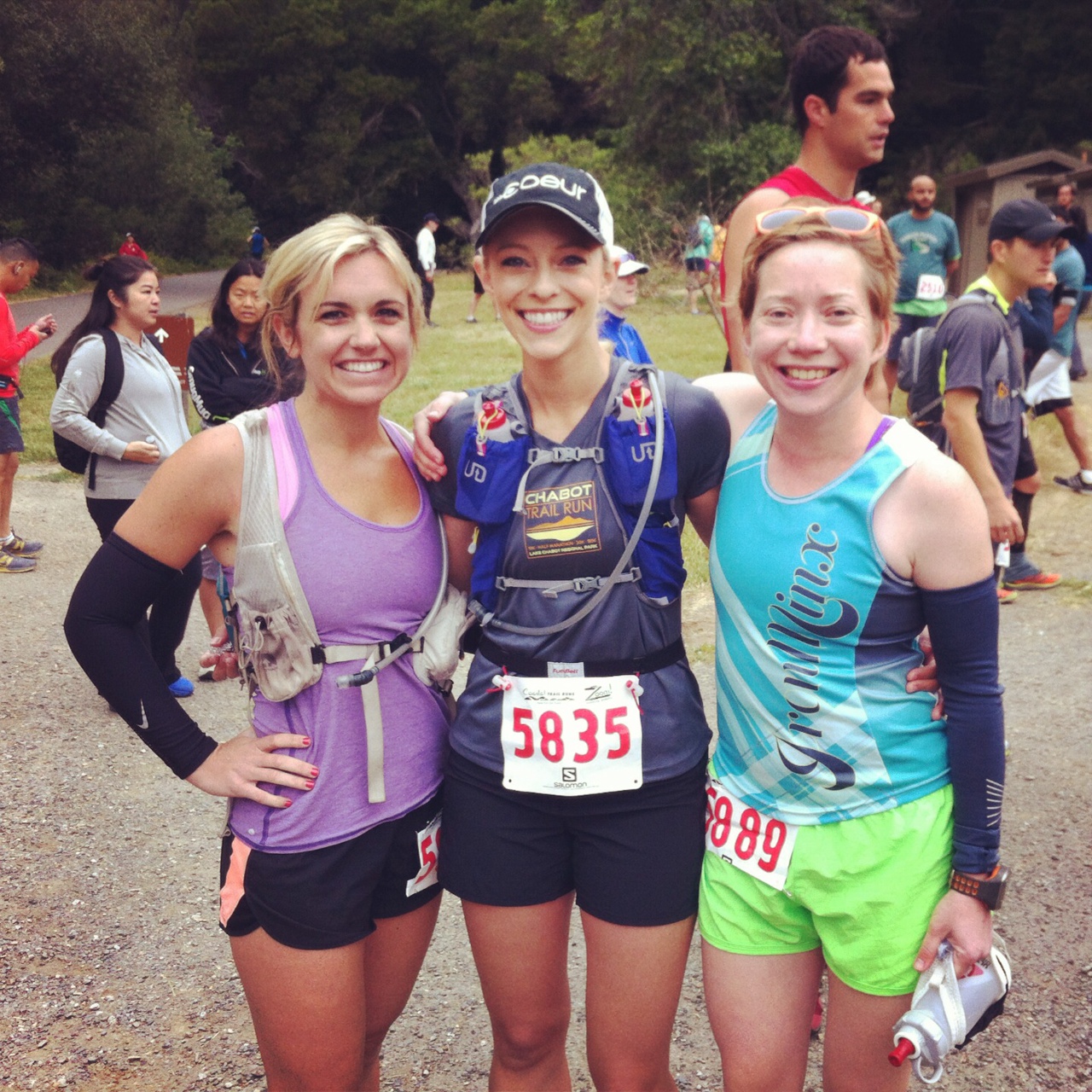
Not too far into the first loop, Jamie and I ran into Vivi and Molly, my partners in crime from the Lake Chabot 30K back in February. They were doing the 30K to prepare for a rim-to-rim Grand Canyon run next weekend, so we ran with them for a bit; great conversation is always a welcome distraction, regardless of distance!

CM50K3

Jamie wanted us to keep things slow and steady for the first loop, so we kept the pace conversational after broke off from the ladies. We also made sure to eat every few miles (I made rice balls and salty balls) and drink every few minutes.

There were aid stations at miles ~5 and ~11, so we stopped each time to fill up on electrolyte drink, salt tabs and snacks. For some reason PB&J sandwich squares and pretzel crisps were hitting the spot, so we’d grab handfuls to munch along the way.

At that second aid station, the volunteers told us that the next station was ~3 miles away, so we knew we were coming up on the finish line area (the first of three times we’d travel though it!). We were in high spirits, and I was proud that I hadn’t once checked my watch (Jamie threatened to take it away from me because of the mind games the mileage can play).

As we spotted the flags near the finish line, I was pretty excited to see that we had completed the first half marathon in ~2:37, and Jamie said she thought we were making great time. We pulled up to the aid station to refill as another friend, Marlana, flew up behind us into the finisher’s chute to complete her 30K!

Mentally, it was a little very daunting knowing that we’d have to pass through here again before coming in for the finish. But rather than dwelling on it, I tried to focus on the task at hand: the second half marathon.

Loop Two: Miles: 13.1-26.2 (~5:17 total time)

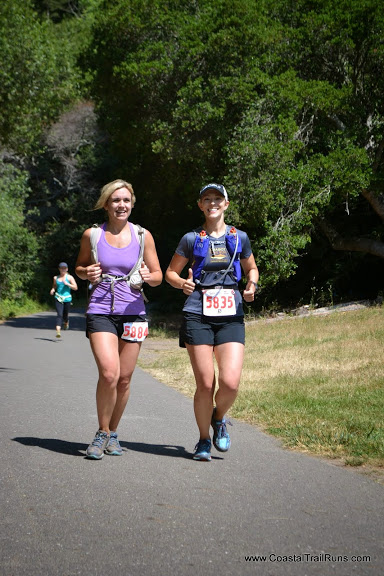
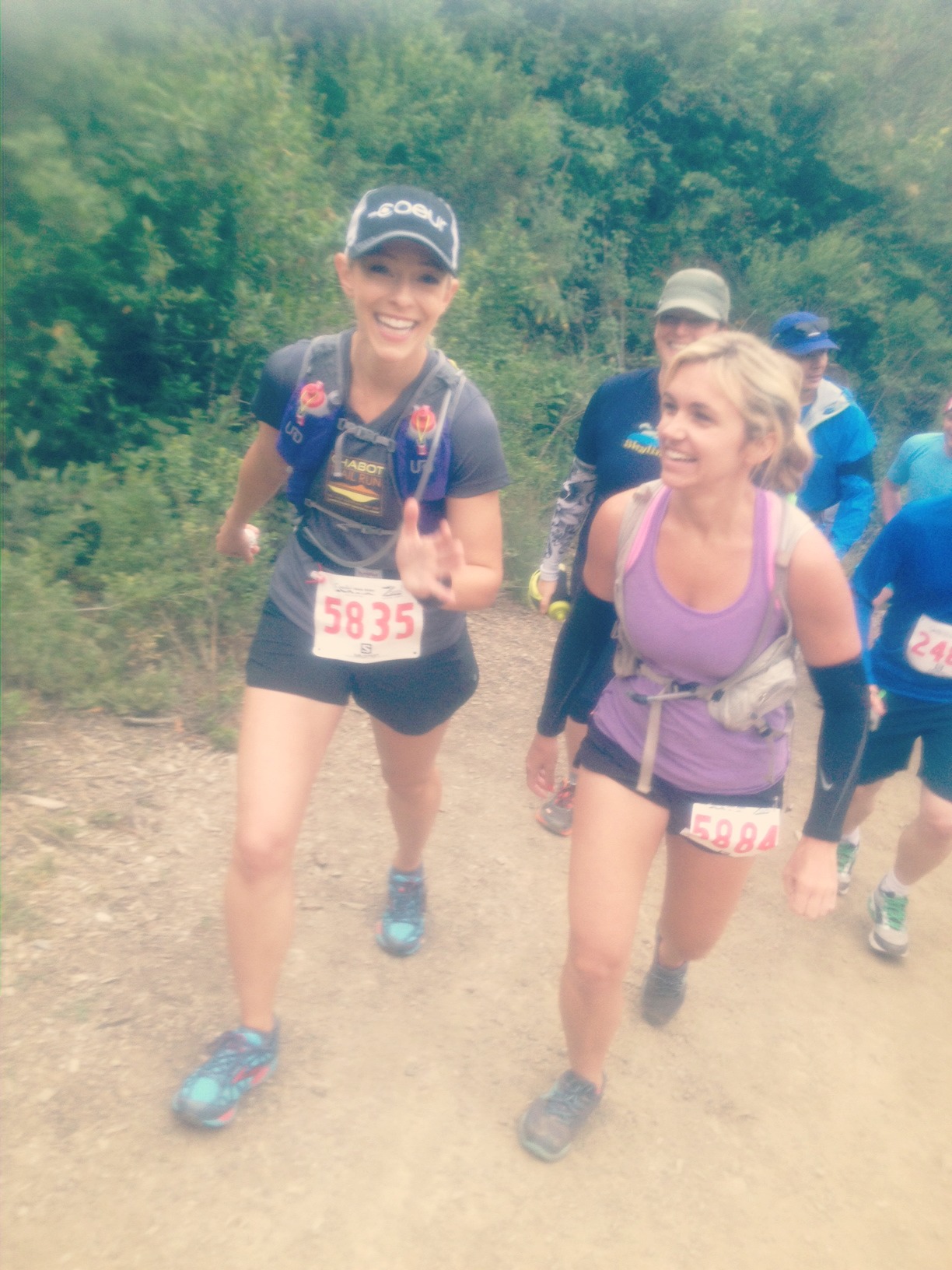
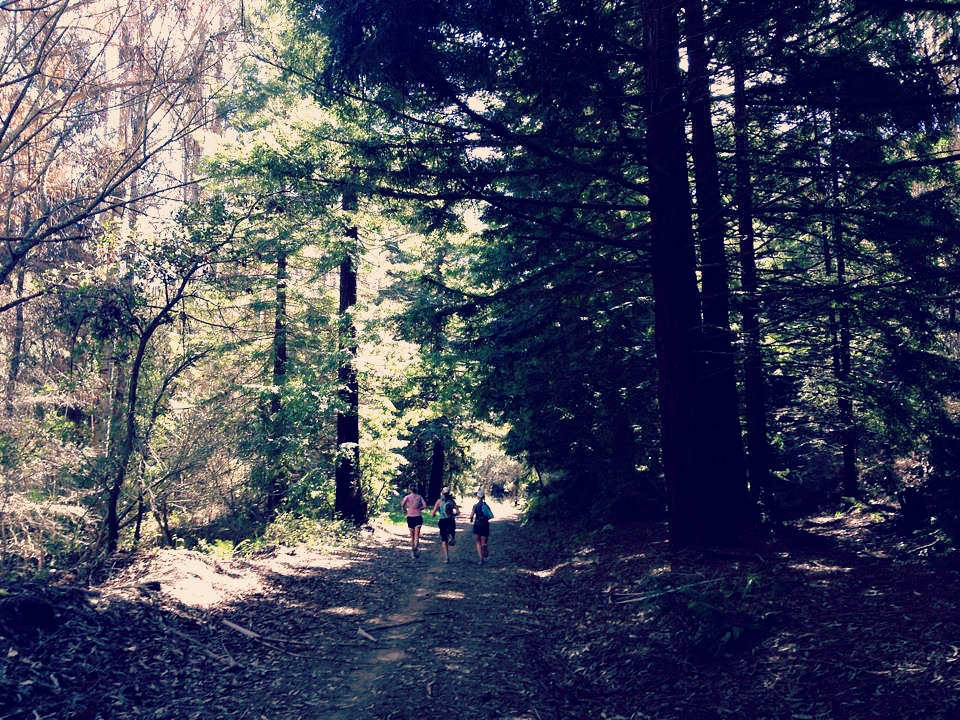
We started the second loop just as we did the first — with lots of climbing. Yes, it was tougher this time. But we were chatting away and laughing — as you can see, Jamie and I were determined to put the “fun” in 50K.

CM50K4

Oddly enough, even though we were repeating the same 13.1-mile loop, there were parts that I remembered clearly and others that I didn’t recognize at all. I also experienced a few moments of “ultra-runner acid trip,” as Jamie called ’em and started seeing a few things out of the corner of my eye, like a runner crouched behind a tree or a polar bear (it was a stump and a fire hydrant covered in plastic, respectively).

Visions aside, Jamie said that this loop was a crucial one; if we could make it through smart and strong, we’d be in good shape for the last five miles. So even though the sun was starting to heat things up and our legs were showing the first signs of fatigue, we continued our strategic mix of walking and running.

This time, the aid stations seemed to come a little more slowly. But we passed the time chatting away and kept up our eating and drinking schedule, particularly at the aid stations where we upped our intake of S! Caps salt tablets to two at a time.

Before we knew it, we were at the mile 24 aid station, with the next aid station a mere 2.2 miles away at the finish line area. I knew that would be a big mental crossroads, so as we pulled in we kept our stay there pretty brief so as not to lose momentum.

I did pause long enough to look at the clock, though — 5:17 for the marathon! That was just the boost I needed. I still hadn’t checked my watch, so I’d been running “blind” with no idea how we were doing on time, although Jamie had assured me we were still steady and strong.

I didn’t want to let my mind get too far ahead of me — Jamie’s advice was to focus on the finish rather than the numbers, on which I tend to get fixated — but I did tell her then that I had secretly wanted to finish in less than seven hours.

And now it seemed within the realm of possibility (after the race, she told me she knew we’d be coming in under 6:30, but didn’t want to get me too hooked on expectations = an awesome pacer).

Loop Three: Miles 26.2-31 (~60 mins for final 5 miles)

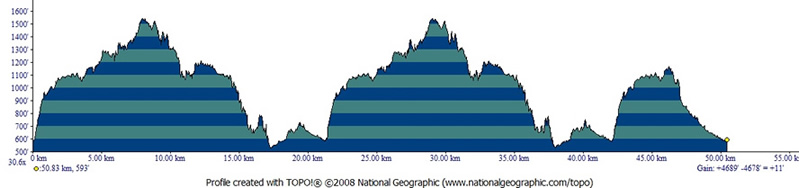
Again, we went up that hill. Although this time (as you can see from the elevation chart above), it wasn’t quite as long. Well, maybe not in distance — but it sure felt about five times as long as the previous two climbs due to the accumulated fatigue in our legs.

But Jamie kept us moving forward — she gave me tips on not only how to maneuver up the hills and to take advantage of the downhills, but also how to keep consistently moving forward in the mounting heat, which was starting to get to me.

By the time we got to the turnoff where the trail split into the smaller final loop from the previous two loops, we knew we were in the home stretch. But at this point, moving was starting to be more of a struggle with stiff legs, achy knees and a flutter in my gut that I’d been managing over the previous miles.

Instead of backing off the food and water, though, we doubled down when I’d feel my gut start to go, which did help. And soon we were back running under a canopy of redwoods, so the cooler air combined with the softer pine-needle-packed running surface was a welcome respite.

After what seemed like a whole lot more than four miles, we made the final turn back toward the finish and saw a sign marking where the half marathon loop and the five-mile loop met. I started getting a little emotional because I knew we were so close, but Jamie reeled me back in to focus on the final portion, which was a series of paved paths through the park.

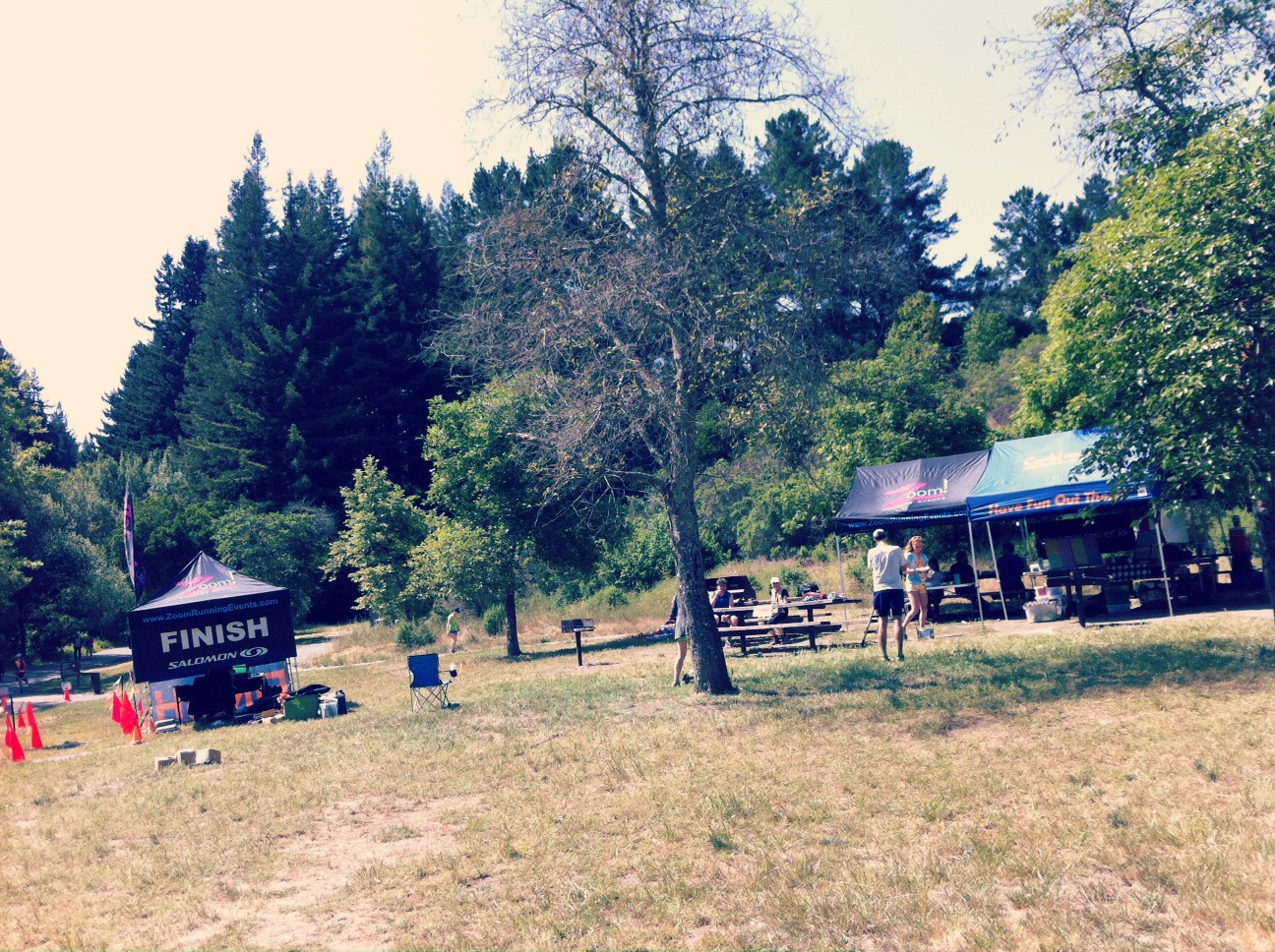
She warned me that it would feel endless. And it did. But at the same time, it flew by in a blur and we saw the finish line flags through the last set of trees. We turned the corner, sprinted (or as close to that as we could) toward the finish line, and Jamie slowed at the last second to let me cross first…

CM50K5

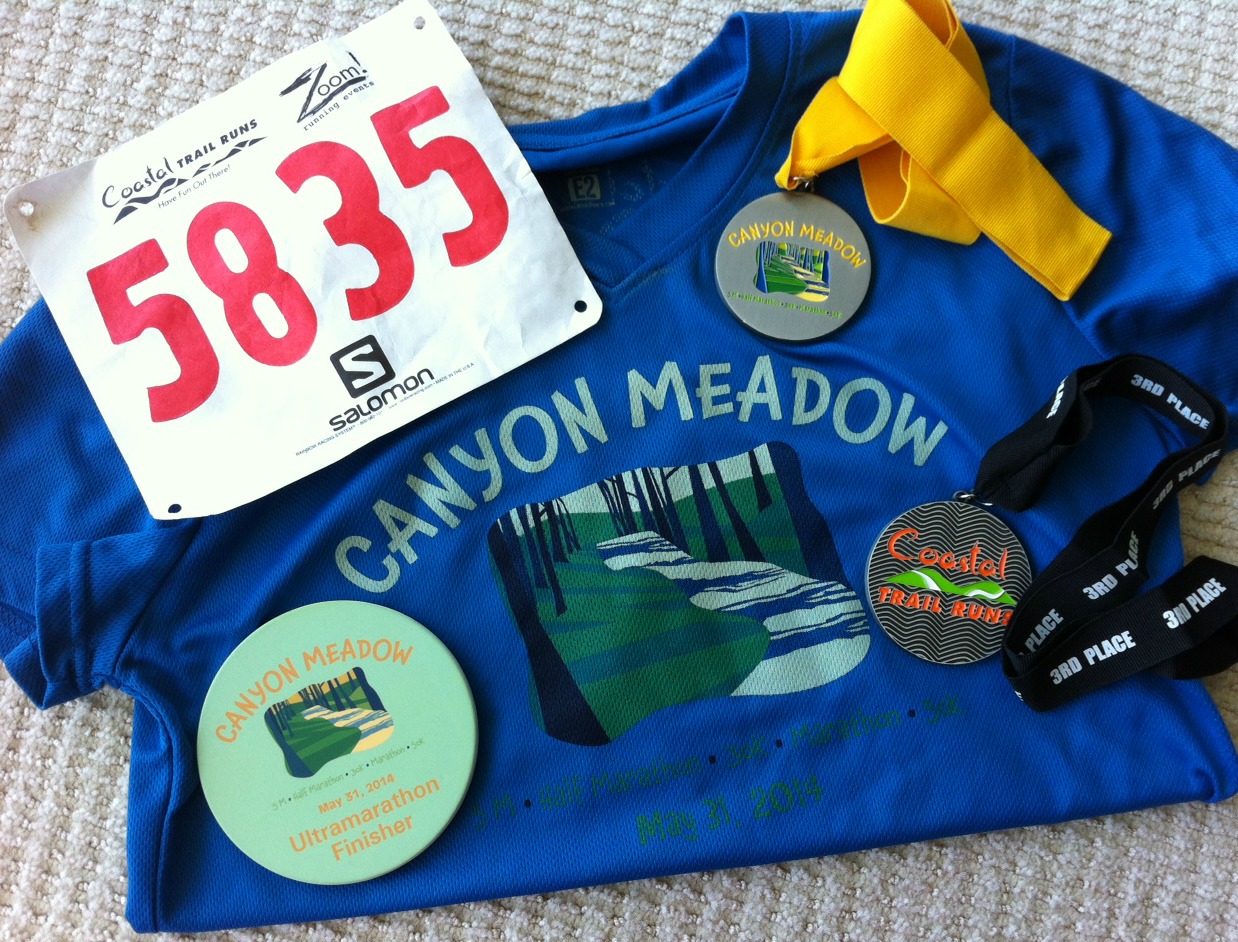
Final time: 6:17:34 (30th overall, 8th female, 3rd age group)

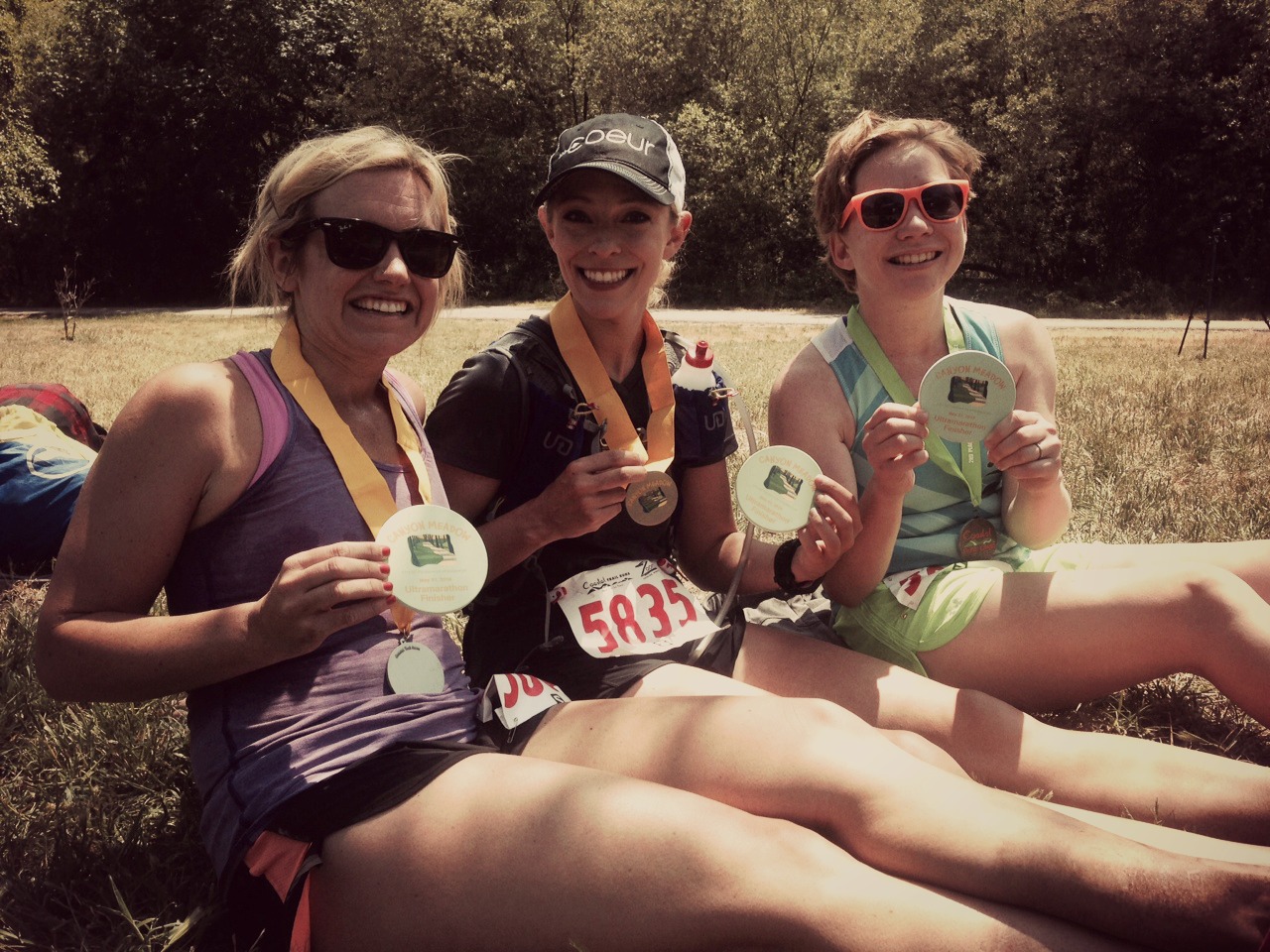
I think my exact words were, “Holy shit!” as we saw the clock. Not only did we finish, but we finished strong and well under the time I was expecting. THANK YOU, Jamie! We hugged the sweatiest hug and collapsed in the shade under a tree near the finish line.

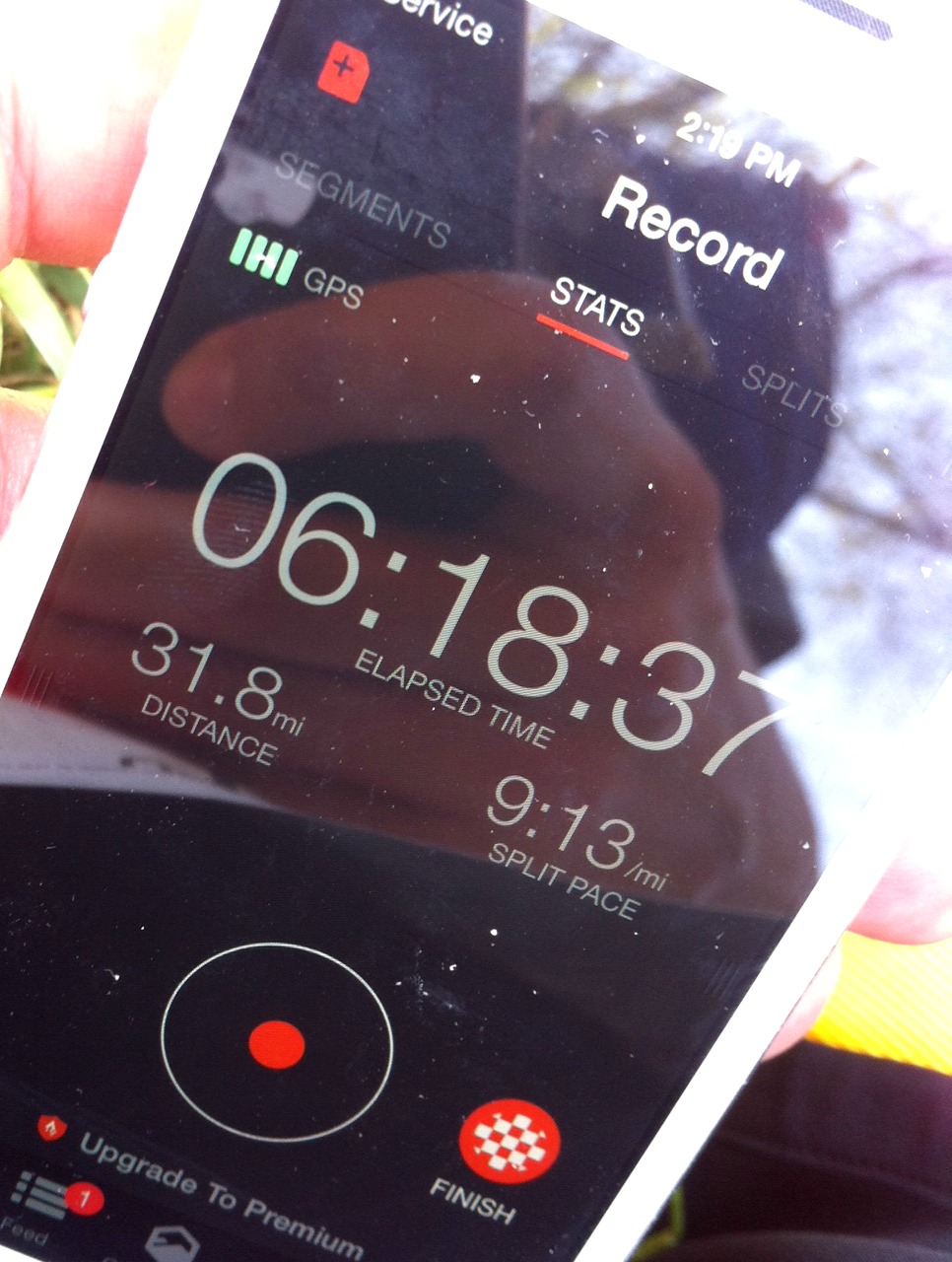
Only then did I check my watch, but unfortunately the GPS must’ve skipped when we were under the canopy, so it only read 30.58. Right then and there I told Jamie I was doubly thankful that I listened to her advice — I had a great run by feel without time, and I knew that the GPS being off would’ve totally thrown me for a mental loop.

Luckily, though, she had recorded it on her Strava, so I’ve got proof!

CM50K6

What did I learn from this experience?

  • The company you keep can make or break your day — even though Jamie was feeling the effects of the later miles, too, I never knew it because she was so focused on keeping things positive for me
  • Nutrition and hydration are critical — Staying ahead of the curve (eating and drinking before you’re hungry or thirsty) is the most important part of maintaining efforts for long periods of time
  • Salt tablets are your friend on hot days — We took ’em at every aid station to help keep us drinking and ward off muscle cramps
  • Don’t be afraid to walk, but do so “with a purpose” — As with eating and drinking, don’t wait until you need to walk; use it strategically up hills to conserve energy so you can make up time on the downhills and go the distance
  • Training will only take you so far; attitude is everything — I agree 100 percent with Jamie’s philosophy: It’s not all about the miles; you’ve just got to build a good base of fitness and the rest is smart strategy on race day
  • Embrace the unknown — It’s damn scary to push your mind and body to a new threshold, but so worth it

CM50K7

So there you have it. As I told Jamie yesterday, if you asked me a few years ago, I never would have considered doing ultra-marathon. In fact, a little over a year ago, I wasn’t even sure my body could handle the 26.2 distance again.

But now? Well, thanks to her encouragement and guidance I had an amazing day out there. Hitting that new 31-mile milestone was an incredible feeling; not just because it was about redefining my limits — it was about resetting expectations for myself.

And you know what? The sky really is the limit.

CM50K8

Thank you, Jamie, for making my first 50K experience “ultra-awesome!” Now, when’s the next one??

Canyon Meadow Ultramarathon: The plan

LakeChabot1

Holy crap. What did I get myself into?

Right now, my brain keeps going back and forth between two thoughts:

I can’t wait to hit the trails tomorrow and make this happen.

That first step after 26.2 will put me officially at the longest distance I’ve ever run…and then I’ve got five miles — and some decent elevation — to go after that. 

Physically, I haven’t kept as regimented a training plan as I usually do for long-distance races. Quantitatively that concerns me a bit, but qualitatively I’m actually not too worried about it because my focus is on covering the distance — which I’m pretty confident I can do — versus racing the clock.

What I have been doing? Getting time “on my feet,” which means long runs (10-15 miles) every weekend, plus oodles of cross-training during the week to ensure I stay in shape without (literally) running myself into the ground.

But I’ve also been taking some time to tend to some of the non-running aspects of the race which, according to recent Born to Run 100-mile finisher Jamie Walker (yep, 1-0-0, that’s not a typo), are just as critical to getting across that finish line in an ultra.

Namely, this means doing some mental preparation and making a plan for staying on top of fueling and hydration during the race. And having an awesome pacer to help me navigate the day is a huge bonus (THANK YOU, Jamie!).

Jamie gave the Feed Zone Portables rice cakes a glowing review for keeping her tummy happy mid-race, so I’ll be following suit and hoping for the same good results. Plus, I’ve whipped up a batch of Hailey Manning’s famous Salty Balls as a second snack option.

Mentally, I know there will be ups and downs throughout the day…but I’ll be keeping two things in mind: First, I just have to keep moving forward. And second, I get to be out there — no one is forcing me — so I might as well enjoy every moment of it!

Finally, I just finished Chrissie Wellington’s autobiography, A Life Without Limits (sensing a theme about awesome female athletes in this post?), and it’s also inspired me to get out there, push those “limits” and see what I’m capable of doing.

In fact, Wellington sums it up pretty perfectly here:

“To my amazement, at so many stages along the way, the limits that I thought I could see in the distance dissolved as I approached them. They turned out not to be real at all but mere assumptions. And that has been the most exciting revelation of all.”

No better motivation than that as I take to the trails 🙂

Stay tuned for the 50K race report!

Mom Knows Best: Can’t-miss advice for life…and breaking a sweat

Mom

Happy Mother’s Day to moms everywhere!

No vacations, no salary, screaming bosses, dealing with poop and vomit. It truly is the #WorldsToughestJob, as evidenced in this recent ad.

Haven’t seen it yet? It’s definitely worth a watch — and, wow, I guess it also goes without saying that Mom has probably picked up a few pointers for dealing with some discomfort, disappointment and delayed gratification along the way.

Which is why we need take her up on that advice…if not for life, at least for your next workout or race. You can thank her later.

“When God closes a door, he opens a window.”

Got injured and had to drop out before that big race? Been there. Didn’t hit your paces or snag that PR…again? Done that.

As frustrating as it feels when things don’t go as planned, try to roll with the punches, keep an open mind and find the growth opportunity in every situation.

“Always be curious.”

Without curiosity and learning there is no growth or forward motion, so don’t be afraid to explore.

Mix up your weekly workout regimen, add in a new form of cross-training, test out a different training program. You won’t know until you give it a shot, and you just may be pleasantly surprised with the results.

“Approach life with a light heart.”

From funny race photos to mid-workout flatulence, from getting lost on trails to losing your lunch in front of people, there’s a good chance something embarrassing will happen sooner or later while you’re breaking a sweat.

In every occurrence, find the funny. And surround yourself with like-minded friends who can help change these moments — or even your life — for the better.

“Don’t judge a book by its cover.”

Every time I race I’m reminded of this one. And as much as my ego gets bruised when I’m passed by the 70-year old man in sweats and an old-school pair of gym shoes, it also makes me smile.

The lesson here? As my grade school history teacher said, “Don’t assume anything. You only make an ‘ass’ out of ‘u’ and ‘me.'” No athlete is perfect, but perfection has never been the standard. Where’s the fun in that, anyway?

“You catch more flies with honey than vinegar.”

It goes without saying that you should be nice to others — but remember to hold yourself in the same regard.

Caught up in negative self-talk? Nip it in the bud, and tell that evil voice inside your head to take a hike.

“Never change who you are for someone else.”

When the gun goes off on race day, there’s an explosion of ego and adrenaline. It’s easy to get caught up in it and speed off…only to crash when your body realizes it’s moving at an unsustainable pace.

A better plan: Run your own race. Competition is good. It’s inspiring, and it can bring out the best in us. But real satisfaction comes from self-motivation, so don’t surrender control of this essential asset.

“Don’t underestimate the power of a nap.”

Classic trench coats. Fresh flowers. Good manners. Little black dresses. Some things never go out of style — and a decent nap is one of ’em.

It works like a charm, whether you’re three, 33 or 103. So if it ain’t broke, don’t fix it!

What are your favorite words of wisdom from Mom?  

Fave Fix: My must-have gear for trail running

50KGear

If there’s one thing I’ve learned from the past few months on the trails, it’s that running off the roads is a whole different beast than running on ’em. Aside from the obvious terrain and elevation challenges, it requires a new approach — from gear to strategy to fueling — to get from Point A to Point B, especially when we’re talking ultra-distances.

Because of that, I wanted to share an inside look at how I’m planning for my first ultra marathon — the Canyon Meadow 50K — at the end of the month. See below for what I’ll be wearing, eating, drinking and using to help me recover when all is said and done…and (fingers-crossed) run 🙂

Feet First: The Brooks Cascadia 8 came highly recommended from several trail runner friends due to its traction and responsiveness, plus it was my favorite of all the brands and styles I tested at San Francisco Running Company. I like to buy my running shoes a half size up to allow for feet to swell, and I may add a Superfeet orthotic insole for a little extra support.

– Keeping Cool (& Chafe-Free): I love a trucker-type hat with breathable mesh and a wide brim to block the sun. And under my technical, sweat-wicking t-shirt, I’ll be wearing a Coeur Sports Checkmate Sports Bra, which has anti-chafe seams that are perfect for long race days. On the bottom, I’ll pair the Lululemon Groovy Run Short with CEP Progressive+ Calf Sleeves to promote circulation and protect lower legs, plus Balega Blister-Resist Trail Socks to try to keep my feet from getting too torn up.

Accessories & Extras: Because I’ll be in and out of the sun, I’m slathering on Banana Boat Sport sunscreen and wearing Tifosi sunglasses, which adjust automatically when exposed to UV rays. Electronics-wise, I’m taking my Jaybird Bluebuds bluetooth headphones and am hoping for an early birthday present (hint hint, Hubby) — the Garmin Forerunner 910XT — to help me track mileage and stay on pace. I’ll also use the easy-on, easy-off Fuel Belt Race Number Belt and apply ample amounts of TriSlide to avoid hot spots.

50KJenny

One of the most essential items on the trails, though? A good hydration pack, which not only allows you to carry and consume water between aid stations, but also makes it easier to have other essentials — such as fuel, extra clothing, first aid items, etc. — at your fingertips throughout the race.

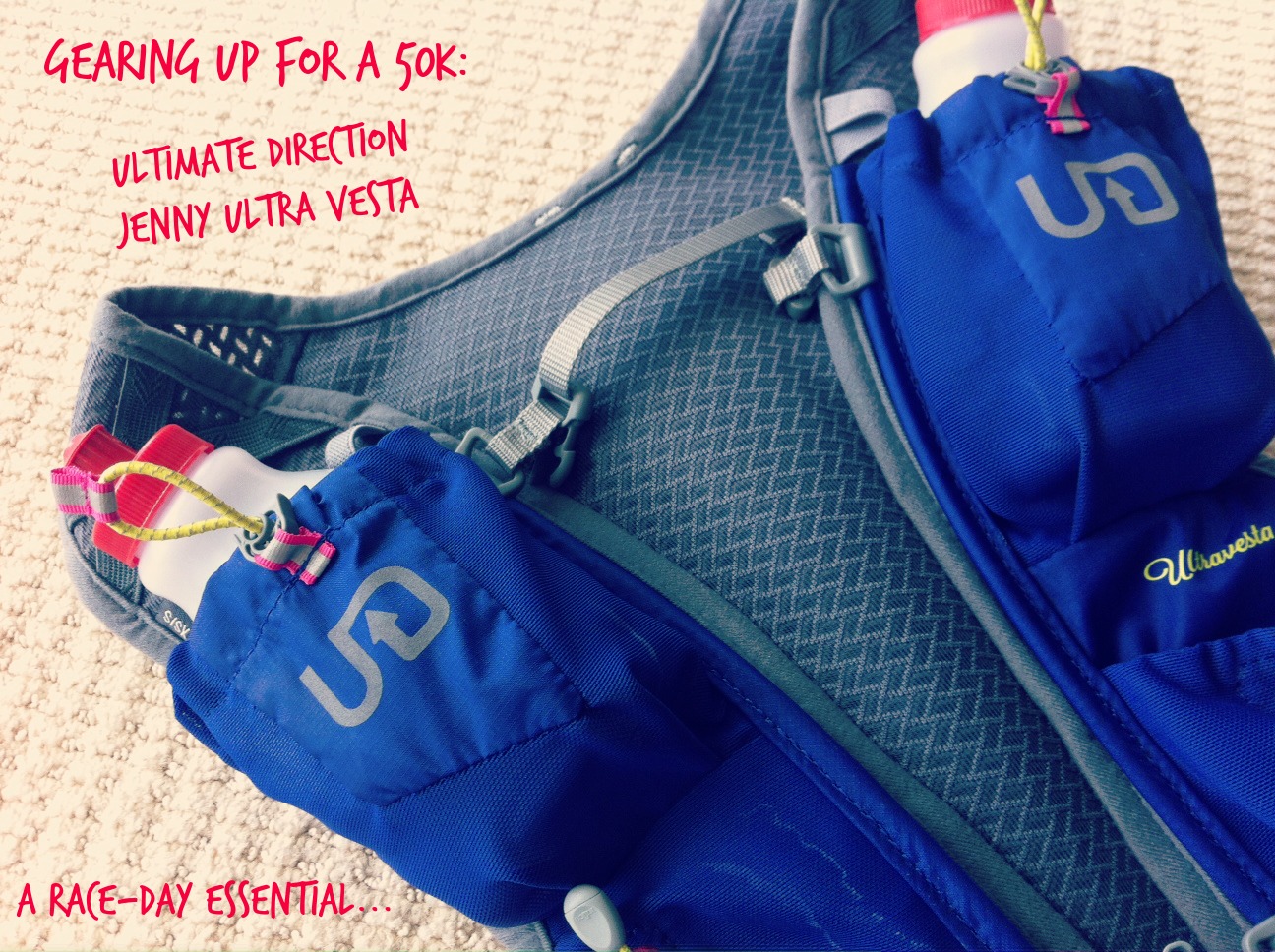
Focus on fit and function; you want something that’s comfortable, compact and efficient so you have everything you need without extra bulk. My favorite is the 2013 Trail Runner Magazine Gear of the Year Award-winning Ultimate Direction Jenny Women’s Ultra Vesta, which is made specifically for women with an adjustable fit.

50KJenny2

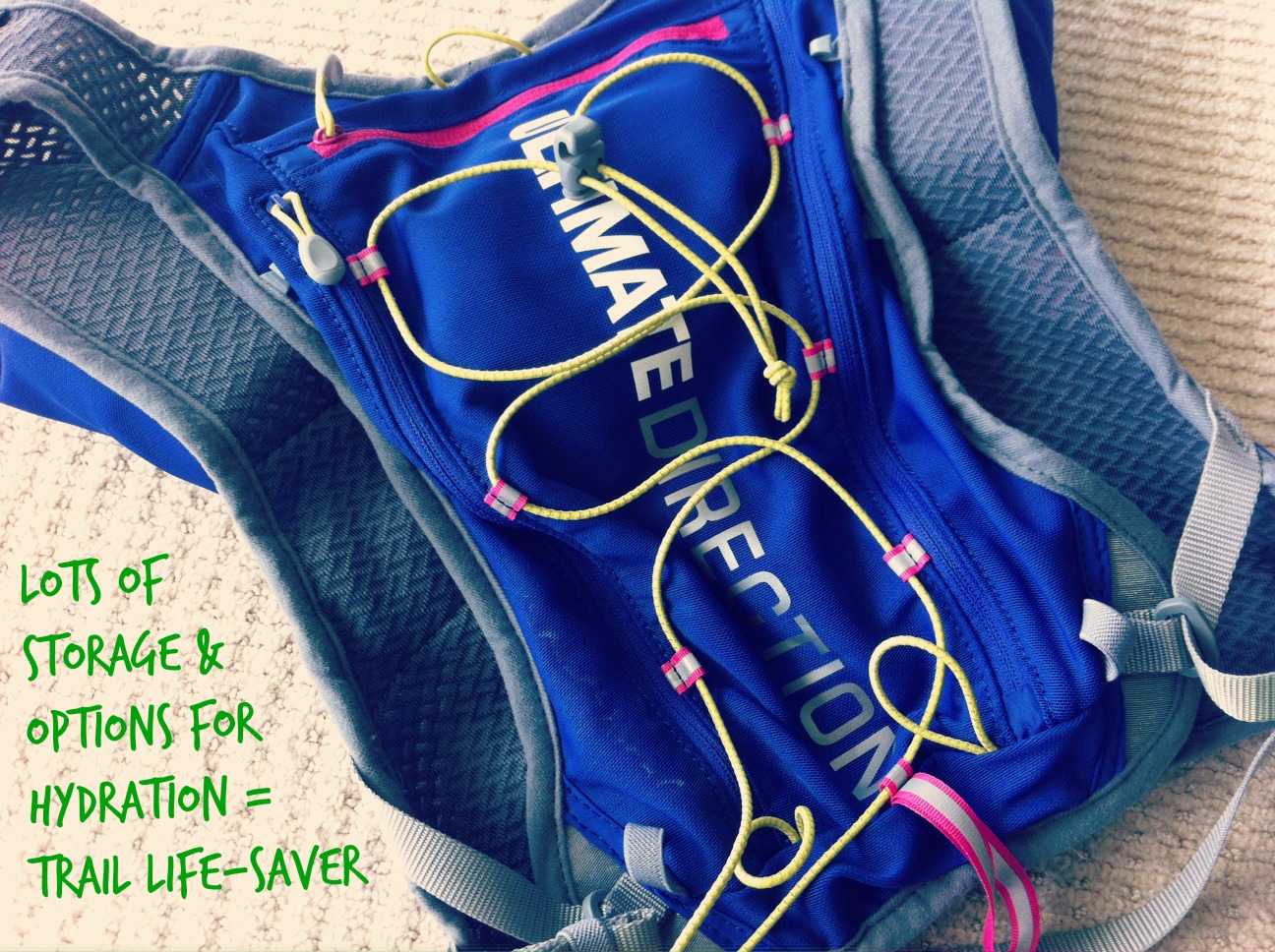
No more water bladder slapping against your back here; the Ultra Vesta’s front strap-mounted holsters offer quick, immediate access to twin 10-ounce water bottles, which are concave against the body and positioned higher on the chest to keep from bouncing against…well, you know.

Besides all the pockets for my cell phone, gels, keys, etc. there’s also a main rear compartment that will accommodate a 70 oz. reservoir (sold separately) for longer treks. And, believe it or not, there’s even an ice axe loop, two trekking pole loops, plus reflective accents for low-light visibility, making this a virtual Swiss Army Knife of packs for all kinds of outings and conditions.

50KFuel

So what am I planning on putting in the pack while running? Well, hopefully not too much…I’m aiming for that delicate balance of being prepared between aid stations (which are usually very well-stocked) and not over-packing, which will fatigue me more quickly.

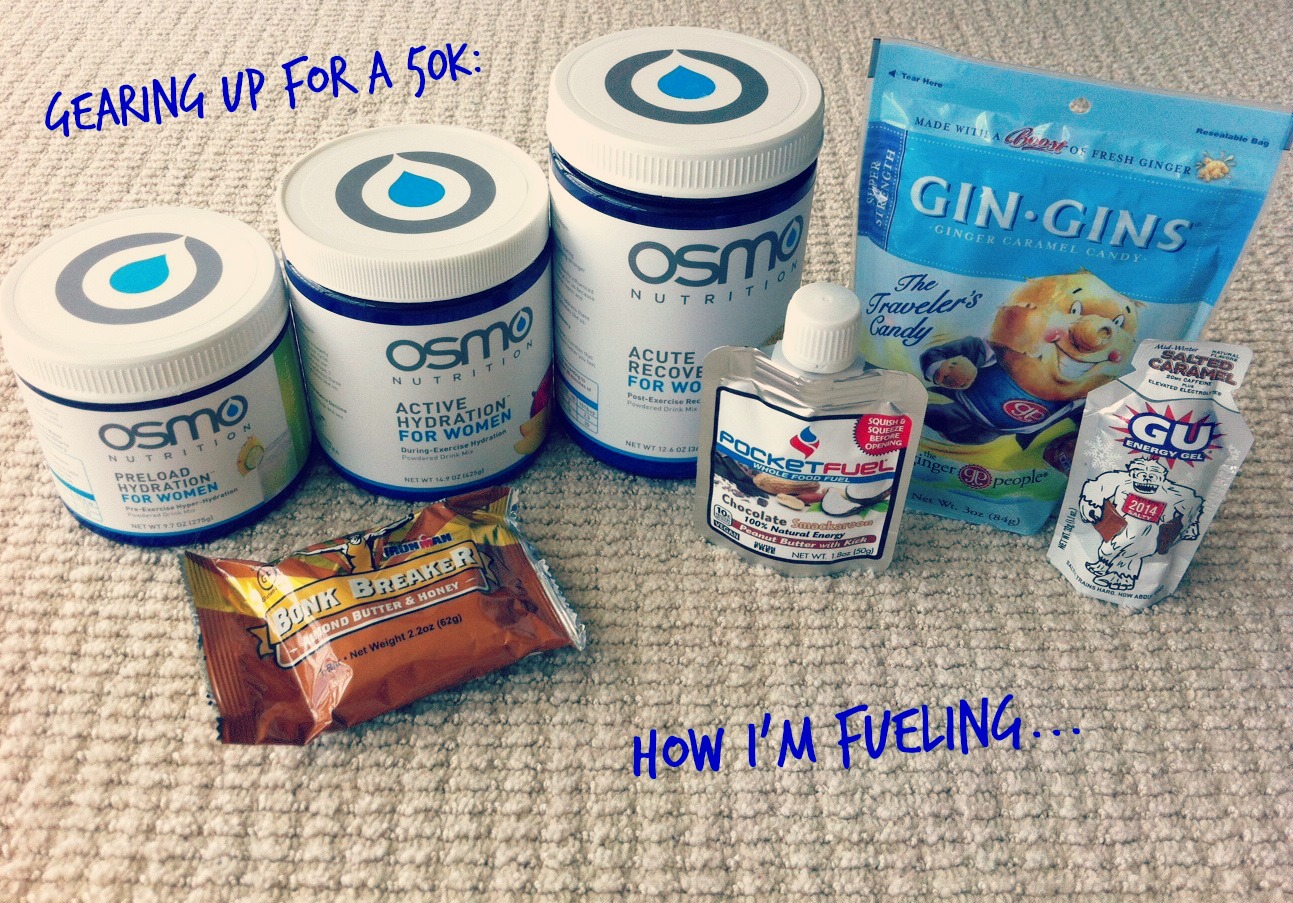
Ward Off Hanger: What’s been working well in training runs is a mixture of PocketFuel for sustained energy, Salted Caramel Gu Energy Gel for a quick hit of sugar and Bonk Breaker energy bars for something more “food”-like. And, of course, Gin Gins Candies from The Ginger People and good ‘ole TUMS to help keep my stomach settled.

Quench Thirst: I’ll fill my water bottles with Osmo Nutrition Active Hydration for the first leg, and I’m aiming to drink every 10 minutes or so throughout the day. Ideally, I’ll refill the bottles at each aid station, most likely with a mix with water and whatever electrolyte drink they’re providing on the course.

50KRecovery

And although the first goal of the day is to cross that finish line in one piece, setting myself up to recover well comes in a close second. The body takes quite a beating over the course of 30-plus miles, so it’s key to remember a few things to aid with muscle repair and regeneration.

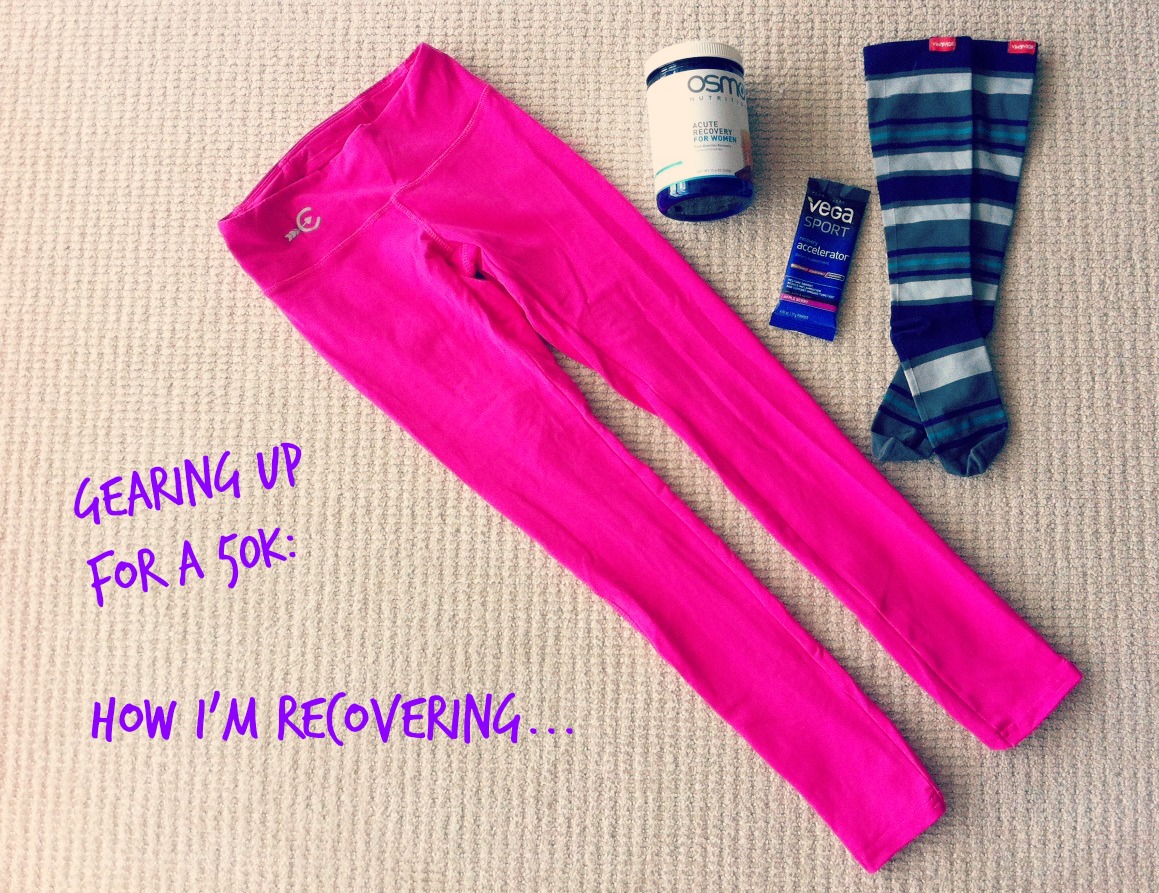
– Refuel and Rebuild: Immediately after finishing (while hitting up the post-race buffet!), I like to mix a packet of Vega Recovery Accelerator in a bottle of water. It’s an all-natural, plant-based recovery drink mix specifically developed to replenish energy and electrolytes, reduce inflammation, muscle and joint pain, support immune system and protein synthesis, and reduce recovery time. Then when I get home, I mix up a recovery smoothie made with Osmo Acute Recovery for Women, a banana, almond milk and ice for an extra boost of nutrition.

Relax and Recover: Finally, one of my favorite post-race treats is a hot shower followed by an afternoon nap in compression gear, which helps reduce swelling and just plain feels good on tired legs. I’ll usually layer Coeur Zipper Tights with Vim & Vigr socks and elevate my legs to start the healing process and make it easier to get out of bed and maneuver around the next day.

What’s your favorite gear to get you through those long trail runs? 

Canyon Meadow Ultramarathon: Ready or not, here I come!

Lake Chabot

“Beware of the company you keep. See that you associate with the right type of people.”         -Dada Vaswani

Here’s the thing about having fit friends: I like to say they’re the best-worst influence — not only do they encourage you to push your limits, but hanging out with them also tends to shift your frame of reference on the crazy scale.

Case in point: Running an ultramarathon (more than 26.2 miles). It was never really on my radar…until I started marathon training with the always-encouraging Pavement Runner and working with ever-amazing Jamie Walker, both of whom have completed many ultras of assorted distances.

Slowly my mindset started changing from, “Who would want to do that?” to “I wonder if I could do that?” to “I think I want to try that!”

Throw in an upcoming 30-something birthday at the end of May, and suddenly signing up for a race of 30-odd miles (50K) that same weekend solidified into a plan.

Oddly enough, Jamie’s said it’s actually easier (in some ways) than a marathon because the approach is completely different; whereas there’s pressure to run the entire 26.2 on the roads, an ultra on the trails is a different beast where pacing is the name of the game.

I got my first taste of it at the Lake Chabot 30K in February, but with this month’s triathlon, I haven’t had as much time to train and/or hit the trails as I’d like. But, regardless, my plan is to stay conservative and to try to finish, injury-free, in about six or seven hours.

Stay tuned for my mini-plan for training in these final weeks leading up to the event, including what I’ll be packing to keep me happy come race day!

Would you ever attempt an ultra? If so, how’d it go? If not, what are your thoughts about where I fall on that crazy scale? 🙂

Race report: HITS Napa Valley Olympic Triathlon

photo 4 (1)

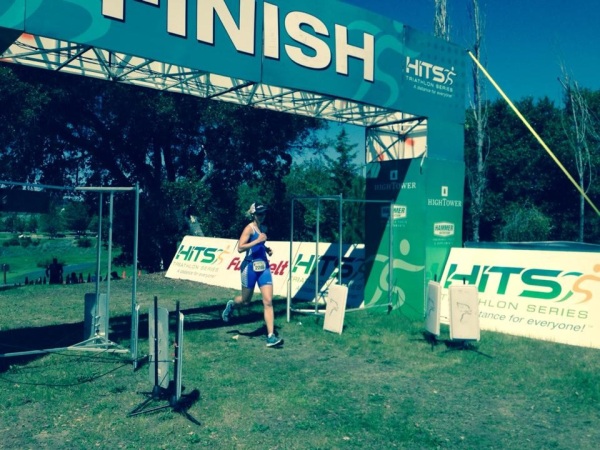
On Monday I gave a quick recap of how the race went this weekend. Today, I’m sharing the full report on my first Olympic-distance triathlon (1500-meter swim, 24.8-mile bike and 6.2-mile run) at HITS Napa Valley.

The Day Before the Race

On Saturday, Hubby and I drove up to Lake Berryessa in Napa for our pre-race packet pick-up. Half of me was excited because, physically, my fitness level was right where I wanted it to be for my initial attempt at this distance: I had taken it easy in the previous weekend’s half marathon, and my final shake-out swim (1500m) and bike (15 mi) in the days leading up to the race felt comfortable and almost effortless.
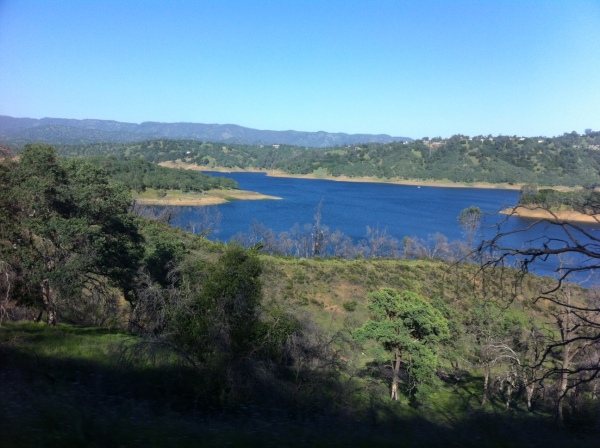
photo 1

The other half of me, however, was starting to get increasingly anxious. I had only gotten in one “real” open-water swim session, despite knowing that that leg would be the most difficult for me mentally. I kept thinking, though, that if I could just power through the swim, I’d be home free for the bike and the run.

But, as they say, “hope is not a strategy”…especially when, on Saturday afternoon, I felt an all-too-familiar tickle in my throat. I chugged water and took all kinds of Vitamin C, Elderberry and Echinacea in the hopes that it was just allergies, but it progressed over the course of the evening into a full-on sore throat and full-body tired feeling.

Not that I’m using my not feeling well as an excuse; I know plenty athletes at all levels who race — and win — through sickness. But, looking back, I do believe that it factored into my ability to attack the course when things got tough. More on that later.

Race Morning

Before we knew it, the 4:30 am alarm was jolting us awake in our hotel room (not that Hubby and I had much sleep that night; we were both up every few hours in anticipation of the big day). We dressed quickly, loaded our gear into the car and set off for the hour-plus drive to the race site.
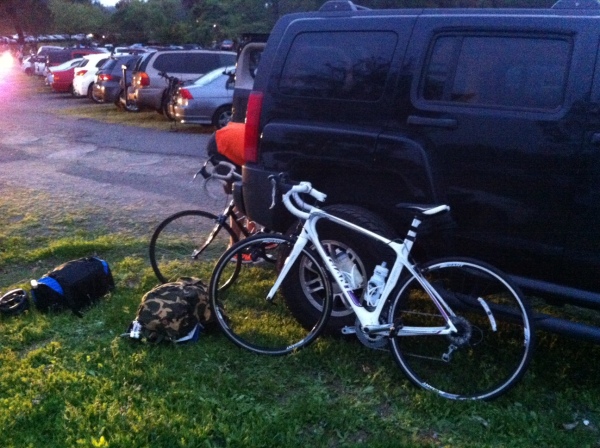
photo 2

We arrived to Chaparral Cove about 6:15 am, and went straight over the the transition area to get set up. It was fairly hectic because everyone performing their respective pre-race rituals (think body-marking, port-o-pottie lines and lubing up with BodyGlide), but I’ve got to hand it to HITS — they streamlined the process extremely well.
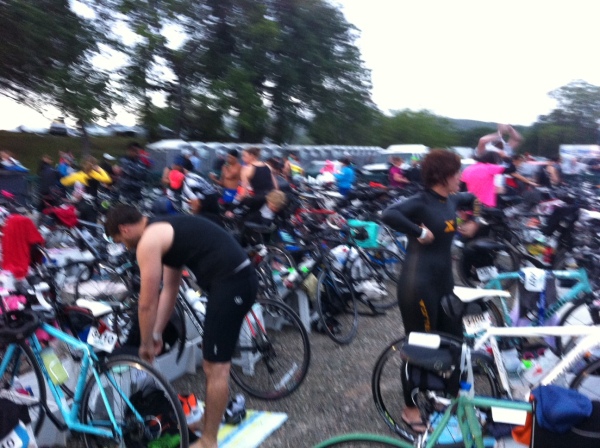
photo 3

Not only did they organize us in alphabetical order within the transition area, but they also provided each athlete with a stool and bike space. Plus, having a bike holder on the ground was SO much better than the hanging kind, which is subject to getting knocked over by overzealous athletes (as I experienced in a previous sprint-distance race).
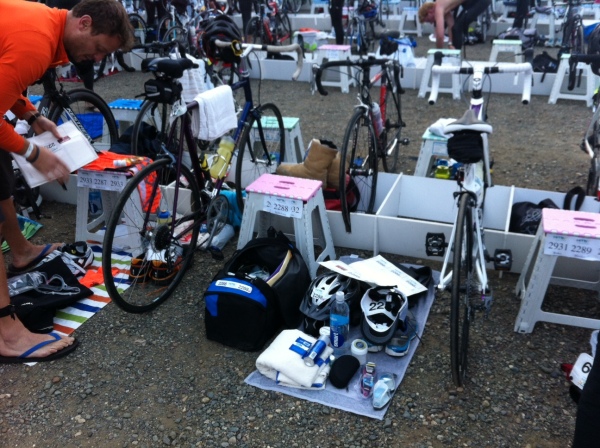
photo 4

The Swim

Once our transition areas were set, we met up with a friend, Tara, and eased into the water for a few minutes before the guns went off. We were expecting the temperature to be in the 50’s, so when we found out it was in the 60’s, it was a pleasant surprise!
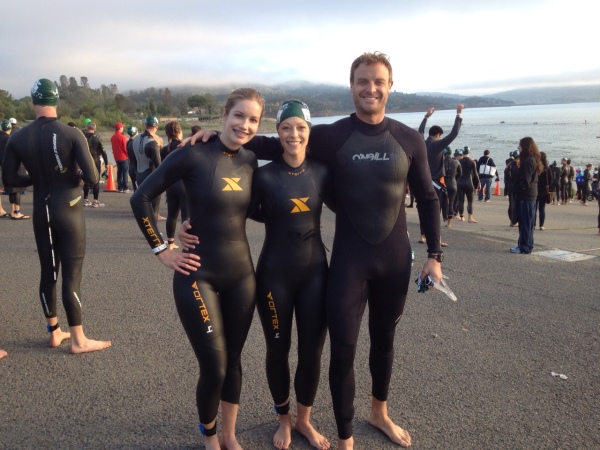
photo 3 (1)

When it was time for the women’s heat to take to the water, I hung toward the back of the pack. After the gun went off, I counted five seconds, then eased my way in. I knew the first few minutes would be complete chaos until everyone found their groove.

Long story short, I never found mine. Mid-way between the shore and the first large buoy was a smaller one, so I gave myself permission to take it easy to that point, and then I’d get down to business. But by the time I reached it, though, I was still in the middle of a splashing pack and started to feel short of breath with my legs and arms getting increasingly heavy.

From there, I figured I’d alternate breaststroke and backstroke until the first big buoy. Or until I calmed down and got my breathing under control. But it only escalated from there. I started hyperventilating. A million thoughts were rushing through my head at once.

Do what you do in the pool. I can’t see anything! Focus on your breath. I just swallowed a mouthful of water! Focus on the next buoy. It’s so far, and I’m losing ground on the group! Why can’t I control my breathing? Relax! I can’t catch a breath. Should I pull over to the kayaker? No, you can’t stop; gotta keep moving forward. I just got kicked! Keep moving. I just inhaled more water! I don’t want to be here. I’m so far out! Just focus on the shore and get there.

Rather than stopping, I resorted to flipping over on my back and counting 15-20 backstrokes before flipping over on my stomach, sighting and doing 5-10 breaststrokes, then repeating the process. I was hoping the routine would help me calm down, but none of my mental tricks were able to override the physical fight-or-flight mode that my body was now locked into.

By the time I rounded the last buoy and headed to shore, things had progressively gotten worse and I started wheezing after swimming through a lovely pile of chunky vomit (ew). Because I hadn’t breathed at a normal rate or depth in 20+ minutes, every deep breath I tried to take would start a coughing fit, which only made matters worse.

By the time I finally hit shore, I wanted to burst out crying — partly out of sheer relief, partly out of disappointment in myself and partly out of terror at having to do it all over again. But I knew the longer I waited, the more I’d psych myself out, so I tried to shake it off as I got back in the water and started lap number two.

I tried again to hit the mental reset button, but it was no use. I had passed the point of no return, still wheezing, unable to take a full breath. I knew I had to make a call: Either spend the second lap fighting, or just give in and try to get it done as best I could to conserve some energy. I chose the latter, and breaststroked/backstroked it in while distracting myself by counting every single stroke.

After I rounded the final buoy, I came up alongside a man who was doing the breaststroke, as well. He must’ve seen me struggling because he smiled and said, “We’re in the home stretch. Almost there, and then we’re done with this!” I could have hugged him; it was just what I needed — knowing that someone else felt what I was feeling — to give me a final push to get to shore.

Once there, I tugged off the top of my wetsuit and made my way up the ramp. But I knew I was in trouble — not only was I still not able to catch a full breath, but I also felt dizzy and completely drained from the adrenaline-ridden adventure in the water.

Time: 55:47

The Bike

I took the first transition (5:48) to strip down, dry off, get dressed in my bike gear and try to recollect myself. It’s never fun getting in from the swim and seeing most of the bikes already gone, but you can either give up or reset your expectations for the day and focus on the finish. Again, I chose the latter, hoping I could make up some time during my stronger disciplines.

Although I was still struggling to catch a breath (every time I’d try to inhale more than halfway, I’d start a coughing fit), the bike leg went really well. I knew I was starting at the back of the pack, so I made a goal to try to pick off as many people as possible to keep myself motivated.

It was an out-and-back-course, and the first half went great; I passed a handful of people, was fueling according to plan (a personal victory to multitask on the bike!) and enjoying myself as I played cat-and-mouse with a fellow rider: I’d pass him on the hill climbs, and he’d breeze past me on the descents.

In fact, it became a bit of a joke after the first few times — I’d pass and tag him, then he’d return the favor. On and on it went, and I think that camaraderie actually helped both of us stay in the race toward the end. Those rolling hills sure got a lot tougher on the way back in, and by that time my stomach started to feel a little wonky.

Although it wasn’t my strongest ride (I was aiming for around 1:30), I was proud that I bounced back and put in a decent effort despite a rough start to the race.

Time: 1:46: 37

The Run

Getting off the bike and into my running gear in the second transition (5:53) proved a more difficult task than I had anticipated. What should have taken me about a minute turned into six because I was dizzy, nauseous and exhausted. Looking back, I think I used up all my adrenaline in the swim, and then finally relaxed on the bike, so when it came time for the run, I had no more “go.”

Even though I had consistently fueled during the bike, I could tell I was on fumes at that point. I was so disoriented, I had to ask a few people to point me toward the run exit out of transition, and when I saw that the first stretch was a hill, I knew the odds of me being able to run the entire 6.2 miles were slim.

Damn. Enter resetting of expectations…again.

Between (still) not being able to take a full breath, a now-upset stomach and cramping calves, I alternated walking up hills and jogging on flats and down hills. I’d literally go until something started going (lungs, stomach, calves), then walk, collect myself and do it again until something else went. Definitely not the way I had intended to spend the last leg of the race.
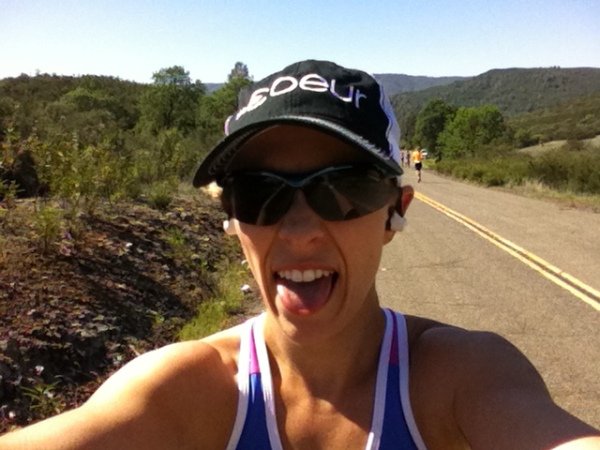
photo 5

The only thing left to do? Turn my frown upside down, turn my tears into cheers. That became my new mantra, and the more horrible I felt, the more I would clap, yell and try to rally all the runners around me as we took turns passing each other. Seeing them perk up, smile and quicken their step in response somehow kept me going. Well, that, and a few cups of Coke at the aid station!

After the final hill climb, I jogged past a women and told her how great she was doing before I slowed to a walk next to her. My stomach was not happy, my whole body ached and I was going to collect myself before jogging to the finish, but she picked up the pace and told me that I couldn’t stop now — we were so close. It was the push I needed  to get running again, around the last corner, down the hill and across the finish line.
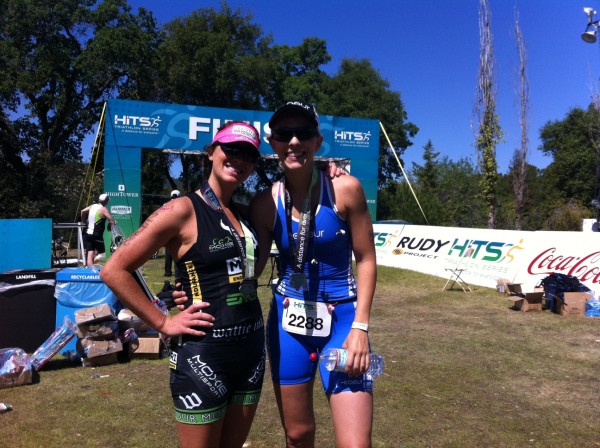
photo 1 (1)

Time: 1:10:16

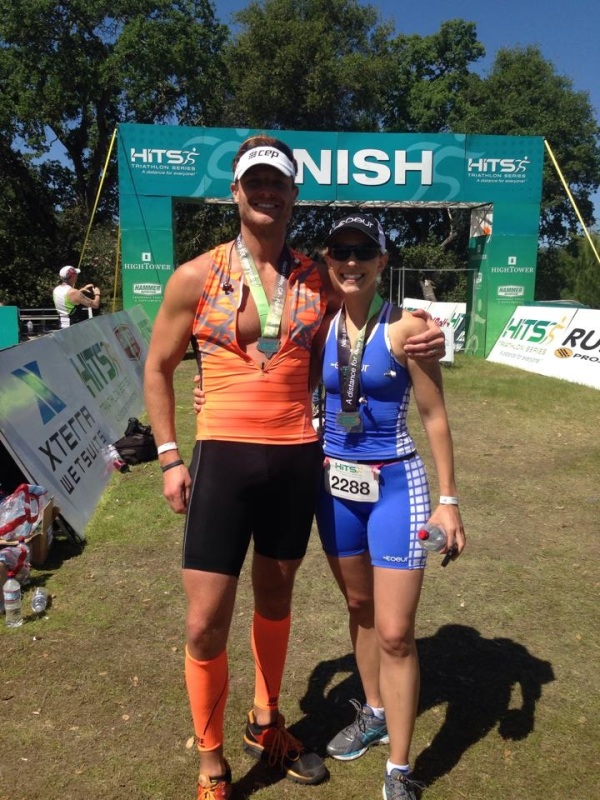
Doris and Hubby were there waiting for me with big smiles and open arms. I’ve never been so happy to cross a finish line; in fact, I think I was in disbelief for the first few minutes.

What followed was a flood of emotions: Joy at the finish, embarrassment at my swim performance, relief that it was over, disappointment in my time, happiness over the bike portion, anger about the less-than-stellar run and pride at putting it all aside to get the race done regardless.

Final time: 4:04:23
photo

What’s next?

Well, after my stomach settled, the first stop Hubby and I made was at Habit Burger to reward ourselves with a little post-race cheeseburger, fries and chocolate shake action.
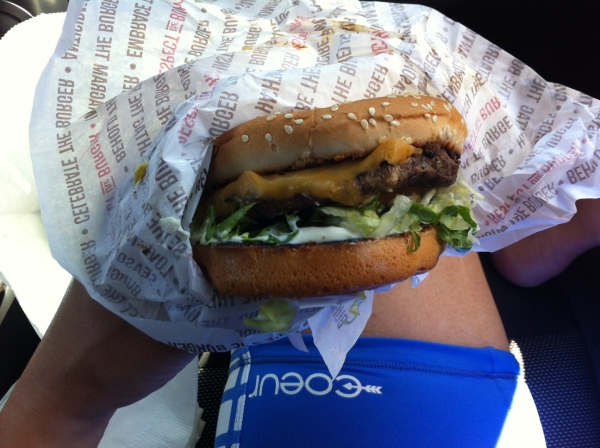
photo 2 (1)

Next on the agenda? Getting well. After the full-body ache set in, I had a suspicion that I was running a temperature. I confirmed it Sunday afternoon, and it has since morphed into a bad cough and head cold, so I’ve spent a few days loading up on vitamins, juice and rest to try to kick this bug.

As for long-term plans, well, I’m mulling over where to go from here.

My hope was to do a half Ironman in the fall after completing this race, but it’s pretty clear I’ve got to go back to the drawing board and work through this open-water mental block before taking on a longer distance. Whether that means lessons, coaching, duathlons and shorter distances — or a combination of all of those — in the meantime, I’m going to try to figure out.

Is it the end for me and triathlon? No, not at all. With my love of running and my new-found passion for cycling, I feel like I’ve just scratched the surface when it comes to multisport events. And not only did I enjoy training immensely, but I also made some major strides on the bike, so I’m most proud of that small, personal victory from this experience.

Most of all, though, I’d never want to walk away from anything with a bad taste in my mouth. So even if I’ve got to start from scratch in the pool and build up to a successful (aka anxiety-free) sprint race, I think it’d be a very rewarding process from start to finish.

And you know what else? Just like I told myself during the swim to keep from throwing in the towel: You just gotta keep moving forward.

How do you bounce back from a tough race?